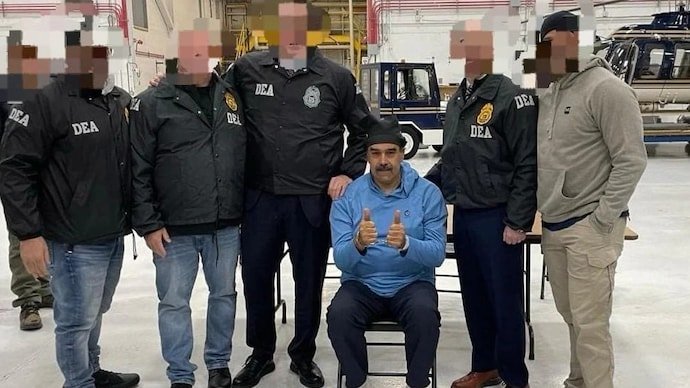
When Nicolas Maduro appeared before a federal judge in New York and described himself as a “prisoner of war,” he was not merely protesting his detention. From a legal and geopolitical standpoint, the statement was a calculated attempt to challenge the very foundation of the United States’ case against him and to reframe his arrest as an act of war rather than a criminal prosecution.
Barely 48 hours after US Delta Force commandos captured Maduro and his wife, Cilia Flores, from a fortified compound in Caracas during a dramatic weekend operation, the former Venezuelan president entered a not-guilty plea to federal charges that include narco-terrorism, cocaine trafficking, and conspiracy. Standing before the court, Maduro insisted that he was not a criminal defendant at all, claiming he had been “kidnapped” during what he described as a military raid rather than a law-enforcement action.
Why Maduro Is Calling Himself a Prisoner of War
By branding himself a prisoner of war (POW), Maduro is sending a message well beyond the courtroom. He is signaling to allies, rivals, and international institutions that his seizure should be interpreted as an act of armed conflict, not a judicial process. While the claim may hold little weight under US domestic law, it carries potential diplomatic and symbolic consequences on the global stage.
The distinction is crucial. If Maduro were recognized as a prisoner of war under international humanitarian law, his treatment would fall under the Geneva Conventions. POWs are not prosecuted merely for belonging to an opposing force, are not tried in civilian courts for actions taken during wartime, and are typically detained until hostilities end rather than sentenced by a criminal judge.
Prisoners of war are also not subjected to personal criminal guilt in the same way civilian defendants are. This legal framework stands in sharp contrast to the US government’s position, which treats Maduro as a long-indicted criminal suspect finally brought before a court of law.
The Trump administration has consistently argued that the operation in Caracas was a law-enforcement mission aimed at apprehending a fugitive facing serious criminal charges. US officials have pointed to the 1989 capture of Panamanian strongman Manuel Noriega on drug trafficking charges as a historical precedent.
Federal Judge Alvin K. Hellerstein made it clear during the hearing that, for now, Maduro’s case will proceed like any other criminal prosecution in the US federal system, regardless of his objections.
US Allegations Against Maduro and His Family
According to US prosecutors, Maduro and his inner circle transformed Venezuela into a central hub for cocaine trafficking to the United States over more than two decades, beginning with his entry into public office in 1999.
The indictment alleges that Maduro, his wife Cilia Flores, their son Nicolás Ernesto Maduro Guerra, and senior political allies collaborated with powerful drug cartels and armed groups. These include Colombia’s FARC, Mexico’s Sinaloa and Zetas cartels, and the Venezuelan criminal organisation Tren de Aragua — all designated by Washington as terrorist entities.
Prosecutors claim the network provided law-enforcement protection and logistical support for massive drug shipments, abused state institutions, and accepted bribes to ensure the safe passage of cocaine through Venezuelan territory.
Maduro is accused of allowing the drug trade to flourish after becoming president in 2013, allegedly enriching himself, his ruling circle, and members of his family in the process. Court filings suggest that his wife, a former president of Venezuela’s National Assembly, received hundreds of thousands of dollars in payments tied to drug trafficking operations.
For years, Maduro has dismissed these allegations as politically motivated. His defence team reiterated in court that his transfer to the United States was unlawful and argued that, as the head of a sovereign state, he should be immune from prosecution.
As he was escorted out of the courtroom, Maduro again described himself as having been “kidnapped” and maintained that he remains Venezuela’s legitimate president, despite his removal from power.
Legal Experts: The Case Will Still Be Treated as Criminal
Legal analysts say Maduro’s rhetoric is unlikely to derail the proceedings. Daniel C. Richman, a former federal prosecutor and professor at Columbia Law School, told The New York Times that the case will ultimately be handled as a criminal trial, even if Maduro raises claims of immunity or invokes international law.
However, Richman cautioned that the process could become more complicated if Maduro refuses to acknowledge the court’s jurisdiction. Criminal proceedings typically assume that defendants, at least initially, accept the authority of the court. A flat rejection of that authority can significantly disrupt and delay legal processes.
Beyond the courtroom, Maduro’s argument resonates because it highlights tensions within the US government’s own narrative. While American officials insist the Caracas operation was civilian in nature, they have simultaneously used military-style language to describe broader US actions against drug networks in Venezuela and the region.
For months, US forces have intercepted vessels allegedly linked to narcotics trafficking in the Caribbean and Pacific. These actions have been partly justified by a classified Justice Department memo asserting that the United States is engaged in an armed conflict with international drug cartels.
During the hearing, Judge Hellerstein cut off Maduro as he challenged the legality of his detention and proclaimed his innocence, reminding him that there would be “a time and place” to raise such arguments. For now, Washington’s position remains unchanged: Nicolas Maduro is being treated not as a prisoner of war, but as a defendant accused of some of the most serious crimes under US law.
For breaking news and live news updates, like us on Facebook or follow us on Twitter and Instagram. Read more on Latest World on thefoxdaily.com.




COMMENTS 0