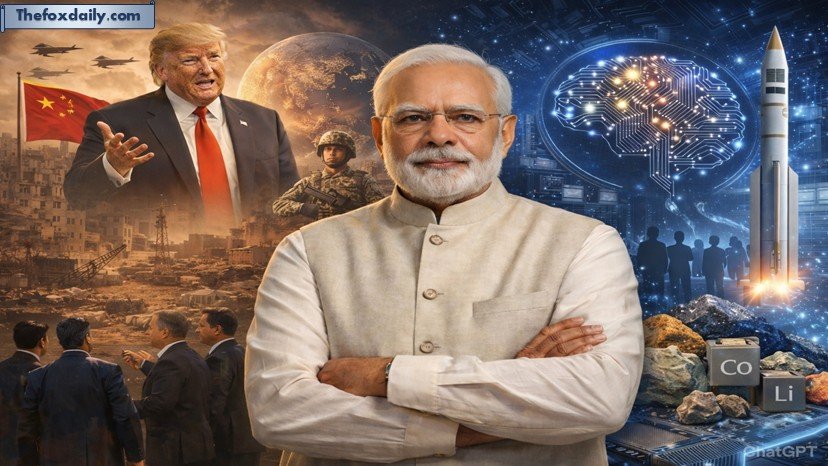
In what may prove to be one of its most consequential technology policy decisions in decades, India formally joined Pax Silica at the India AI Impact Summit on February 20, 2026. The agreement was signed by Union Minister Ashwini Vaishnaw and US envoy Sergio Gor, symbolizing India’s deeper integration into a strategic technology coalition designed to reduce global dependence on china’s silicon ecosystem.
This move is more than a diplomatic gesture. It represents India’s formal entry into a coordinated global effort to secure the entire semiconductor value chain – from mining rare earth minerals to building advanced Artificial Intelligence systems. For New Delhi, it signals a transition from being primarily a consumer of high-end semiconductor technology to aspiring to become a key contributor within the global silicon architecture.
What Is Pax Silica? Understanding the Silicon Alliance
The name Pax Silica combines the Latin word “Pax” (peace) with silica, the foundational mineral used to produce silicon – the core material behind semiconductors. The symbolism is deliberate. In the modern AI-driven world, control over silicon equates to technological stability and geopolitical influence.
The alliance was launched in December 2025 under US Under Secretary Jacob Helberg as a response to several converging crises: COVID-era semiconductor shortages, China’s export restrictions on gallium and rare earth elements, and rising awareness that technological dependence had evolved into a national security vulnerability.
The founding members of Pax Silica include the United States, Australia, japan, South Korea, the United Kingdom, Singapore, Greece, Israel, the Netherlands, Qatar, and the United Arab Emirates. Each member brings strategic strengths:
- Australia supplies critical minerals.
- The Netherlands controls EUV lithography technology through ASML, essential for advanced chip fabrication.
- Japan and South Korea provide fabrication expertise and semiconductor manufacturing capacity.
- India, as the 12th signatory, contributes scale, engineering talent, digital infrastructure, and a population of 1.4 billion generating vast AI-relevant data.
The Four Pillars of Pax Silica
1. Mining and Refining: Reducing China’s Rare Earth Dominance
Currently, approximately 90% of the world’s rare earths, gallium, and germanium used in semiconductors, electric vehicles, and defense systems are refined in China. This concentration presents strategic vulnerabilities.
Pax Silica’s first pillar focuses on joint extraction and refining projects outside China. India, through state-backed entities like KABIL and NCMM, is pursuing mineral acquisitions in Argentina and Chile. The alliance’s stated goal is to achieve 50% non-China sourcing of critical minerals by 2030.
However, India presently holds virtually zero percent of global rare earth processing capacity. Scaling up will require massive capital investment, power infrastructure expansion, environmental clearances, and international partnerships.
2. Semiconductor Manufacturing: Building Fabrication Capacity
The second pillar centers on co-funded semiconductor fabrication plants across allied nations. It integrates ultra-pure chemical supplies from Japan and advanced EUV lithography tools from the Netherlands, while harmonized export controls prevent sensitive technologies from reaching adversarial nations.
For India, this pillar aligns with the $10 billion India Semiconductor Mission. Initiatives such as Micron’s packaging facility in Sanand and Tata’s semiconductor project in Gujarat stand to benefit from access to Korean fabrication expertise and advanced ASML equipment.
This collaboration could significantly reduce India’s reliance on semiconductor imports, which currently account for nearly 95% of domestic demand.
3. Compute Infrastructure: Powering the AI Economy
The third pillar addresses compute capacity – the backbone of artificial intelligence development. AI training requires massive GPU clusters, reliable data center infrastructure, and uninterrupted energy supply.
Under the IndiaAI Mission, India has committed to deploying over 34,000 GPU units in sovereign clusters. Combined with a vast engineering workforce and one of the world’s largest digital user bases, India positions itself as both a compute hub and an AI data powerhouse within the alliance framework.
4. AI Deployment and Advanced Manufacturing
The fourth pillar focuses on frontier AI models, robotics, ethical AI governance, and collaborative research and development. This dimension extends beyond hardware into standards-setting and innovation ecosystems.
India’s domestic large language models and AI startups align with this pillar, reinforcing its ambition to move from AI consumption to AI creation. Participation in joint R&D and governance frameworks also grants India influence in shaping global AI norms.
Strategic Implications for India and the Global Tech Order
India’s semiconductor import dependence has long been recognized as a structural vulnerability. Joining Pax Silica provides access to coordinated investment, supply chain diversification, and technological collaboration that could accelerate domestic manufacturing ambitions.
The government’s semiconductor output target of $100 billion by 2030 now becomes part of a broader allied ecosystem rather than a standalone national objective. Foreign direct investment into fabrication clusters and rare earth processing facilities is expected to increase as policy alignment strengthens.
At a geopolitical level, India’s membership reinforces the emerging bifurcation in global technology supply chains – one anchored around China and another around allied democracies.
Challenges Ahead: Can Pax Silica Counter China?
Despite its ambition, Pax Silica faces formidable challenges. China has invested over $150 billion in domestic semiconductor subsidies and continues securing mining rights across Africa and Latin America. It is simultaneously accelerating indigenous lithography and refining capabilities.
Moreover, Pax Silica currently lacks legally binding enforcement mechanisms. Coordination alone does not guarantee execution. Infrastructure bottlenecks, regulatory delays, and environmental concerns could slow India’s rare earth ambitions.
Building fabrication plants, refining minerals, and deploying AI-scale compute infrastructure will demand sustained funding, industrial policy consistency, and political will over the next decade.
A Seat at the Silicon High Table
By signing Pax Silica, India has not merely entered the semiconductor era – it has claimed a strategic role within it. The signing ceremony marks the beginning of a long-term industrial transformation.
Factories must be built. Minerals must be refined. GPUs must be deployed. Standards must be written. India now has a seat at what could be called the global “silicon high table.”
What New Delhi does with that seat will shape its technological sovereignty – and possibly the balance of global tech power – for a generation to come.
For breaking news and live news updates, like us on Facebook or follow us on Twitter and Instagram. Read more on Latest World on thefoxdaily.com.



COMMENTS 0