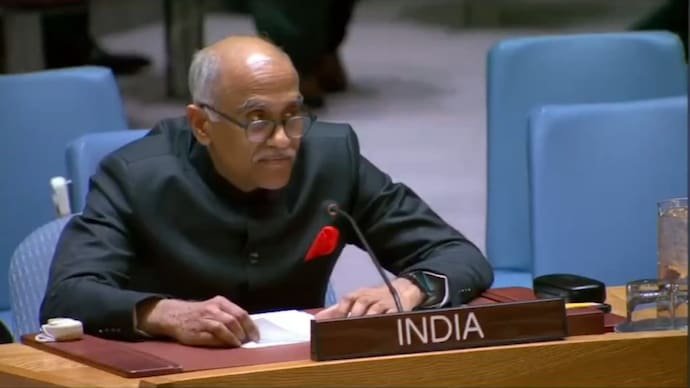
India launched a sharp counterattack against Pakistan at the United Nations Security Council on Monday, asserting that Islamabad’s actions are driven by a singular objective to “harm my country and my people,” according to India’s Permanent Representative to the UN, Parvathaneni Harish.
Responding to remarks made by Pakistan’s elected representative at the Security Council, Harish rejected Pakistan’s version of events surrounding Operation Sindoor, describing the claims as misleading and politically motivated.
“I now address the remarks made by Pakistan’s representative, who has a single-minded agenda of harming my nation and its citizens. He has propagated an inaccurate and self-serving narrative about Operation Sindoor in May of last year,” Harish said during the UNSC session.
Detailing the sequence of events, Harish stated that Pakistan had continued issuing threats of escalation until May 9. “On May 10, after preparing for further attacks, the Pakistani military directly contacted our military leadership and pleaded for a cessation of hostilities,” he said.
He further claimed that the impact of India’s military response was evident. “The destruction caused to multiple Pakistani air bases by Indian operations—including images of damaged runways and burnt-out hangars—is already in the public domain,” Harish added.
#WATCH | Permanent Representative of India to the United Nations, Parvathaneni Harish, responds to Pakistan’s remarks at the UN Security Council, reiterating India’s position on Operation Sindoor and regional security. (Source: ANI)
Taking the floor, Harish also reiterated India’s long-standing position on terrorism, asserting that Pakistan’s links to terror groups remain a core concern. “The Pakistani representative speaks of a ‘new normal.’ Let me be clear—terrorism cannot be normalised, no matter how much Pakistan wishes it to be,” he said.
“It is not normal to tolerate the continued use of terrorism as an instrument of state policy. This hallowed chamber cannot be allowed to become a platform for legitimising terrorism,” the Indian envoy emphasized.
India has consistently maintained that Pakistan was unable to withstand New Delhi’s air defence capabilities and was forced to seek a ceasefire within hours of initiating a large-scale offensive on May 10 last year.
A recent detailed assessment by a Switzerland-based military think tank supported India’s assertion, stating that the Indian Air Force’s air superiority over significant parts of Pakistani airspace “coerced” Islamabad into urgently seeking a ceasefire after losing its ability to contest air operations during the four-day conflict.
Pakistan, however, has claimed that it shot down six Indian fighter jets and damaged multiple Indian airbases during the conflict—allegations that India has repeatedly and categorically denied.
During his address, Harish also criticized Pakistan for what he termed as interference in India’s internal matters, reiterating New Delhi’s firm stance on Jammu and Kashmir.
“The Union Territory of Jammu and Kashmir has been, is, and will always remain an integral and inalienable part of India,” he stated.
Harish further defended India’s decision to place the Indus Waters Treaty in abeyance, saying that while the agreement was signed in good faith over six decades ago, Pakistan has repeatedly violated its spirit.
“India signed the Indus Waters Treaty 65 years ago in a spirit of goodwill and cooperation. Over the decades, Pakistan has betrayed this trust through three wars and thousands of terror attacks against India,” he said.
He added that thousands of Indian lives have been lost due to terror attacks supported by Pakistan. “India was compelled to announce that the treaty would be held in abeyance until Pakistan, a global epicentre of terrorism, credibly and irrevocably ends its support for cross-border and other forms of terror,” Harish said, urging Islamabad to introspect on the rule of law.
In a pointed remark, Harish also took a dig at Pakistan’s internal political-military dynamics, referring to its Army Chief, Asim Munir.
“Pakistan could begin by examining how its armed forces engineered a constitutional coup through the 27th Amendment, granting lifetime immunity to its chief of defence forces,” he remarked.
Asim Munir was promoted to the rank of Field Marshal by the Shehbaz Sharif-led government in May 2025, becoming only the second individual in Pakistan’s history to hold the position.
For breaking news and live news updates, like us on Facebook or follow us on Twitter and Instagram. Read more on Latest World on thefoxdaily.com.





COMMENTS 0