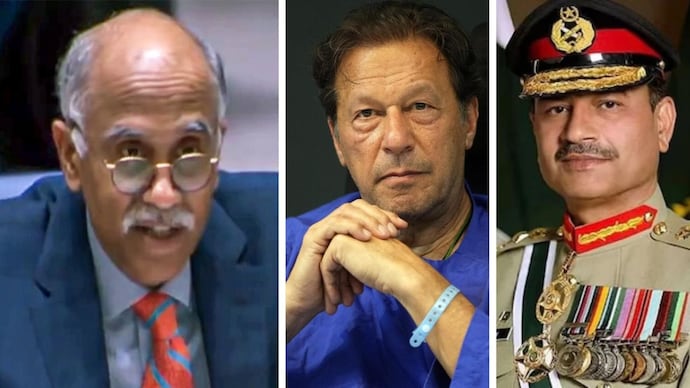
New York: India on Tuesday strongly criticised Pakistan at the United Nations Security Council (UNSC), drawing a direct connection between Islamabad’s prolonged political turmoil and its history as a sponsor of cross-border terrorism. The Indian delegation underlined that Pakistan’s internal instability is inseparable from its external conduct.
Leading India’s intervention, Ambassador Harish Parvathaneni highlighted the imprisonment of former Pakistani Prime Minister Imran Khan, the banning of his political party, and the central role played by Pakistan’s military in what he described as a “constitutional coup” carried out through the 27th Constitutional Amendment.
India’s remarks came in response to Pakistan’s repeated attempts to internationalise bilateral issues and divert attention from its domestic failures during multilateral forums, including the UNSC.
Pakistan’s Democratic Crisis and the Case of Imran Khan
Speaking during the UNSC Open Debate on “Leadership for Peace”, Ambassador Parvathaneni referred to Imran Khan’s incarceration since August 2023 in a EUR 190 million corruption case. He also cited multiple cases filed against Khan under Pakistan’s Anti-Terrorism Act in connection with the protests of May 9, 2023.
The Indian envoy further drew attention to concerns raised by the United Nations Special Rapporteur on Torture, Alice Jill Edwards, regarding the alleged inhumane treatment of the former prime minister at Adiala Jail. These concerns, India said, underscore the erosion of democratic norms and Human Rights in Pakistan.
“Pakistan, of course, has a unique way of respecting the will of its people — by jailing a prime minister, by banning the ruling political party, and by allowing its armed forces to engineer a constitutional coup through the 27th Amendment, granting lifetime immunity to its Chief of Defence Forces,” Parvathaneni said.
The amendment, he noted, fundamentally altered Pakistan’s judicial and military framework and provided lifetime legal protection to Chief of Defence Forces General Asim Munir, further weakening civilian oversight.
India Rejects Pakistan’s Jammu & Kashmir Claims
India also categorically rejected Pakistan’s repeated references to Jammu and Kashmir at the UN, calling them “unwarranted” and reflective of Islamabad’s “obsessive focus on harming India and its people.”
Ambassador Parvathaneni reaffirmed that Jammu & Kashmir and ladakh are integral and inalienable parts of India, stressing that Pakistan has no locus standi to comment on India’s internal matters.
“It is unrealistic to expect a serving non-permanent member of the Security Council to fulfil its responsibilities if it chooses to pursue this obsession across all UN platforms in pursuit of a divisive agenda,” he said, questioning Pakistan’s credibility as a UNSC member.
Pakistan Described as the Global Epicentre of Terrorism
Defending India’s decision to place the Indus Waters Treaty in abeyance, the Indian envoy pointed to Pakistan’s decades-long record of supporting terrorism. He cited the April 2025 terror attack in Pahalgam, which claimed the lives of 26 civilians in a religion-driven assault, as a recent example of Pakistan-sponsored violence.
“India signed the Indus Waters Treaty in good faith sixty-five years ago,” Parvathaneni stated. “Pakistan has violated the spirit of the Treaty by waging three wars and carrying out thousands of terror attacks against India over the past six and a half decades.”
He added that India has made it clear the Treaty will remain on hold until Pakistan takes credible, irreversible, and permanent steps to end cross-border terrorism in all its forms.
UN Security Council Reform: An Urgent Global Imperative
Beyond its criticism of Pakistan, India strongly advocated comprehensive reforms of the UN Security Council, describing them as an “urgent global imperative” required to address modern geopolitical realities.
Ambassador Parvathaneni argued that the UNSC’s nearly eight-decade-old structure no longer reflects present-day power dynamics or adequately represents large parts of the developing world.
Quoting UN Secretary-General António Guterres, he said, “We cannot build a future for our grandchildren with systems built for our grandparents.” He urged the Intergovernmental Negotiations process on UNSC reform to move toward time-bound, text-based negotiations.
India reiterated its long-standing position in favour of a more inclusive, representative, transparent, and effective Security Council, highlighting its consistent contributions to UN peacekeeping and its commitment to upholding international peace and security.
For breaking news and live news updates, like us on Facebook or follow us on Twitter and Instagram. Read more on Latest World on thefoxdaily.com.





COMMENTS 0