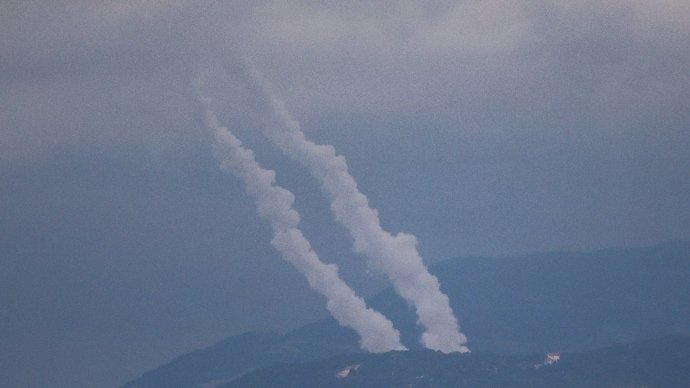
In a dramatic and unprecedented escalation, Iran and Hezbollah launched their first coordinated missile strikes on Israel since the outbreak of the latest round of hostilities, according to multiple reports and Israeli officials. The joint assault represents a significant turning point in the widening Middle East conflict, signaling deeper military coordination between Tehran and the Lebanon-based militant group.
The attacks occurred almost simultaneously, triggering red alert sirens across major Israeli cities, including Jerusalem and Tel Aviv. Civilians were seen rushing to underground shelters as air defense systems scrambled to intercept incoming threats.
According to the Israeli military, Iran fired a volley of missiles toward Israeli territory while Hezbollah launched multiple projectiles from southern Lebanon, including drones. The scale and synchronization of the attack have raised concerns about a broader regional war.
Details of the Coordinated Missile and Drone Strikes
Israeli officials confirmed that the assault marked the first publicly acknowledged coordinated military action between Iran and Hezbollah against Israel in the current conflict cycle. While Hezbollah has frequently engaged Israel in cross-border clashes, this level of direct coordination with Tehran signals a strategic escalation.
The Israel Defence Forces (IDF) reported that the initial barrage was followed by additional launches. According to the IDF, the coordinated strike involved:
| Attacking Party | Type of Weapon Used | Number of Projectiles | Launch Location |
|---|---|---|---|
| Iran | Ballistic Missile | 1 (Initial Confirmed) | Iranian Territory |
| Hezbollah | Rockets & Drones | 6 Projectiles | Southern Lebanon |
| Iran & Hezbollah | Second Coordinated Wave | Undisclosed | Multiple Launch Points |
The IDF stated that a second coordinated wave of attacks was launched “a short time later,” further intensifying the security situation. Hezbollah, an Iran-backed Shia militant organization based in Lebanon, has long been considered one of Israel’s most formidable regional adversaries.
The synchronized timing of the missile and drone strikes suggests high-level operational coordination, reflecting growing military alignment between Iran and its proxy forces.
Israel Advances Into Southern Lebanon Amid Escalation
As cross-border hostilities intensified, Israel confirmed that its ground forces advanced into parts of southern Lebanon. This development marks a new phase in the conflict, potentially transforming what had been largely aerial and missile exchanges into a broader ground confrontation.
The Israeli military released its first video footage from positions inside southern Lebanon, indicating that Israeli troops had established forward positions within Lebanese territory. The move underscores mounting tensions along the Israel-Lebanon border.
In a statement posted on social media platform X, the IDF said its Northern Command was reinforcing defensive positions as violence escalated. The statement suggested that ground operations near the border could become a sustained component of the ongoing conflict.
Meanwhile, Lebanese officials reported heavy casualties from Israeli strikes. Lebanon’s Social Affairs Minister Haneen Sayed stated that at least 72 people were killed in Israeli Airstrikes within Lebanese territory. The broader regional toll continues to rise, with more than 1,045 individuals reported dead across Iran and Lebanon since the escalation began.
Conflict Expands Beyond the Middle East
The crisis is no longer confined to Israel, Lebanon, and Iran. In a major international development, an Iranian naval vessel was sunk by a United States submarine off the southern coast of Sri Lanka in the Indian Ocean.
Sri Lanka’s deputy foreign minister identified the vessel as the frigate IRIS Dena, which was reportedly returning to Iran from an eastern Indian port when it was struck. The sinking occurred hundreds of miles from the Persian Gulf, signaling the global dimensions of the confrontation.
At least 87 people were killed in the maritime incident, further escalating tensions between Washington and Tehran.
Iranian Missile Toward Turkey Intercepted by NATO
Tensions intensified further after Iran reportedly launched a ballistic missile toward Turkey, a NATO member state. Turkish officials confirmed that the missile was intercepted by NATO air defense systems before it could enter Turkish airspace.
According to Turkey’s defense ministry, the missile passed over Syria and Iraq before being destroyed over the eastern Mediterranean Sea. The incident marks one of the most serious spillovers of the conflict into NATO territory.
| Incident | Location | Outcome | Casualties |
|---|---|---|---|
| Iran-Hezbollah Strike on Israel | Israel (Jerusalem, Tel Aviv) | Missiles Intercepted, Red Alerts Triggered | Ongoing Assessment |
| US Submarine Sinks IRIS Dena | Indian Ocean (Near Sri Lanka) | Iranian Frigate Destroyed | 87 Dead |
| Missile Toward Turkey | Eastern Mediterranean | Intercepted by NATO | No Reported Casualties |
In a strong statement, Turkey’s defense ministry declared: “All necessary steps to defend our territory and airspace will be taken… and we reserve the right to respond to any hostile actions.”
NATO later issued a statement expressing solidarity with Turkey and condemning the missile incident. Turkish Foreign Minister Hakan Fidan formally lodged a protest with his Iranian counterpart Abbas Araqchi following the attempted strike.
Rising Risk of Broader Regional and Global War
The coordinated missile strikes by Iran and Hezbollah against Israel, Israeli ground advances into southern Lebanon, the sinking of an Iranian warship near Sri Lanka, and a missile incident involving NATO-member Turkey collectively signal a rapidly widening conflict.
What began as localized hostilities now appears to be evolving into a broader geopolitical confrontation involving multiple state and non-state actors. With mounting casualties and expanding battle zones, international observers warn that the risk of a wider regional war – and possibly global ramifications – is increasing by the day.
As diplomatic efforts struggle to keep pace with military developments, the coming days will be critical in determining whether the conflict can be contained or spirals into a far more devastating confrontation.
For breaking news and live news updates, like us on Facebook or follow us on Twitter and Instagram. Read more on Latest World on thefoxdaily.com.






COMMENTS 0