
As US military pressure intensifies in the Middle East, Iran appears to be taking urgent steps to protect what analysts describe as its “nuclear Gold” — enriched uranium and the infrastructure that sustains it. Satellite imagery and open-source intelligence indicate that Tehran is both hardening its nuclear sites and repositioning key naval assets in anticipation of a possible American strike.
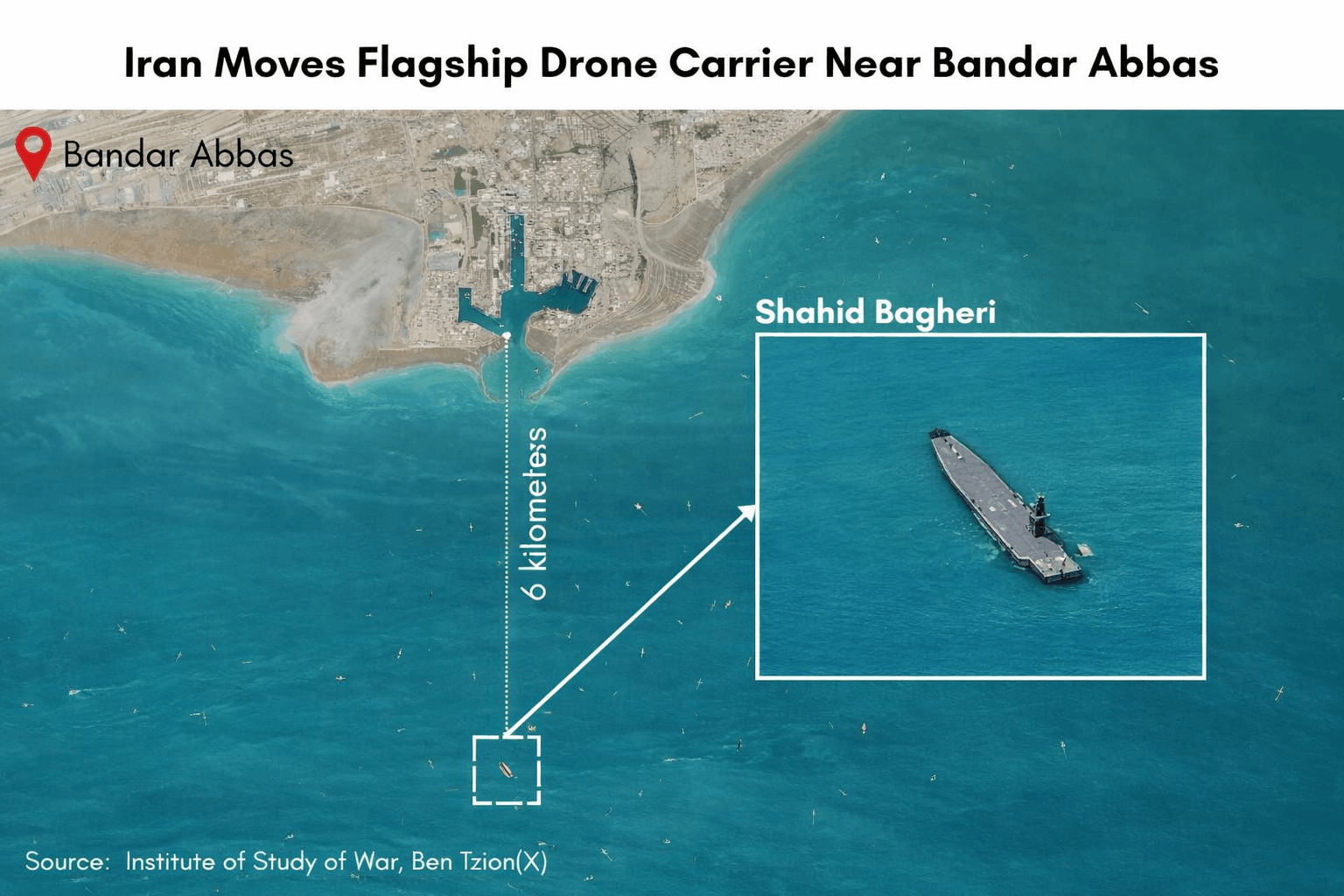
The USS Abraham Lincoln Carrier Strike Group, a major component of US naval power, has been deployed deep into the Arabian Sea. In response, Iran’s navy has moved its flagship drone carrier, Shahid Bagheri, to a position roughly six kilometres off the coast of Bandar Abbas, close to the strategically vital Strait of Hormuz.
On land, Iran’s behaviour suggests heightened anxiety. Analysts say the country is accelerating efforts to bury, reinforce, and conceal critical nuclear infrastructure.
Iran Buries Nuclear Infrastructure Deeper Underground
Researchers at the Washington-based Institute for Science and International Security (ISIS) have analysed recent commercial satellite imagery showing intensified activity at Iran’s nuclear facilities. According to assessments led by physicist and nuclear weapons expert David Albright, Iran is actively sealing tunnel entrances and strengthening underground access points at key sites.
At the Esfahan nuclear complex, imagery reveals that tunnel entrances have been deliberately covered with large quantities of fresh soil. Multiple dump trucks were observed transporting earth along access roads, indicating systematic backfilling — a measure likely intended to obscure entry points and reduce vulnerability to airstrikes.
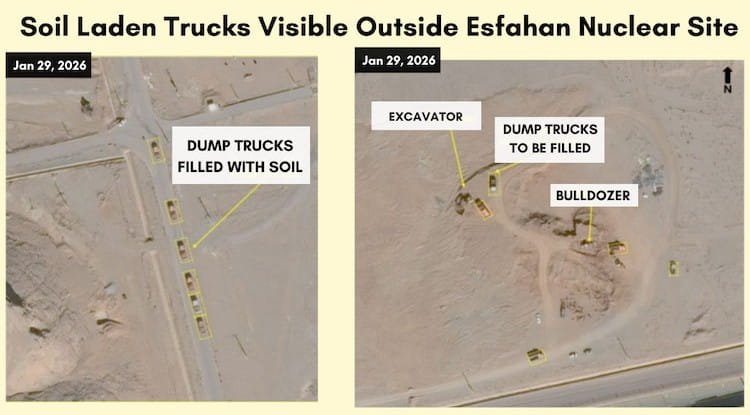
Iran’s renewed focus on subterranean concealment follows lessons learned from last year’s 12-day conflict, during which US forces reportedly struck the Fordow and Natanz facilities using bunker-buster munitions.
In June 2025, the United States deployed twelve 30,000-pound GBU-57 Massive Ordnance Penetrators (MOPs) against Fordow, targeting ventilation shafts that led to centrifuge cascade halls buried more than 200 feet underground.
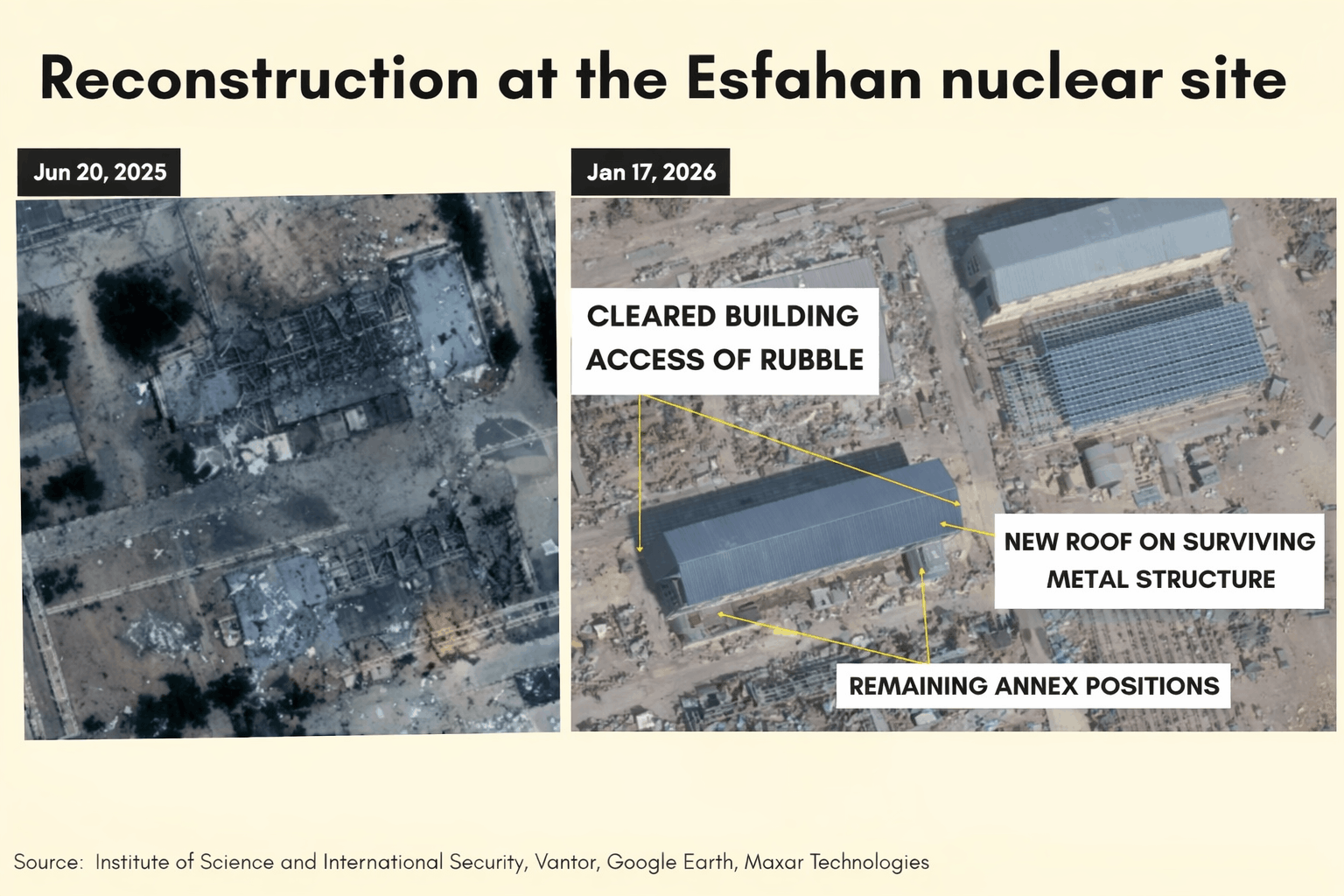
Satellite imagery from December 2025 and January 2026 shows that Iran has since repaired structural damage at Esfahan caused by an Israeli air strike in June 2025. The metal framework and roof of a damaged annex have been reconstructed, though parts of lower-level structures inside the building appear to remain intact.
Naval Maneuvers Signal Rising Tensions at Sea
The military buildup is not limited to land. Shortly after the USS Abraham Lincoln entered the region, Iranian state-affiliated media reported that Tehran had deployed “hundreds of fast, missile-launching and support vessels” near the US carrier strike group.
Open-source satellite analysis by researcher Ben Tzion, corroborated by the Institute for the Study of War (ISW), confirms the presence of the IRGC Navy’s Shahid Bagheri drone carrier operating just off Bandar Abbas. The positioning places Iranian naval assets in close proximity to one of the world’s most critical maritime chokepoints.
Iranian media have also reported that the Islamic Revolutionary Guard Corps (IRGC) Navy plans to conduct a two-day live-fire exercise in the Strait of Hormuz on February 1 and 2. Western analysts interpret the drills as a deterrence signal aimed at complicating any potential US military action.
While neither Chinese nor Russian outlets have confirmed joint involvement, Iranian media have speculated about possible combined naval exercises with china and Russia in the Indian Ocean and the Sea of Oman in the coming days.
According to ISW, the current naval activity is particularly notable because Iran did not deploy major naval assets during the June 2025 Israel–Iran conflict. “The visible movement of ships and the announcement of live-fire exercises suggest a deliberate escalation in signalling,” the think tank noted.
A Region on Edge
Taken together, the satellite evidence and naval movements point to a clear conclusion: Iran is preparing for the possibility of a direct confrontation with the United States. By burying nuclear infrastructure deeper underground and positioning naval forces closer to US assets, Tehran appears intent on safeguarding its strategic capabilities while projecting deterrence.
Whether these measures succeed in preventing a strike — or instead contribute to further escalation — remains uncertain. What is clear is that tensions in the Persian Gulf are entering a volatile phase, with both sides signalling readiness for conflict.
For breaking news and live news updates, like us on Facebook or follow us on Twitter and Instagram. Read more on Latest World on thefoxdaily.com.






COMMENTS 0