- Iran’s Position: Talks Yes, But With Conditions
- Conflicting Reports and the ‘Deadlock’ Narrative
- Pakistan’s Role as Mediator
- Background: How the Conflict Escalated
- Why the Terms of Negotiation Matter
- Analysis: Is There Really a Deadlock?
- Key Positions of Stakeholders
- Insight: The Power of Narrative in Diplomacy
- What Happens Next?
- Conclusion: A Complex Path to Peace
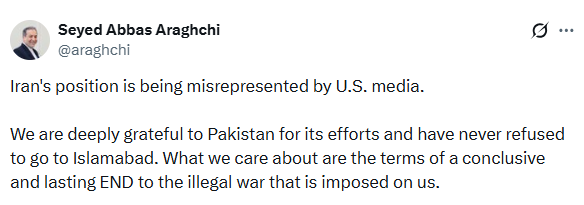
Iran has firmly rejected claims that it refused to participate in Peace Talks in Islamabad, pushing back against reports suggesting a diplomatic deadlock in Pakistan-mediated negotiations with the United States. Iranian Foreign Minister Seyed Abbas Araghchi stated that Tehran has “never refused to go to Islamabad,” but emphasized that any negotiations must result in a “conclusive and lasting” end to what Iran describes as an “illegal war.”
The clarification comes at a time when the conflict, now entering its sixth week, continues to escalate across the Gulf region. Reports had indicated that Iran was unwilling to meet US officials and had deemed Washington’s conditions “unacceptable,” raising concerns that diplomatic efforts were stalling. However, Tehran’s latest statement suggests that the issue may not be about location or willingness—but about the terms and outcomes of the proposed talks.
Pakistan, which has positioned itself as a mediator in the conflict, has also denied that its peace initiative has hit a roadblock. Officials in Islamabad dismissed reports of a deadlock as “baseless,” maintaining that diplomatic channels remain active despite the challenges.
Iran’s Position: Talks Yes, But With Conditions
At the heart of Iran’s stance is a clear message: negotiations are not off the table, but they cannot be symbolic or inconclusive. Araghchi’s statement highlights Tehran’s concern that talks must lead to tangible and lasting results rather than temporary ceasefires or vague commitments.
“We have never refused to go to Islamabad. What matters are the terms of a conclusive and lasting end to the illegal war imposed on us.”
This position reflects a broader diplomatic strategy. Iran is signaling that it does not want to engage in talks that merely pause hostilities without addressing the underlying causes of the conflict. In other words, Tehran appears wary of entering negotiations that could be used as a tactical pause rather than a genuine path to peace.
There is also a messaging element at play. By accusing US media of misrepresenting its stance, Iran is attempting to shape the narrative and reinforce its position both domestically and internationally.
Conflicting Reports and the ‘Deadlock’ Narrative
The perception of a deadlock largely stems from reports suggesting that Iran had declined to attend planned meetings in Islamabad and rejected US demands. These reports painted a picture of stalled Diplomacy, with mediation efforts reaching a “dead end.”
However, such narratives often emerge in complex geopolitical situations where multiple stakeholders, each with their own agendas, communicate through indirect channels. What one side interprets as refusal may, in reality, be a strategic delay or a demand for better terms.
Pakistan’s response adds another layer to this complexity. Officials have categorically denied that negotiations have stalled, calling such claims a “figment of imagination.” This contradiction highlights a common feature of international diplomacy: public statements rarely tell the full story.
Pakistan’s Role as Mediator
Pakistan’s involvement as a mediator is both strategic and delicate. Positioned geographically and politically between key regional players, Islamabad has an interest in preventing further escalation, particularly given the potential economic and security implications of a prolonged conflict.
Pakistani officials have maintained that communication channels between Tehran and Washington remain open, even if progress is slower than expected. Back-channel diplomacy—often conducted quietly and away from media scrutiny—appears to be ongoing.
This approach is not unusual. In many high-stakes conflicts, significant breakthroughs occur behind closed doors rather than in formal, public negotiations.
Background: How the Conflict Escalated
The current conflict began on February 28 with joint US-Israeli strikes targeting Iran. The strikes reportedly resulted in the death of Supreme Leader Ali Khamenei and several top military commanders, marking a dramatic escalation.
Iran’s response was swift and far-reaching, expanding the conflict across the Gulf region. Retaliatory actions have disrupted energy supply chains and heightened tensions in key maritime routes, particularly the Strait of Hormuz—a critical artery for global oil shipments.
The broader implications of the conflict extend far beyond the immediate region. Any prolonged disruption in energy flows can have significant economic consequences worldwide, affecting fuel prices, trade, and market stability.
Why the Terms of Negotiation Matter
Iran’s insistence on a “conclusive and lasting” outcome is rooted in past experiences. Temporary ceasefires or partial agreements have often failed to resolve deeper issues, leading to renewed hostilities.
From Tehran’s perspective, entering talks without clear guarantees could weaken its strategic position. This explains the emphasis on conditions rather than simply agreeing to meet.
On the other hand, the United States may be seeking incremental steps—such as a ceasefire—before addressing broader concerns. This difference in approach is a key factor contributing to the perceived stalemate.
Analysis: Is There Really a Deadlock?
Labeling the situation as a “deadlock” may be premature. Diplomatic negotiations, especially in conflict scenarios, rarely follow a linear path. Periods of apparent stagnation are often part of the process.
What appears to be a breakdown in talks could actually be a phase of recalibration, where both sides reassess their positions and strategies. Iran’s public statements suggest that it is not rejecting dialogue but is instead setting clear expectations.
Similarly, Pakistan’s insistence that mediation efforts are ongoing indicates that discussions have not completely collapsed.
In this context, the situation may be better understood as a negotiation gap rather than a deadlock—a difference in expectations that has yet to be bridged.
Key Positions of Stakeholders
| Stakeholder | Position | Key Concern |
|---|---|---|
| Iran | Open to talks but demands lasting resolution | Ensuring long-term peace and security |
| United States | Seeking negotiations, possibly incremental steps | Managing conflict escalation |
| Pakistan | Acting as mediator, denies deadlock claims | Regional stability and diplomatic credibility |
Insight: The Power of Narrative in Diplomacy
One of the most interesting aspects of this situation is how narratives are shaped and contested. Iran accuses US media of misrepresentation, while Pakistan dismisses reports of stalled talks. Each side is attempting to control the narrative, which in turn influences public perception and diplomatic leverage.
In modern Geopolitics, information is as much a tool as military or economic power. The way events are framed can impact negotiations, alliances, and even outcomes.
In simpler terms, diplomacy today is not just about what happens at the negotiating table it’s also about what is said outside it.
What Happens Next?
The immediate future of the negotiations will depend on whether both sides can find common ground on the terms of engagement. This could involve compromises on key issues or the involvement of additional mediators.
Back-channel diplomacy is likely to play a crucial role in this phase. While public statements may suggest rigidity, private discussions often allow for more flexibility.
There is also the possibility that external factors—such as economic pressures or regional dynamics—could influence the pace and direction of talks.
Conclusion: A Complex Path to Peace
The situation surrounding Iran’s participation in Islamabad talks highlights the complexities of modern diplomacy. While reports of a deadlock have raised concerns, the reality appears more nuanced.
Iran has not rejected negotiations outright but has instead set clear conditions for meaningful engagement. Pakistan continues to facilitate dialogue, and communication channels remain open despite challenges.
Ultimately, the path to peace will depend on whether all parties can move beyond differing narratives and focus on substantive outcomes. In conflicts of this scale, progress is rarely straightforward—but neither is it impossible.
And if there’s one lesson from history, it’s this: diplomacy often looks like a mess before it starts making sense.
For breaking news and live news updates, like us on Facebook or follow us on Twitter and Instagram. Read more on Latest World on thefoxdaily.com.






COMMENTS 0