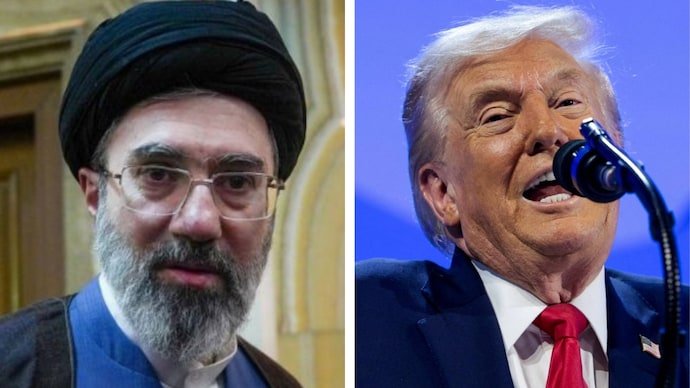
As the Iran-US conflict enters its second month, Tehran has firmly rejected repeated claims from Washington that diplomatic talks are underway. Iranian officials insist that no direct or indirect negotiations have taken place since the war began on February 28, highlighting a widening gap between the two sides.
The strong denial comes despite multiple statements from the White House suggesting that discussions were “progressing well” and that a potential agreement could be within reach.
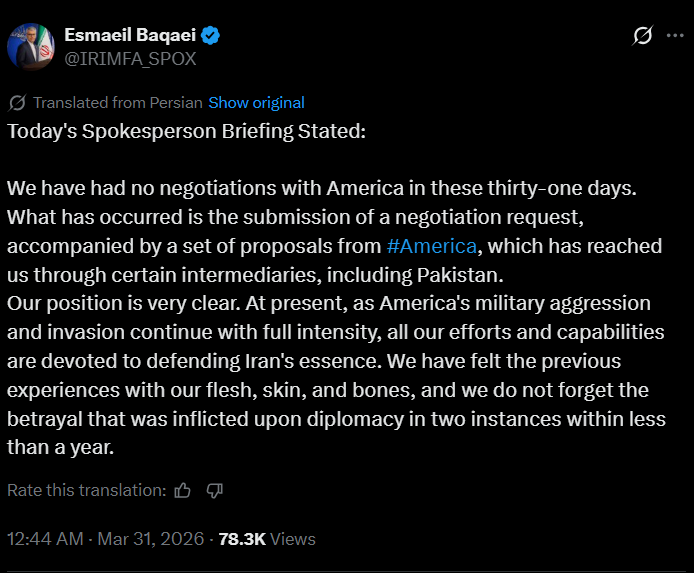
In an official statement released on Tuesday, Iran’s Foreign Ministry clarified its position, stating that there has been no engagement with the United States during the 31 days of ongoing hostilities.
Foreign Ministry spokesperson Esmaeil Baqaei explained that while Washington has expressed interest in negotiations, it has done so only by sending proposals through intermediaries rather than engaging in actual talks.
“In these thirty-one days, we have not engaged in any conversations with the United States,” Baqaei said. “What has occurred is the submission of a request for negotiations along with proposals, which have reached us through intermediaries, including Pakistan.”
His remarks underline Iran’s cautious stance, shaped by previous diplomatic experiences that Tehran views as betrayals.
Baqaei emphasized that Iran remains focused on defending its sovereignty amid ongoing military operations, signaling that diplomacy is not currently a priority.
“We have a very clear position. All our resources and efforts are focused on protecting Iran as the United States continues its full-scale aggression,” he said. “We have experienced past betrayals firsthand and will not forget them.”
Conflicting Narratives From Washington and Tehran
Iran’s statement directly contradicts comments made by White House Press Secretary Karoline Leavitt, who recently claimed that negotiations with Iran were “continuing and going well.”
US President Donald Trump has also repeatedly asserted that communication channels with Iranian officials remain open, both directly and indirectly, and has suggested that a breakthrough deal could be close.
In addition, Trump indicated that Washington has been in contact with Mohammad Bagher Ghalibaf, Iran’s parliamentary speaker, describing him as a potential interlocutor. He stated that the United States would assess within a week whether meaningful cooperation with him is possible.
These sharply contrasting accounts have raised questions about the true state of diplomacy, with analysts pointing to deep mistrust and strategic messaging from both sides.
| Aspect | Iran’s Position | US Position |
|---|---|---|
| Diplomatic Talks | No talks held since February 28 | Talks are ongoing and progressing |
| Communication Method | Only proposals via intermediaries | Direct and indirect communication claimed |
| Trust Level | Low due to past “betrayals” | Optimistic about possible agreement |
| Focus | Military defense and sovereignty | Diplomacy alongside military pressure |
War Continues With No Signs of De-escalation
The ongoing conflict, which began on February 28 under Operation Epic Fury, has now entered its second month with no clear path toward resolution. The situation remains volatile, with both military operations and political rhetoric intensifying across the region.
The crisis escalated rapidly following initial US-Israeli strikes that reportedly killed Iran’s Supreme Leader Ayatollah Ali Khamenei, along with several senior military officials. Since then, the conflict has expanded, drawing in multiple regional actors.
Despite global calls for restraint, efforts to broker peace have so far failed to produce tangible results.
Iran has rejected a proposed 15-point peace plan put forward by President Trump, instead presenting its own set of demands. These include the lifting of economic Sanctions, formal recognition of Iran’s sovereignty over the Strait of Hormuz, and compensation in the form of war reparations.
The stark differences in expectations and priorities continue to hinder any meaningful diplomatic progress.
Deepening Mistrust Shapes Future of Negotiations
The conflicting narratives from Washington and Tehran highlight the deep mistrust that defines the current phase of the conflict. While both sides publicly express interest in peace, their statements suggest vastly different interpretations of reality.
As backchannel communications remain uncertain and official dialogue appears nonexistent, the chances of a near-term diplomatic breakthrough remain slim.
With military operations ongoing and rhetoric intensifying, the Iran-US standoff continues to pose serious risks to regional stability and Global energy security.
For breaking news and live news updates, like us on Facebook or follow us on Twitter and Instagram. Read more on Latest World on thefoxdaily.com.




COMMENTS 0