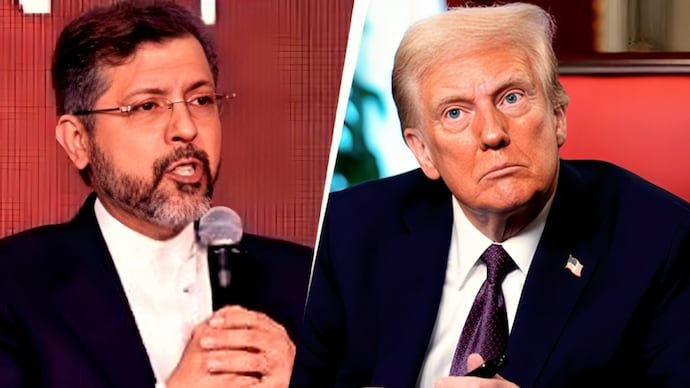
Iran’s Deputy Foreign Minister Saeed Khatibzadeh sharply criticised US President Donald Trump after the American leader suggested he should have a role in determining Iran’s next supreme leader. Speaking at an international conference, Khatibzadeh mockingly remarked that Trump “cannot even appoint the mayor of New York,” highlighting what he described as Washington’s interference in Iranian affairs.
The comments came during the Raisina Dialogue in New Delhi, where the Iranian diplomat also described the ongoing conflict in the Middle East as an “existential war” for Tehran. According to him, Israel has dragged the United States into the crisis due to what he called the “delusion of a Greater Israel.”
Trump’s Remarks Spark Diplomatic Reaction
The exchange follows statements made by Donald Trump suggesting that the United States should have a voice in selecting Iran’s next supreme leader after the reported death of Iran’s Supreme Leader Ayatollah Ali Khamenei during recent US-Israel military strikes.
Trump reportedly indicated that Washington would prefer a leader who could bring “peace and harmony” to Iran. He also dismissed the possibility of Khamenei’s son, Mojtaba Khamenei, succeeding his father, despite speculation that he was a leading contender.
Khatibzadeh responded by criticising the idea of American involvement in Iran’s leadership decisions.
“President Trump is asking for change in the leadership of Iran and says he must have a voice in that process, while he cannot even appoint the mayor of New York,” Khatibzadeh said, referencing the recent mayoral election victory of Zohran Mamdani, a politician known for openly criticising Trump.
| Key Political Figures Mentioned | Role / Context |
|---|---|
| Donald Trump | US President who suggested involvement in choosing Iran’s next leader |
| Saeed Khatibzadeh | Iran’s Deputy Foreign Minister who criticised Trump |
| Ayatollah Ali Khamenei | Iran’s Supreme Leader reportedly killed in recent strikes |
| Mojtaba Khamenei | Son of Ali Khamenei, considered a potential successor |
| Zohran Mamdani | New York mayoral election winner referenced in the remarks |
Iran Calls Conflict an “Existential War”
During his speech, Khatibzadeh described the current regional crisis as a fight for Iran’s survival. He argued that Israel was responsible for expanding the conflict by drawing the United States deeper into the confrontation.
“Everyone from Saudi Arabia to Oman knows that this is Israel’s war,” Khatibzadeh said during the geopolitical discussion. He claimed that Israel’s policies were driven by what he described as an ideological pursuit of a “Greater Israel.”
According to the Iranian official, the ongoing war is intended to prevent the realisation of that geopolitical ambition.
Warning Over US Military Presence in the Persian Gulf
Khatibzadeh also issued a strong warning regarding the American military presence in the Persian Gulf region. He stated that Iran would seek to end the deployment of US forces in the area.
“We have no choice but to end the American presence in the Persian Gulf region,” the deputy foreign minister said.
He further questioned Washington’s justification for maintaining military infrastructure in the region.
“Are US radars in the Gulf there for fishing in the Persian Gulf?” he asked rhetorically while criticising claims that Iran represents the primary threat to regional stability.
| Major Developments in the Conflict | Details |
|---|---|
| Start of Major Strikes | February 28 – US and Israel launched airstrikes on Iran |
| Main Objective Claimed | Prevent Iran from developing nuclear weapons |
| Key Casualty Reported | Iran’s Supreme Leader Ayatollah Ali Khamenei reportedly killed |
| Iran’s Response | Missile strikes on Israel and US facilities |
| Estimated Death Toll | More than 1,000 people reportedly killed in Iran |
Concerns Over Targeting National Leaders
Khatibzadeh also criticised the targeting of national leaders during armed conflicts. He questioned whether it was acceptable for one country to assassinate the head of another state during international disputes.
“Should the head of a state be targeted when there are problems between countries? This is unheard of,” he said. “If this becomes the new standard, it will be extremely dangerous.”
The statement reflects growing concerns among international observers about the implications of leadership targeting during military operations.
Conflict Expands Across the Middle East
The crisis intensified after large-scale Airstrikes were launched by the United States and Israel on February 28, targeting Iranian military and administrative infrastructure. Washington and its allies stated that the operation aimed to stop Tehran from developing nuclear weapons.
The strikes reportedly killed several senior Iranian officials and caused significant damage to the country’s military structures.
Iran responded by launching missile attacks against Israeli positions as well as US military sites and strategic interests across the Middle East and the Persian Gulf.
As the conflict continues to escalate, reports suggest that more than 1,000 people have been killed in Iran amid ongoing bombardments and retaliatory strikes.
The situation remains highly volatile, with regional powers and global leaders closely monitoring developments that could reshape geopolitical dynamics across the Middle East.
For breaking news and live news updates, like us on Facebook or follow us on Twitter and Instagram. Read more on Latest World on thefoxdaily.com.




COMMENTS 0