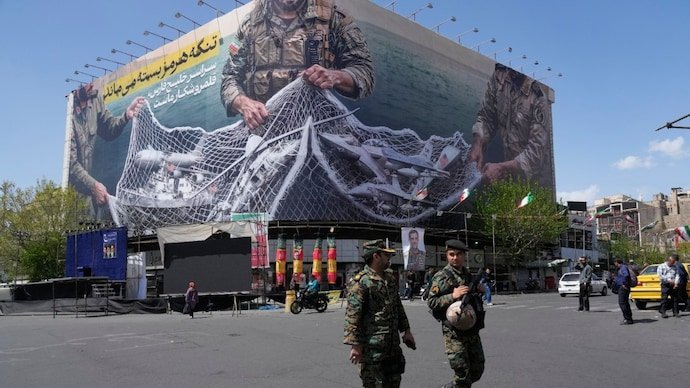
- Iran’s Message: “Security for All or None”
- US Blockade: What Is Happening?
- Shipping Disruption Already Visible
- Talks Collapse: The Trigger Behind Escalation
- Strait of Hormuz: A Strategic Flashpoint
- Oil Markets React Sharply
- Economic Pressure and Strategic Intent
- What Happens If Tensions Escalate?
- Conclusion: A Region on the Brink
Tehran/Washington: Iran has issued one of its strongest warnings yet, declaring that no port in the persian gulf or the Sea of Oman will remain safe if its own maritime Infrastructure is targeted. The statement comes just hours before the United States begins enforcing a naval blockade on Iranian ports, marking a dangerous escalation in an already volatile regional Conflict.
The warning underscores the growing risk that tensions between Washington and Tehran could spill beyond bilateral confrontation into a broader regional crisis affecting global trade and energy flows.
Iran’s Message: “Security for All or None”
Iran’s Military and the Islamic Revolutionary Guard Corps (IRGC) framed the situation in stark terms, emphasizing collective security in regional waters.
“Security in the Persian Gulf and the Sea of Oman is either for everyone or for no one.”
The message was clear: any attempt to isolate Iran’s ports could trigger retaliatory measures affecting the entire region’s maritime infrastructure.
“No port in the region will be safe,” Iranian officials warned.
This broad threat signals a shift from targeted retaliation to a potentially wider disruption strategy.
US Blockade: What Is Happening?
The United States, through its Central Command, has announced that it will begin enforcing a blockade on vessels entering or leaving Iranian ports.
Key details of the move include:
- Applies to Iranian ports across the Persian Gulf and Gulf of Oman
- Enforcement extends to vessels of all nationalities
- Transit between non-Iranian ports via the Strait of Hormuz remains allowed
The blockade is intended to increase economic and strategic pressure on Tehran following the collapse of recent US-Iran negotiations.
Shipping Disruption Already Visible
Even before full enforcement, the announcement has disrupted maritime activity in the region.
| Shipping Activity | Details |
|---|---|
| Pre-Conflict Daily Crossings | 100–135 vessels |
| Post-Ceasefire Movement | Just over 40 vessels |
| Current Trend | Sharp slowdown after blockade announcement |
This decline reflects growing uncertainty among shipowners and insurers, many of whom are unwilling to risk passage under escalating tensions.
Talks Collapse: The Trigger Behind Escalation
Failed Negotiations in Pakistan
The blockade follows high-level US-Iran talks in Pakistan that ended without agreement. The discussions were seen as a last opportunity to stabilise the situation and extend a fragile ceasefire.
However, both sides remained far apart:
- The US demanded commitments on Iran’s nuclear programme
- Iran sought compensation for damages and access to frozen assets
The lack of compromise deepened mistrust and set the stage for escalation.
Strong Words from Iranian Leadership
Iranian officials have adopted increasingly firm rhetoric:
- “If you fight, we will fight,” warned a senior parliamentary leader
- Military advisers reiterated that Iran has “untouched levers” to respond
These statements suggest readiness for both direct and indirect retaliation.
Strait of Hormuz: A Strategic Flashpoint
The Strait of Hormuz remains central to the crisis. While Iran has stated that the waterway is open to non-military vessels, it has warned that military ships could face a forceful response.
| Key Importance | Details |
|---|---|
| Global Oil Flow | ~20% passes through Hormuz |
| Strategic Role | Primary export route for Gulf oil |
| Risk Level | High due to military presence and tensions |
Any disruption here can have immediate global consequences.
Oil Markets React Sharply
The looming blockade has already triggered volatility in global Energy Markets.
- US crude rose by approximately 8% to $104.24 per barrel
- Brent crude increased by around 7% to $102.29 per barrel
- Prices were near $70 per barrel before the conflict escalated
This sharp rise reflects fears of supply disruptions and prolonged instability in the region.
Economic Pressure and Strategic Intent
The US blockade appears aimed at tightening pressure on Iran’s oil exports, including shipments that reportedly bypass Sanctions through indirect or “dark” routes.
By restricting access to Iranian ports, Washington is attempting to:
- Limit Tehran’s revenue streams
- Reduce its influence over regional shipping routes
- Force concessions in future negotiations
However, this strategy carries significant risks, including unintended escalation.
What Happens If Tensions Escalate?
Iran’s warning suggests that retaliation may not be limited to its own waters. Potential scenarios include:
- Disruption of multiple Gulf ports
- Increased attacks on commercial shipping
- Expanded military confrontation in key sea lanes
Such developments could transform a regional standoff into a broader crisis affecting global trade and security.
Conclusion: A Region on the Brink
Iran’s declaration that “no port will be safe” marks a significant escalation in rhetoric and signals a willingness to widen the conflict if provoked. Combined with the US decision to enforce a naval blockade, the situation is rapidly approaching a tipping point.
With shipping already disrupted and oil prices rising, the global impact is becoming increasingly visible.
Forward-looking insight: The coming days will be crucial. If diplomatic efforts fail to resume, the Hormuz crisis could evolve into a broader regional confrontation, with lasting consequences for Global Energy Markets, maritime security, and geopolitical stability.
For breaking news and live news updates, like us on Facebook or follow us on Twitter and Instagram. Read more on Latest World on thefoxdaily.com.


COMMENTS 0