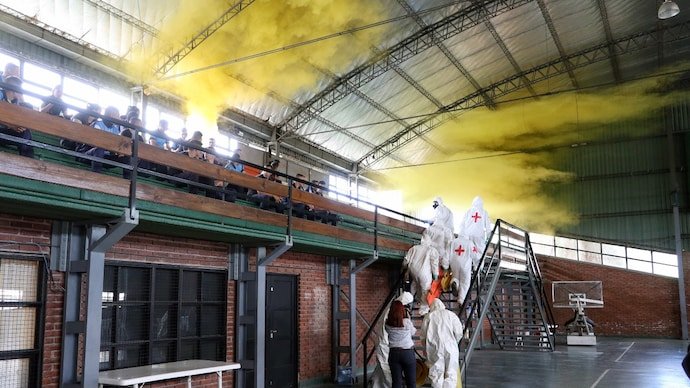
As tensions continue to escalate in the ongoing US-Israel–Iran conflict, global attention has shifted toward a controversial and alarming possibility — the use of a “dirty bomb” by Tehran. While Iran has faced significant military pressure from coordinated US and Israeli strikes, experts believe it may still possess unconventional options capable of causing widespread disruption without triggering full-scale nuclear war.
Rising Conflict and Strategic Pressure on Iran
Now entering its fourth week, the conflict involving the United States, Israel, and Iran shows no signs of slowing down. Iran has launched multiple retaliatory drone and missile attacks across the Middle East. However, despite these responses, Tehran appears to be at a tactical disadvantage due to sustained military pressure and losses.
Amid this scenario, discussions around Iran’s potential use of a radiological weapon — commonly known as a dirty bomb — have intensified. Such a device could allow Iran to impose significant costs on its adversaries without crossing the threshold into nuclear warfare.
What Is a Dirty Bomb?
A dirty bomb, or radiological dispersal device (RDD), is a weapon that combines conventional explosives with radioactive materials. When detonated, it spreads radioactive particles into the surrounding environment in the form of dust or smoke, contaminating large areas.
Unlike a nuclear bomb, which creates massive destruction through intense heat and blast energy, a dirty bomb primarily causes environmental contamination and long-term health risks. Its immediate explosive impact is limited, but the psychological, economic, and health consequences can be severe.
| Aspect | Dirty Bomb (RDD) | Nuclear Weapon |
|---|---|---|
| Explosion Type | Conventional explosive | Nuclear reaction (fission/fusion) |
| Main Impact | Radiation contamination | Massive blast and heat destruction |
| Immediate Damage | Limited | Extreme and widespread |
| Long-Term Effects | Radiation exposure, environmental damage | Radiation plus large-scale devastation |
| Classification | Not typically classified as WMD | Weapon of Mass Destruction (WMD) |
Health and Environmental Impact of a Dirty Bomb
The immediate danger from a dirty bomb comes from the explosion itself, which can cause injuries and structural damage. However, the longer-term risks stem from radioactive exposure.
Radioactive dust and smoke released into the air can travel significant distances, posing health risks if inhaled. High levels of exposure can lead to Acute Radiation Syndrome (ARS), affecting vital systems such as bone marrow, the digestive tract, and the cardiovascular system.
Over time, exposure to radiation increases the likelihood of severe conditions including cancer, leukemia, heart disease, and cataracts. Additionally, contamination of farmland and water sources can create prolonged environmental and economic challenges.
Economic and Psychological Consequences
Beyond physical harm, the economic impact of a dirty bomb attack can be devastating. Cleanup operations for radioactive contamination are extremely costly and time-consuming. Large urban areas may face long-term evacuations, reduced business activity, and infrastructure disruption.
Studies have shown that a single dirty bomb attack in a major city could lead to billions of dollars in losses over time, largely due to decontamination efforts and public fear. The psychological impact — including panic, displacement, and loss of confidence — often exceeds the physical damage.
Can Iran Build a Dirty Bomb?
Experts suggest that building a dirty bomb is technically easier than developing a nuclear weapon. Radioactive materials required for such devices are often used in civilian applications, including medical treatments, industrial processes, and scientific research.
Iran is believed to possess significant quantities of enriched uranium, reportedly up to 60% purity. While this level is below the threshold required for nuclear weapons, it could still be used in a radiological dispersal device.
In addition to uranium, other radioactive materials such as Caesium-137, Cobalt-60, and Americium-241 — commonly found in medical and industrial equipment — can also be used to construct a dirty bomb.
Will Iran Use a Dirty Bomb?
Despite having the potential capability, most experts believe that Iran is unlikely to deploy a dirty bomb under normal circumstances. The political, military, and diplomatic consequences would be severe, potentially triggering overwhelming retaliation and isolating Iran on the global stage.
Historically, Iran has relied on strategic ambiguity and indirect methods rather than overt escalation. Using a dirty bomb would remove that ambiguity and expose the country to significant international backlash.
However, analysts warn that in an extreme scenario — such as facing total military defeat — Iran could consider unconventional options. A dirty bomb might be used as a last-resort tactic to create disruption and psychological impact rather than large-scale destruction.
Possible Targets and Strategic Implications
If ever deployed, a dirty bomb would likely be aimed at maximizing disruption rather than casualties. Potential targets could include densely populated urban areas, major financial centers, ports, or symbolic landmarks.
Strategically important chokepoints such as the Strait of Hormuz could also be targeted. Any radioactive contamination in such regions could disrupt global shipping routes, drive up oil prices, and trigger widespread economic instability.
There is also speculation that such an attack could be carried out through proxy groups, allowing Iran to maintain a degree of plausible deniability while still achieving its strategic objectives.
Conclusion: A Risky and Uncertain Possibility
While there is no confirmed evidence that Iran has built or plans to use a dirty bomb, the possibility cannot be entirely dismissed in a rapidly escalating conflict environment. The use of such a weapon would represent a dangerous shift, intensifying an already volatile geopolitical situation.
As tensions remain high, global observers continue to monitor developments closely. The potential use of radiological weapons underscores the importance of diplomatic efforts to prevent further escalation and maintain regional and global stability.
For breaking news and live news updates, like us on Facebook or follow us on Twitter and Instagram. Read more on Latest World on thefoxdaily.com.





COMMENTS 0