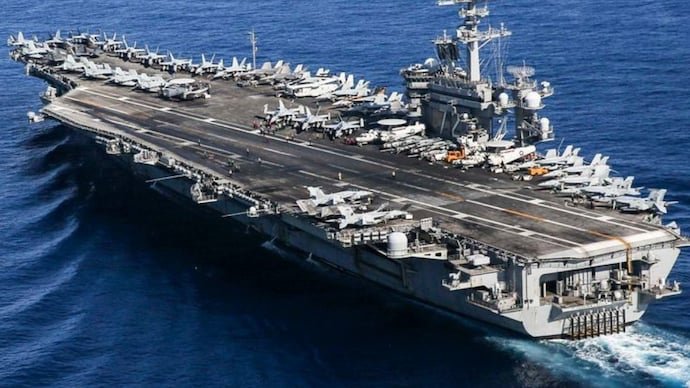
As tensions continue to simmer across West Asia, the deployment of the US Navy’s aircraft carrier strike group led by the USS Abraham Lincoln into the northern Arabian Sea has revived a long-standing strategic question: can Iran realistically threaten — or even sink — a US aircraft carrier?
The arrival of the Abraham Lincoln has once again focused attention on this issue within military and security circles. Aircraft carriers remain the most visible symbol of American power projection, and their presence near Iran inevitably raises concerns about escalation, deterrence, and the true balance of capabilities between the two sides.
On paper, US President Donald Trump would now be in a position to authorize rapid Airstrikes against Iran if tensions were to spiral. The Abraham Lincoln, a nuclear-powered Nimitz-class aircraft carrier, carries roughly 60 F/A-18 Super Hornet fighter jets capable of striking deep into Iranian territory and sustaining high-tempo operations across a vast area.
Despite this overwhelming American advantage, Iran is not without options of its own — particularly in the realm of missile warfare.
Iran’s Missile Strengths and Air Power Limitations
Iran’s conventional air force is widely regarded as outdated and underpowered. Years of international Sanctions have left Tehran with a shrinking fleet of aging combat aircraft, many of which struggle with maintenance and modernization challenges. In numerical and technological terms, Iran’s air force is no match for even a single US carrier air wing.
Where Iran compensates is in missile technology.
Over the past two decades, Tehran has built one of the world’s most diverse missile arsenals, encompassing cruise missiles, short-, medium-, and intermediate-range ballistic missiles, as well as increasingly sophisticated hypersonic systems. Hypersonic weapons — typically traveling at speeds exceeding Mach 5 — dramatically reduce reaction times for defenders and complicate interception.
Among the systems Iran claims to have operationalized is the Fattah-2, which reportedly uses a hypersonic boost-glide vehicle. In addition, Iran has demonstrated its willingness to adapt ballistic missiles for anti-ship roles. During 2024, Iranian-supplied missiles and drones were used by Houthi forces to target commercial and military vessels in the Gulf of Aden, offering indirect evidence of Tehran’s evolving maritime strike concepts.
The Carrier’s Shield: Layered US Missile Defense
The USS Abraham Lincoln does not operate alone. It is protected by a carrier strike group composed of cruisers and destroyers equipped with the Aegis combat system, one of the most advanced naval air and missile defense networks in existence.
This defensive umbrella is deliberately layered.
At the outermost level, electronic warfare systems attempt to jam, confuse, or deceive incoming missiles. Beyond that sit long-range interceptors from the Standard Missile family. Each Aegis-equipped destroyer typically carries around 90 air-defense missiles, including the RIM-174 SM-6, an extended-range interceptor with a reach exceeding 400 kilometers.
More advanced variants of the Standard Missile also incorporate anti-ballistic missile capabilities, allowing them to engage ballistic and certain hypersonic threats at different stages of flight. These systems are designed to work together, creating redundancy rather than reliance on a single layer of defense.
How Iran Might Attempt an Attack
If Iran were to attempt to strike the Abraham Lincoln, it would likely prioritize saturation over precision.
Rather than relying on a small number of highly accurate weapons, Iranian forces could attempt to overwhelm the carrier strike group’s defenses by launching large numbers of Shahed-136 long-range drones alongside cruise and ballistic missiles. The goal would be to exhaust US interceptors and sensors, creating openings for higher-value hypersonic weapons to penetrate.
Geography would also play a critical role. Iran’s coastal missile forces are most effective in confined waters such as the Persian Gulf or parts of the Gulf of Oman. For this reason, a US carrier is unlikely to operate in those narrow spaces. Instead, the Abraham Lincoln would likely remain in the open Arabian Sea, using distance and Oman’s mountainous terrain as partial geographic shields.
The Targeting Problem: Iran’s Core Vulnerability
The greatest limitation on Iran’s ability to strike a US aircraft carrier lies not in missile speed or explosive power, but in targeting.
Aircraft carriers are not stationary targets. A Nimitz-class carrier displaces more than 100,000 tons and can travel at speeds exceeding 25 knots, covering hundreds of kilometers each day. Carrier strike groups deliberately alter their routes and operational patterns to avoid predictability.
To successfully hit such a target, Iran would need a reliable and continuous “kill chain” — combining real-time satellite surveillance, sensor fusion, secure command-and-control systems, and immediate missile launch capability.
At present, Iran lacks a dependable near-real-time satellite tracking network capable of continuously monitoring a fast-moving carrier and feeding precise targeting data directly to missile units. Without that capability, even the most advanced hypersonic missile risks being launched toward empty ocean.
Capability Versus Reality
In theory, Iran’s missile arsenal gives it the ability to threaten even the world’s most powerful navy. In practice, sinking a US aircraft carrier remains extraordinarily difficult.
The USS Abraham Lincoln is protected not only by sophisticated missile defenses and electronic warfare systems, but also by mobility, operational secrecy, and layered redundancy. Iran’s missiles are lethal, but their effectiveness against a moving carrier strike group is sharply constrained without the surveillance and targeting infrastructure needed to guide them.
The strategic reality is familiar: Iran can raise the cost and risk of US naval operations in the region, but consistently destroying a carrier would require capabilities it does not currently possess. For now, deterrence hinges less on who has the fastest missile, and more on who can see, track, and strike first.
For breaking news and live news updates, like us on Facebook or follow us on Twitter and Instagram. Read more on Latest World on thefoxdaily.com.






COMMENTS 0