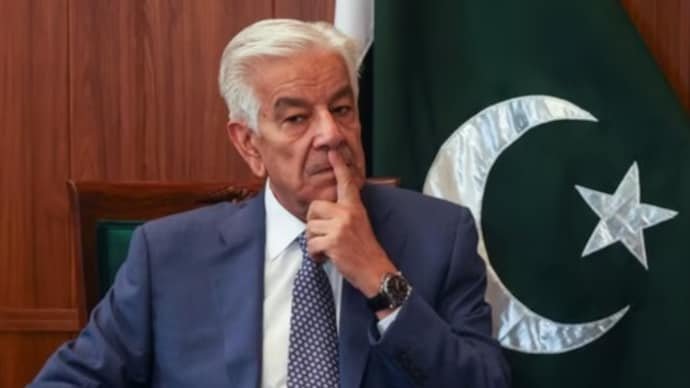
Amid escalating tensions in the Middle East, Pakistan’s Defence Minister Khawaja Asif has alleged that the ongoing conflict involving the United States, Israel, and Iran is part of a broader “Zionist plan” aimed at weakening Pakistan and turning it into a “vassal state.”
Speaking against the backdrop of US and Israeli military strikes on Iranian territory, Asif warned that an Israeli victory could trigger a coordinated regional alignment involving India, Afghanistan, and Iran – all united in hostility toward Pakistan.
The remarks come at a time when Pakistan shares a volatile 900-kilometre border with Iran and is already grappling with tensions along its western and eastern frontiers.
Pakistan ‘Spooked’ by Iran Conflict
Pakistan has been closely monitoring developments after US and Israeli attacks inside Iran intensified regional instability. Iran shares a long border with Pakistan’s insurgency-hit Balochistan province, an area that has experienced decades of unrest.
In a post on X (formerly Twitter), Khawaja Asif claimed that Zionism – the movement advocating for the establishment and protection of a Jewish homeland – has played a “direct or indirect” role in conflicts affecting the Islamic world since the creation of Israel in 1948.
He alleged that Zionist ideology has been the driving force behind large-scale conflicts in Muslim-majority regions and further claimed that major global powers were “held hostage by Zionism.” According to Asif, Zionists have influenced the course of the Global Economy for decades.
Referring specifically to the Iran-Israel-US confrontation, Asif stated that “a war had been imposed” on Iran despite Tehran’s willingness to negotiate. He alleged that the war was “orchestrated” with the aim of extending Israel’s strategic influence toward Pakistan’s borders.
Warning of Regional ‘Encirclement’
One of the most striking elements of Asif’s statement was his warning that an Israeli victory could lead to a “joint single-point agenda” among India, Afghanistan, and Iran – centred on hostility toward Pakistan.
He claimed such a development would “surround us with enemies from all sides,” destabilise Pakistan’s frontiers, and effectively reduce the country to a subordinate or “vassal” state.
Pakistan is already facing strained relations with Taliban-led Afghanistan and has recently experienced heightened military tensions with India. The geopolitical situation has added to Islamabad’s concerns about regional isolation.
| Country | Current Status with Pakistan | Relevance to Asif’s Warning |
|---|---|---|
| Iran | Shares 900-km border; security cooperation with tensions | Conflict escalation may impact border stability |
| India | Long-standing rival; recent military tensions | Alleged potential alignment against Pakistan |
| Afghanistan | Tense relations with Taliban-led government | Accused of possible strategic coordination |
Call for National Unity and Muslim Solidarity
Khawaja Asif urged Pakistan’s approximately 250 million citizens to recognise what he described as a broader “conspiracy” against the country. He appealed for unity beyond political or religious divides, emphasising the need for collective national strength in the face of perceived external threats.
He also reaffirmed Pakistan’s status as a nuclear power, asserting that its nuclear capability serves as a deterrent against external aggression. Asif acknowledged the role of former Prime Minister Nawaz Sharif in conducting the 1998 nuclear tests, which formally declared Pakistan’s nuclear weapons capability.
Expressing solidarity with Palestine, Asif concluded his remarks with the statement, “May Palestine be free,” and urged Muslim-majority nations to unite, recognise their shared challenges, and take coordinated action.
Backdrop: Escalating Middle East Conflict
Asif’s comments come amid a fierce military confrontation between Iran and the United States and Israel. Reports indicate that high-ranking Iranian military and clerical figures were killed in recent strikes, significantly weakening Tehran’s leadership structure.
In response, Iran has reportedly launched drones and missiles targeting multiple locations across the region, escalating tensions across the Middle East and raising concerns about a broader regional war.
The evolving conflict has intensified geopolitical fault lines, with ripple effects extending beyond the Middle East to South Asia.
Political Narrative and Regional Dynamics
Asif’s remarks align with Pakistan’s longstanding narrative of strategic encirclement. Islamabad has often accused regional actors of attempting to destabilise the country, particularly in its insurgency-prone Balochistan province.
Critics, however, argue that Pakistan’s foreign policy challenges stem from complex regional dynamics and internal security issues rather than a unified external conspiracy.
As the Iran conflict unfolds, regional alignments and diplomatic calculations are likely to evolve, making the coming weeks critical for South Asian and Middle Eastern stability.
For breaking news and live news updates, like us on Facebook or follow us on Twitter and Instagram. Read more on Latest World on thefoxdaily.com.





COMMENTS 0