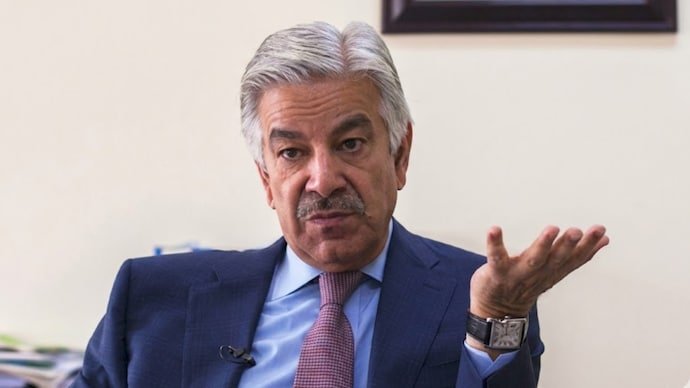
As tensions between Pakistan and Afghanistan intensify into cross-border strikes and retaliatory military operations, Pakistan’s Defense Minister Khawaja Asif has once again pointed fingers at India, alleging that New Delhi is orchestrating a “proxy war” against Islamabad through Kabul.
In a recent interview with France 24, Asif claimed that Afghan forces’ cross-border actions are part of a broader strategy allegedly supported by India. However, he did not present concrete evidence to substantiate these serious allegations.
“So, to reiterate, they are currently engaging in a proxy war against Pakistan. Delhi and Kabul and all these outfits, terrorism outfits in Kabul, they are on the same page,” Asif said during the interview.
When directly asked whether he was implying that India was instructing Kabul to carry out attacks against Pakistan, Asif responded, “Absolutely.”
The interviewer pressed further, questioning whether he possessed any verifiable proof to support such a significant claim. In response, Asif stated, “It is a serious allegation because it is having serious consequences for US.”
He further added that India would likely reject the accusation outright. “It will not be accepted in India. How are you going to convince them to accept it? They’ll continue to deny it. However, their connection with Kabul is excellent. And now we are facing a proxy war and we will, inshallah, we will,” Asif remarked.
Pakistan-Afghanistan Tensions Escalate Into Cross-Border Operations
The allegations come at a time when relations between Pakistan and Afghanistan have sharply deteriorated, with both sides engaging in military actions along the disputed border. In recent days, hostilities have escalated to what observers describe as near full-scale military exchanges.
According to reports, the latest round of escalation began Thursday night when Afghan forces launched strikes into Pakistani border regions. Afghan authorities claimed to have captured multiple Pakistani military posts during the operation. The move was widely interpreted as retaliation for a prior Pakistani military strike conducted earlier in the week inside Afghan territory.
Islamabad had described its earlier action as a targeted counterterrorism operation aimed at militant hideouts operating from Afghan soil. However, Kabul viewed the move as a violation of sovereignty, triggering a cycle of retaliatory strikes.
Hours after Afghan forces initiated their cross-border action, explosions and loud blasts were reported in Kabul. As of now, Islamabad has not released a comprehensive official statement detailing its position on the most recent developments.
Key Developments in the Pakistan-Afghanistan Border Crisis
| Issue | Details |
|---|---|
| Allegation by Khawaja Asif | India is allegedly using Kabul to wage a proxy war against Pakistan |
| Evidence Presented | No public proof provided during interview |
| Recent Afghan Action | Cross-border strikes into Pakistani territory; claim of capturing army posts |
| Pakistan’s Earlier Strike | Described as targeted operation against militant hideouts in Afghanistan |
| Current Diplomatic Status | No direct communication between Pakistan and Taliban government |
No Direct Communication With Taliban Government
Asif also acknowledged that Pakistan currently does not maintain direct communication channels with the Taliban-led government in Afghanistan. He revealed that Islamabad has reached out to friendly nations in an attempt to mediate and ease tensions, but so far, those diplomatic efforts have not yielded tangible progress.
The lack of direct dialogue further complicates the situation, increasing the risk of miscalculation and unintended escalation between the two neighboring countries.
The Durand Line Dispute Remains a Core Flashpoint
A longstanding source of friction between Pakistan and Afghanistan is the Durand Line – the 2,611-kilometer border that separates the two nations. Afghanistan has never formally recognized the Durand Line as an official international boundary, a position that has historically strained relations between Kabul and Islamabad.
The border region has witnessed repeated clashes over the years, with both sides accusing each other of harboring or supporting militant elements. The current spike in hostilities adds to months of simmering tensions.
Months of Rising Violence Along the Border
The recent escalation is not an isolated incident. For several months, relations between Pakistan and Afghanistan have been under severe strain. In October, deadly border clashes resulted in the deaths of dozens of soldiers, civilians, and suspected militants.
The violence followed explosions in Kabul, which Afghan officials blamed on Pakistan. In response, Islamabad conducted strikes deep inside Afghanistan, claiming it was targeting terrorist safe havens. Each episode has contributed to a worsening cycle of accusation, retaliation, and counter-retaliation.
Regional Security Concerns Intensify
With both military tensions and diplomatic rhetoric escalating, regional stability remains fragile. Khawaja Asif’s accusation that India is coordinating with Kabul to wage a proxy war adds another geopolitical layer to an already volatile situation.
While India has not officially responded to the latest allegations, such claims are likely to further strain diplomatic ties in South Asia. Without credible evidence presented publicly, the accusations remain politically significant but unverified.
As cross-border hostilities continue and communication channels remain limited, the risk of further escalation between Pakistan and Afghanistan – and potentially involving regional powers – cannot be ruled out. The coming days may prove critical in determining whether the situation stabilizes through diplomacy or deteriorates into deeper conflict.
For breaking news and live news updates, like us on Facebook or follow us on Twitter and Instagram. Read more on Latest World on thefoxdaily.com.





COMMENTS 0