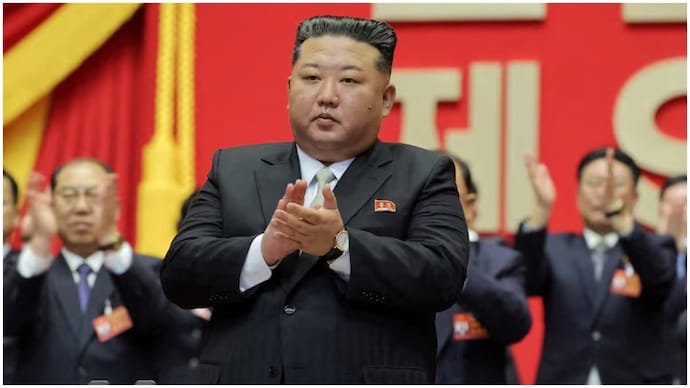
Kim Jong-un, the leader of North Korea, has delivered a sharp warning to South Korea while simultaneously leaving room for potential dialogue with the United States. Speaking at the conclusion of a major ruling party congress in Pyongyang, Kim reiterated that his country could “completely destroy” South Korea if its security were threatened, underscoring his hardened stance toward Seoul.
At the same time, Kim indicated that relations with Washington could improve — but only if the United States abandons what he describes as its “hostile policy” toward North Korea. His remarks reflect a dual-track strategy: intensifying military capabilities while preserving diplomatic flexibility with the U.S.
Workers’ Party Congress Sets Five-Year Defense Goals
The statements came as North Korea wrapped up a seven-day congress of the Workers’ Party in Pyongyang — the country’s most significant political gathering. The event, carefully choreographed and attended by thousands of delegates, highlighted Kim’s leadership and outlined strategic objectives for the next five years.
The congress concluded with a large-scale nighttime military parade in Kim Il Sung Square, named after Kim’s grandfather and North Korea’s founding leader. During the event, Kim was accompanied by his daughter, Kim Ju-ae, believed to be around 13 years old, who has increasingly appeared alongside him at major public events.
Dressed in similar leather coats, father and daughter were seen engaging in conversation, pointing toward parade formations, and observing fighter jets flying overhead. The optics reinforced the message of continuity in leadership and military strength.
Notably, state media footage suggested that North Korea’s largest intercontinental ballistic missiles (ICBMs) — capable of reaching the U.S. mainland — were absent from the parade. Analysts speculate this omission may have been a calculated move to avoid escalating tensions with Washington ahead of potential diplomatic engagement.
Kim’s Warning to South Korea
During the congress, Kim doubled down on his refusal to engage in dialogue with Seoul. He declared that North Korea would permanently exclude the South from the concept of a unified nation and insisted there was “absolutely nothing to discuss” with what he described as an adversary state.
“As long as the Republic of Korea cannot escape its geopolitical condition of sharing a border with us, the only way it can live safely is to abandon all ties with us and refrain from provoking us,” Kim said, referring to South Korea by its formal name.
This rhetoric marks a continuation of the hard-line approach Kim adopted in 2024, when he officially abandoned North Korea’s longstanding goal of peaceful reunification and labeled the South a permanent enemy.
South Korea’s Unification Ministry responded by expressing regret over the North’s hostile framing of inter-Korean relations and reaffirmed its intention to “patiently” pursue stability and peace on the Korean Peninsula.
Keeping the U.S. Option Open
Despite his aggressive language toward Seoul, Kim struck a more nuanced tone regarding Washington. He stated that North Korea maintains the “toughest stance” against the United States but added that there is “no reason we cannot get along” if the U.S. withdraws its so-called hostile policies.
North Korea frequently uses the term “hostile policy” to refer to U.S.-led sanctions, military pressure, and demands for denuclearization. Kim emphasized that the future of U.S.-North Korea relations “depends entirely on the U.S. attitude.”
“We are prepared for either peaceful coexistence or ongoing conflict, and the decision is not ours to make,” he said.
Diplomatic engagement between the two nations has remained stalled since the collapse of Kim’s second summit with former U.S. President Donald Trump in 2019. Since then, Pyongyang has rejected calls from Washington and Seoul to resume talks aimed at dismantling its nuclear program.
Strengthening Nuclear and Military Capabilities
At the congress, Kim declared that North Korea’s status as a nuclear weapons state has been “permanently cemented.” He outlined ambitious plans to expand both the quantity and sophistication of the country’s nuclear arsenal.
Key military objectives announced include:
- Increased production of tactical nuclear weapons aimed at South Korea.
- Development of submarine-launched intercontinental ballistic missiles (SLBMs).
- Expansion of nuclear warhead stockpiles.
- Deployment of more nuclear-capable artillery systems along the border.
- Advancement of AI-powered attack drones and electronic warfare systems.
- Improved reconnaissance satellites and anti-satellite capabilities.
Many weapons projects announced during the 2021 congress — including solid-fuel ICBMs and hypersonic systems — have since been tested or deployed. In 2023, North Korea successfully launched its first military reconnaissance satellite and recently claimed progress in developing a nuclear-powered submarine.
Shifting Foreign Policy: Russia and Beyond
In recent months, Kim has prioritized strengthening ties with Russia, reportedly supplying troops and military equipment to support Moscow’s conflict in Ukraine. Analysts believe Pyongyang may be seeking Military Technology and economic assistance in return.
However, experts caution that North Korea could lose strategic leverage if the Ukraine conflict winds down, potentially reducing its importance to Moscow. This reality may explain Kim’s decision to avoid fully closing the door on engagement with Washington.
Strategic Messaging and Regional Implications
Analysts suggest Kim’s intensified rhetoric toward South Korea serves both domestic and strategic purposes. By portraying Seoul as hostile and irrelevant as a diplomatic intermediary, he reinforces his authority at home while positioning North Korea as an independent nuclear power on the regional stage.
At the same time, his calibrated approach toward the United States signals that Pyongyang remains interested in sanctions relief and implicit international recognition as a nuclear state — but only on its own terms.
As North Korea accelerates weapons development while maintaining conditional openness to talks with Washington, the Korean Peninsula enters another period of heightened uncertainty. Whether the coming years bring renewed diplomacy or deeper confrontation may depend largely on how the United States and South Korea respond to Kim’s evolving strategy.
For breaking news and live news updates, like us on Facebook or follow us on Twitter and Instagram. Read more on Latest World on thefoxdaily.com.




COMMENTS 0