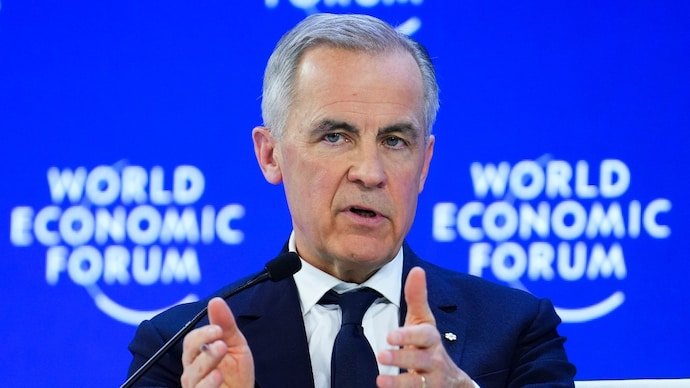
Canadian Prime Minister Mark Carney delivered one of the bluntest assessments of the international system in recent memory as global leaders gathered at the World Economic Forum in Davos, declaring that the long-standing US-led global order has effectively collapsed.
Speaking before political and business elites in the swiss Alps, Carney argued that the assumptions underpinning the so-called rules-based international order are no longer credible and that the world is entering a far more fragmented and dangerous phase.
“I’ll be honest,” Carney said. “We are experiencing a rupture, not a transition. The old order will not return.”
Without naming the United States or President Donald Trump directly, Carney took aim at what he described as decades of American hegemony, contending that powerful nations increasingly exempt themselves from the very rules they once promoted.
“We always knew the story of the international rules-based order was partially false,” Carney said. “When it was convenient, the strongest exempted themselves. trade rules were applied unevenly.”
He acknowledged that this imperfect system had once delivered stability and prosperity, noting that American dominance helped provide global public goods. But he stressed that the underlying bargain has now broken down.
“That myth served a purpose,” Carney said. “American hegemony contributed to stability. But that bargain no longer works.”
According to Carney, a series of recent shocks — spanning banking collapses, pandemics, energy crises and geopolitical conflict — have exposed the dangers of deep global interdependence at a time when major powers increasingly deploy economic tools as instruments of coercion.
“Great powers have started using economic integration as weapons,” he warned. “Leverage through tariffs. Financial infrastructure as coercion. Supply chains as vulnerabilities to be exploited.”
For Canada, the implications are stark. Carney cautioned that long-held beliefs that geography, alliances and economic integration alone could guarantee security and prosperity are no longer sufficient.
“You cannot live within the lie of mutual benefit through integration when integration becomes the source of your subordination,” he said.
The prime minister argued that Canada must pursue a “principled and pragmatic” strategy that strengthens domestic capacity while diversifying trade and security relationships to reduce dependence on any single partner.
He also acknowledged that multilateral institutions such as the World Trade Organization and the United Nations have been weakened, forcing countries — particularly middle powers — to operate with greater self-reliance.
“A country that cannot feed itself, fuel itself or defend itself has few options,” Carney said. “When the rules no longer protect you, you must protect yourself.”
While rejecting isolationism, Carney warned against a descent into a “world of fortresses,” arguing that it would ultimately make nations poorer and more exposed.
“You are on the menu if you are not at the table,” he said, urging middle powers to form flexible coalitions with like-minded partners.
Carney concluded by dismissing nostalgia for the past. “The previous order will not return,” he said. “We should not mourn it. From this fracture, we can build something stronger, fairer and more resilient.”
He described this challenge as the defining task for middle powers — nations with the most to lose from unchecked great-power rivalry and the most to gain from genuine cooperation.
Macron Strikes a Defiant Note
European leaders echoed Carney’s warnings, condemning what they described as President Trump’s “new colonialism” and cautioning that Washington’s push to assert control over Greenland marks a critical moment for Europe.
French President Emmanuel Macron denounced what he called bullying tactics and a disregard for international norms following weeks of increasingly aggressive rhetoric from Trump over the resource-rich Arctic island, an autonomous territory within the Kingdom of Denmark.
Speaking at Davos, Macron said France and Europe would not “passively accept the law of the strongest.”
He criticised what he described as “useless aggressivity” behind Trump’s threats to impose punitive tariffs on countries opposing a US takeover of Greenland, warning that the world was entering “a time of renewed imperial temptations.”
“We prefer respect over intimidation,” Macron said. “And we prefer the rule of law to brutality.”
His remarks came just hours after Trump published private messages from the French president and threatened to impose a 200 percent tariff on French wine.
Macron said attempts to weaken Europe through economic pressure and trade sanctions were “fundamentally unacceptable — especially when used as leverage against territorial sovereignty.”
Trump has recently intensified his rhetoric, stating that the United States would obtain Greenland “one way or the other” and insisting there could be “no going back” on that objective.
President Trump is scheduled to address the Davos forum later today.
For breaking news and live news updates, like us on Facebook or follow us on Twitter and Instagram. Read more on Latest World on thefoxdaily.com.






COMMENTS 0