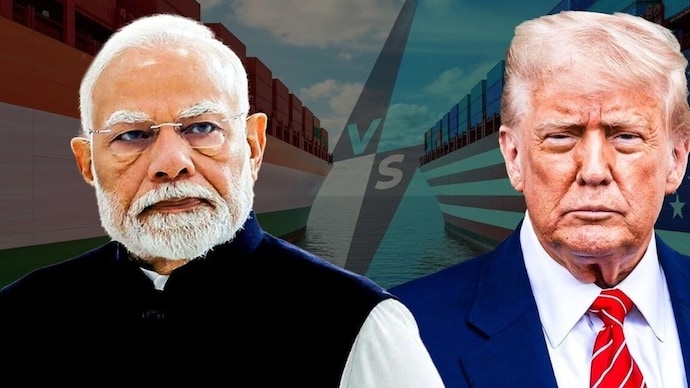
New Delhi: Prime Minister Narendra Modi has chosen to participate in the ASEAN 2025 Summit in Kuala Lumpur virtually, citing Deepavali celebrations as the reason for his absence. However, several diplomatic experts and opposition leaders are questioning this justification, suggesting that the real motive behind his virtual attendance may be to avoid an uncomfortable face-to-face encounter with US President Donald Trump.
Observers point out that the timing of this decision is particularly sensitive. Trump has recently taken a hard stance against nations that continue trade or energy partnerships with America’s rivals. His administration’s imposition of 50% tariffs on Indian exports and sanctions on Russian oil imports — which India heavily depends on — have strained bilateral relations. With crucial Bihar state elections approaching, the last thing Modi needed was a public confrontation or an embarrassing photo-op where Trump could criticize India’s policies on trade or energy security.
China Capitalizes on India’s Absence
While Modi’s decision to stay home may avoid short-term awkwardness, experts warn it comes with a heavy diplomatic cost. China has been quick to seize the moment, using Modi’s absence to strengthen its already dominant position in Southeast Asia. With ASEAN-China trade surpassing $900 billion, Beijing is moving rapidly to finalize the ASEAN-China Free Trade Area 3.0 Agreement.
From industrial parks in Malaysia to railway projects in Laos, China’s Belt and Road Initiative (BRI) continues to expand its influence across the region. Diplomats fear that every missed handshake, photo opportunity, and private conversation between world leaders provides China with an edge in shaping Southeast Asia’s future economic and geopolitical landscape.
India’s Act East Policy Faces a Major Test
India’s trade partnership with ASEAN, valued at over $130 billion annually, has long been a cornerstone of Modi’s Act East Policy – an initiative launched in 2014 to project India as a democratic and economic counterweight to China’s growing dominance.
Yet, Modi’s virtual participation sends a concerning message to ASEAN member nations that are delicately balancing relationships between major powers. Diplomats fear that India’s influence could diminish if it continues to be seen as hesitant or reactive while its competitors, notably Xi Jinping and Trump, actively engage in-person diplomacy.
Opposition Questions Modi’s Diplomatic Commitment
Modi’s recent decision to skip the Gaza Peace Summit has already drawn criticism from the opposition. The Congress Party has accused the Prime Minister of “dodging diplomacy” and “running away from Trump.”
While External Affairs Minister S. Jaishankar will represent India at the ASEAN Summit, analysts argue that leader-to-leader interactions remain irreplaceable in diplomacy. Summit diplomacy thrives on personal rapport — the handshakes, side meetings, and informal exchanges that foster mutual trust. Each absence chips away at India’s diplomatic visibility and soft power in the region.
Trump and Xi Set the Stage, India Watches from Afar
In Kuala Lumpur, Trump’s appearance has already become the centerpiece of global media attention. His outreach to ASEAN leaders and assertive remarks on trade have reinforced America’s return to Indo-Pacific diplomacy. Meanwhile, Xi Jinping continues to leverage China’s economic muscle to secure multi-billion-dollar infrastructure agreements.
Against this backdrop, India’s absence feels glaring. Strategic analysts warn that “absence is never neutral in Asian diplomacy.” Each summit missed by a major leader is an opportunity lost — one that adversaries are quick to exploit.
A Moment That Could Define India’s Regional Role
Modi’s decision to skip ASEAN 2025 may be tactically convenient, but it risks undermining India’s long-term strategy in the Indo-Pacific. The Act East Policy was designed to ensure that India remained an active player in regional decision-making. However, as Trump commands the headlines and China deepens its economic roots, India’s virtual participation may signal hesitation rather than confidence.
In the high-stakes theater of Asian diplomacy, visibility equals influence. Each summit, handshake, and corridor conversation shapes the narrative — and this time, India’s silence might speak louder than its presence.
Key Takeaways
- PM Modi cited Deepavali celebrations as the reason for skipping the ASEAN 2025 Summit.
- Diplomatic observers suspect the move was to avoid meeting US President Donald Trump.
- China is rapidly expanding its influence in Southeast Asia through trade and infrastructure deals.
- India’s absence raises concerns over its Act East Policy and regional leadership role.
- Opposition leaders accuse Modi of avoiding tough diplomatic confrontations.
For breaking news and live news updates, like us on Facebook or follow us on Twitter and Instagram. Read more on Latest World on thefoxdaily.com.






COMMENTS 0