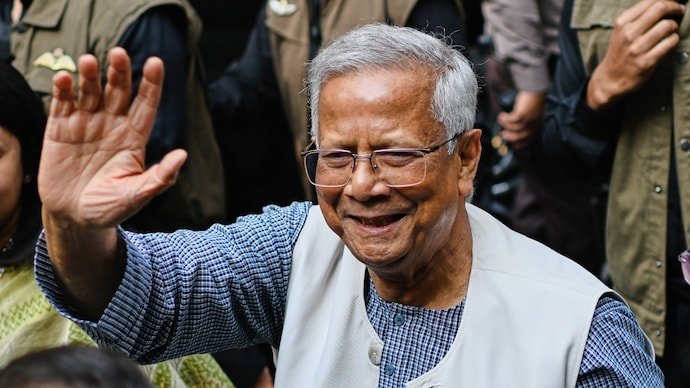
In his farewell address, Bangladesh’s outgoing interim leader Muhammad Yunus once again stirred diplomatic unease with India by referring to the sensitive northeastern region popularly known as the Seven Sisters. His remarks, delivered during a 25-minute nationally televised speech, are being interpreted by strategic observers as a continuation of rhetoric that had already pushed India-Bangladesh relations to a low point during his 18-month tenure.
Yunus, a Nobel laureate who headed Bangladesh’s interim administration, asserted that the country was no longer a “submissive” state and emphasized its sovereign decision-making. However, it was his renewed reference to India’s northeast — without explicitly naming India — that has drawn attention in diplomatic circles.
What Did Yunus Say About the ‘Seven Sisters’?
In his address, Yunus stated, “Bangladesh can provide huge potential for economic prosperity for the seven sister states, Nepal and Bhutan… Our open seas are not just borders — they are gateways to the global economy.”
The statement is widely interpreted as positioning Bangladesh as a strategic access point to the landlocked northeastern states of India — namely Arunachal Pradesh, Assam, Manipur, Meghalaya, Mizoram, Nagaland, and Tripura — collectively known as the Seven Sisters.
Significantly, Yunus referred to the region without explicitly mentioning India, a move that many analysts see as diplomatically pointed. This is not the first time he has used such phrasing. During his visit to china last year, Yunus described India’s northeast as “landlocked” and encouraged greater Chinese engagement in the region. That comment had drawn sharp criticism from several northeastern chief ministers as well as India’s External Affairs Minister S. Jaishankar.
Diplomatic Sensitivities and Regional Implications
India has historically maintained a firm stance against what it views as external commentary or involvement in its internal affairs. The northeast region holds both strategic and geopolitical significance, particularly due to its proximity to China, Myanmar, and Bangladesh, as well as its connection to mainland India through the narrow Siliguri Corridor, often referred to as the “Chicken’s Neck.”
Yunus’ repeated mention of the Seven Sisters, especially in the context of economic gateways and regional access, is seen by some policy experts as an attempt to elevate Bangladesh’s strategic importance in South Asia’s connectivity architecture.
Throughout his tenure, Yunus’ administration witnessed rising anti-India rhetoric within sections of Bangladesh’s political discourse. Critics argue that relations with New Delhi cooled considerably during this period, even as Bangladesh explored closer engagement with China and Pakistan.
China’s Prominence in Yunus’ Farewell Address
China featured prominently in Yunus’ final speech. He emphasized what he called the importance of maintaining a “strategic balance” in foreign relations and highlighted expanding cooperation with Beijing.
Particular mention was made of the Teesta River restoration project, a Chinese-backed initiative that has been closely watched by Indian strategic observers due to its geographical proximity to the Siliguri Corridor. Yunus also referenced progress on a 1,000-bed international hospital project in Nilphamari, describing it as a milestone in Bangladesh-China collaboration.
Earlier this year, the Yunus administration allowed Chinese officials and envoys to visit the Teesta project site despite reservations expressed in Indian strategic circles. This move further underscored Dhaka’s evolving foreign policy posture during his leadership.
“No Longer Submissive”: A Message to India?
In a particularly striking portion of his speech, Yunus declared:
“Bangladesh today is self-assured, proactive, and accountable in defending its autonomous interests. Bangladesh is no longer a nation that follows orders and advice from other nations or has a servile foreign policy.”
While he did not name India directly, the statement has widely been interpreted as an indirect reference to New Delhi. The Yunus administration had frequently suggested that Bangladesh’s foreign policy under former Prime Minister Sheikh Hasina was perceived as being closely aligned with India.
Observers note that such language, particularly in a farewell address, signals an attempt to frame his tenure as one marked by assertive sovereignty and independent diplomacy.
Domestic Context and Political Undertones
Yunus’ term as interim leader was not without controversy. His administration faced domestic criticism over episodes of violence, concerns regarding attacks on minority communities including Hindus, and tensions involving media freedoms. Against this backdrop, some analysts suggest that strong nationalist messaging in his farewell speech may have been aimed at consolidating domestic political narratives.
By invoking sovereignty, dignity, and strategic autonomy, Yunus appeared to underscore his administration’s efforts to reposition Bangladesh’s foreign policy orientation.
How Has India Responded?
As of now, the Government of India has not issued an official statement responding to Yunus’ remarks. However, senior Supreme Court advocate Mahesh Jethmalani publicly criticized the outgoing leader, accusing him of attempting to portray India as an “external villain” amid governance challenges in Bangladesh.
In social media comments, Jethmalani suggested that references to sovereignty and the Seven Sisters were part of a broader political strategy. He argued that leadership challenges at home should not translate into rhetorical positioning against neighboring countries.
What Is Implied by Yunus’ Speech?
Strategic analysts believe Yunus’ farewell address carries layered messaging:
- A reaffirmation of Bangladesh’s sovereign foreign policy stance.
- An attempt to enhance Bangladesh’s strategic relevance in regional connectivity.
- A subtle signal to domestic audiences emphasizing independence from perceived external influence.
- A continued outreach toward China as part of a broader geopolitical balancing strategy.
Whether the speech will have a lasting impact on India-Bangladesh relations remains to be seen. Historically, ties between the two nations have been shaped by deep economic cooperation, cultural connections, and shared security interests. However, rhetoric touching upon sensitive territorial or strategic issues tends to attract heightened scrutiny in New Delhi.
As leadership transitions unfold in Dhaka, diplomatic observers will be closely watching whether future engagements signal recalibration, continuity, or further divergence in the trajectory of India-Bangladesh relations.
For breaking news and live news updates, like us on Facebook or follow us on Twitter and Instagram. Read more on Latest World on thefoxdaily.com.






COMMENTS 0