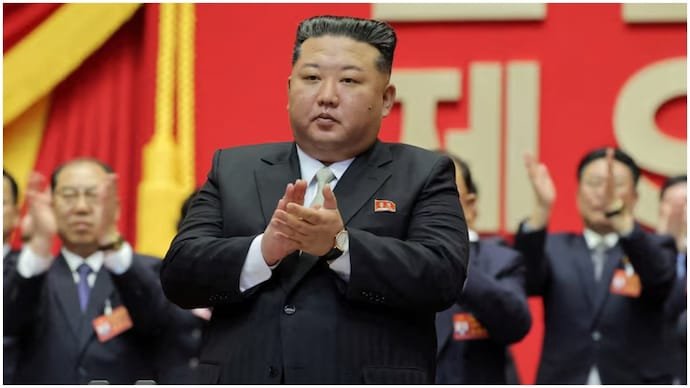
North Korea has conducted a significant test of a high-thrust, solid-fuel missile engine, marking another step in its ongoing efforts to strengthen its strategic military capabilities. According to state media reports, leader Kim Jong Un personally oversaw the test and described it as a major advancement in the country’s defence programme.
The test is part of North Korea’s broader five-year military development plan, which focuses on enhancing what it calls its “strategic strike means.” This phrase is widely interpreted as a reference to nuclear-capable intercontinental ballistic missiles (ICBMs) designed to reach targets as far as the United States mainland.
Engine Upgrade Signals Increased Missile Power
According to the Korean Central News Agency (KCNA), the newly tested engine uses advanced composite carbon fibre materials and delivers significantly higher thrust compared to earlier versions.
The engine reportedly achieved a maximum thrust of approximately 2,500 kilotons, a notable increase from the roughly 1,971 kilotons recorded during a previous solid-fuel engine test conducted in September. This jump in performance highlights North Korea’s efforts to enhance the range and payload capacity of its missile systems.
| Engine Specification | Details |
|---|---|
| Engine Type | Solid-fuel missile engine |
| Material Used | Composite carbon fibre |
| Maximum Thrust (Latest Test) | Approx. 2,500 kilotons |
| Previous Test Thrust | Approx. 1,971 kilotons |
| Strategic Purpose | Enhancing ICBM range and payload capacity |
Focus on Multi-Warhead Capability
Analysts believe that the increase in engine power may be linked to North Korea’s efforts to develop missiles capable of carrying multiple warheads. Such advancements would significantly improve the chances of overcoming missile defence systems deployed by adversaries.
By boosting propulsion strength, the country could potentially extend the reach of its missiles while also increasing their effectiveness against advanced interception technologies.
Solid-Fuel Technology Enhances Readiness
The continued focus on solid-fuel missile technology represents a major shift in North Korea’s weapons strategy. Unlike older liquid-fuel missiles, which require lengthy preparation and fueling before launch, solid-fuel systems can be deployed more quickly and are harder to detect prior to liftoff.
This capability reduces the window for pre-emptive strikes and enhances the survivability of North Korea’s missile forces.
Test Conducted Amid Rising Global Tensions
The engine test comes shortly after Kim Jong Un addressed North Korea’s Parliament, where he reaffirmed his commitment to strengthening the country’s nuclear status. During the speech, he criticised the United States, accusing it of engaging in what he described as global “state terrorism and aggression.”
Although the exact timing and location of the test were not disclosed, the development is seen as part of a broader pattern of military advancements by North Korea in recent years.
Five-Year Military Plan Drives Strategic Expansion
The missile engine test is aligned with North Korea’s five-year defence strategy, which prioritises the modernisation of its armed forces and the development of advanced weapons systems.
Enhancing “strategic strike means” remains a central objective of this plan, with a particular focus on strengthening long-range missile capabilities.
ICBM Development and Remaining Challenges
North Korea has already tested several intercontinental ballistic missiles that demonstrate the potential to reach the United States. These tests have raised concerns among Global Security experts about the country’s growing capabilities.
However, some analysts argue that technical challenges remain, particularly in ensuring that nuclear warheads can survive the extreme conditions of atmospheric reentry during long-range flights.
Others believe that North Korea’s continued investment and years of research may have already addressed many of these issues, suggesting that its missile programme is more advanced than previously assumed.
Diplomatic Stalemate with the United States
The latest test also reflects the ongoing stalemate in diplomatic relations between North Korea and the United States. High-profile talks between Kim Jong Un and US President Donald Trump collapsed in 2019, leading to a renewed focus on military development.
Despite maintaining that it is open to dialogue, North Korea has insisted that the United States must abandon its demand for complete nuclear disarmament as a precondition for negotiations.
As tensions persist, the country continues to advance its missile and nuclear capabilities, signalling that it intends to strengthen its position both militarily and diplomatically on the global stage.
For breaking news and live news updates, like us on Facebook or follow us on Twitter and Instagram. Read more on Latest World on thefoxdaily.com.






COMMENTS 0