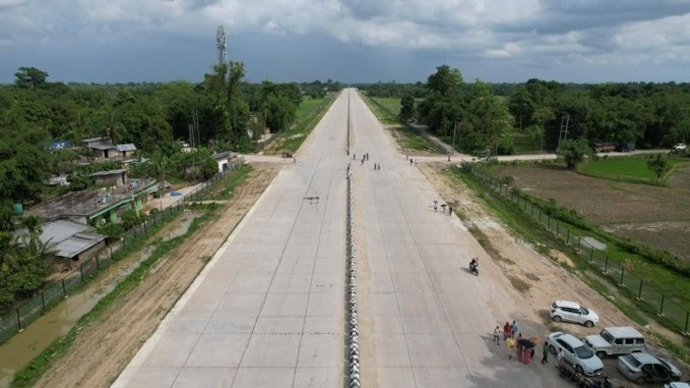
Moran, Assam: At a time when the India–china border remains strategically sensitive and geopolitically complex, India is set to operationalise the first Emergency Landing Facility (ELF) in the North-East. Built along a nearly 4-kilometre stretch of national highway in Assam’s Moran, this highway-based airstrip can be swiftly converted into a fully functional military runway during war-like scenarios or disaster emergencies.
This landmark development represents a significant leap in India’s defence infrastructure in the eastern theatre, especially amid China’s aggressive expansion of airfields, heliports, and logistics bases across Tibet and Xinjiang.
Strategic Importance of Moran Emergency Landing Facility in Assam
The Moran ELF is located approximately 240 kilometres from the India-China border. Designed as a certified contingency runway, it can support emergency take-off and landing operations for a range of Indian Air Force (IAF) aircraft, including:
- Fighter jets such as Rafale and Su-30MKI
- Heavy-lift transport aircraft like the C-17 Globemaster
- Tactical transport platforms including the C-130J Super Hercules
The project reflects a broader doctrinal shift in India’s defence preparedness — integrating civilian infrastructure with military capability to enhance rapid mobilisation and operational flexibility.
Following successful trial runs, the airstrip is now fully prepared for operational deployment. The formal inauguration is scheduled for February 14, and Prime Minister Narendra Modi is expected to land at Moran’s ELF. The ceremony will also feature an aerial display involving fighter jets, transport aircraft, and helicopters — demonstrating the runway’s operational readiness.
OSINT Analysis: Satellite Imagery Traces Development Timeline
An in-depth Open Source Intelligence (OSINT) assessment, supported by satellite imagery from Copernicus, tracks the transformation of the highway into a strategic airstrip.
Satellite data indicates that construction of the highway began in March 2024, with imagery from December 2024 showing an under-construction stretch nearing structural completion. However, the decisive phase of converting the highway into a military-capable runway began in June 2025, when auxiliary infrastructure — including support buildings and operational facilities — was erected along the corridor.
This phased development underscores careful planning and calibrated execution, ensuring the airstrip meets both civilian highway standards and military aviation requirements.
IAF’s Broader Plan: 28 Emergency Landing Facilities Across India
In March 2022, the Indian Air Force identified 28 Emergency Landing Facilities (ELFs) across the country as part of its long-term strategic preparedness blueprint.
Out of these:
- Five ELFs are planned in Assam
- Four in West Bengal
- Two in Bihar
This brings a total of nine ELFs in eastern India alone — a clear indicator of the government’s focus on strengthening the eastern frontier. These highway-based airstrips significantly reduce dependence on conventional airbases and provide redundancy in times of conflict.
China’s Expanding Airpower Infrastructure in Tibet and Xinjiang
India’s move to operationalise the Moran ELF must be viewed against the backdrop of China’s expanding military infrastructure along the Line of Actual Control.
Since 2017, China has constructed or upgraded at least 37 airports and heliports in Tibet and Xinjiang, including 22 military or dual-use facilities, according to assessments by the Center for Strategic and International Studies (CSIS) ChinaPower Project.
Key dual-use airports located in the eastern sector opposite Arunachal Pradesh include:
- Nyingchi Mainling Airport
- Qamdo Bamda Airport
- Lhasa Gonggar Airport
These long-runway facilities allow the People’s Liberation Army (PLA) Air Force to deploy fighter aircraft, transport planes, personnel, and logistics equipment across high-altitude terrain with improved efficiency. Satellite imagery and open-source assessments reveal upgraded runways, reinforced aircraft shelters, fuel storage zones, and expanded support infrastructure.
This systematic enhancement of China’s border airpower capability has significantly altered the strategic calculus in the eastern sector.
Why the Moran ELF Matters in the India–China Strategic Equation
The operationalisation of the Moran Emergency Landing Facility signals India’s intent to maintain credible deterrence while enhancing rapid-response capabilities in the Northeast.
Highway airstrips serve multiple strategic functions:
- Provide alternate landing options if conventional airbases are compromised
- Enable faster deployment of air assets near the border
- Improve disaster response and humanitarian operations
- Enhance survivability and dispersal of airpower
In a theatre where terrain is challenging and geopolitical tensions can escalate unpredictably, infrastructure readiness becomes a force multiplier. The Moran ELF, therefore, is not merely a highway innovation — it is a calculated strategic asset designed to reinforce India’s defence posture in the eastern frontier.
As both India and China continue infrastructure development along the border, the coming years will likely see further strategic recalibration. For now, Moran stands as a visible assertion of preparedness, resilience, and infrastructural resolve in India’s Northeast.
For breaking news and live news updates, like us on Facebook or follow us on Twitter and Instagram. Read more on Latest World on thefoxdaily.com.

COMMENTS 0