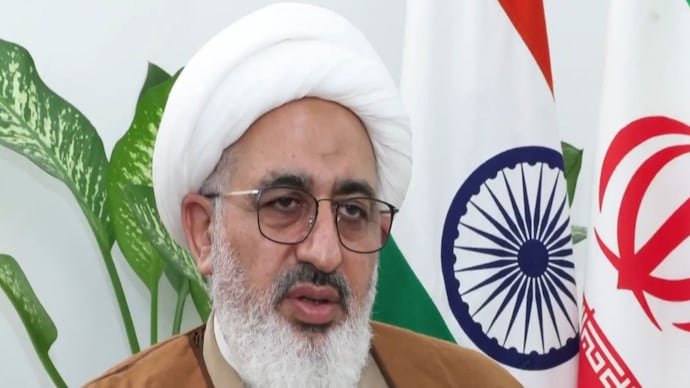
Iran has never sought to acquire nuclear weapons because such arms are considered “haram,” or forbidden, under Islamic principles, Supreme Leader Ali Khamenei’s Representative in India, Abdul Majid Hakeem Ilahi, has said. Reiterating Tehran’s long-standing position, Ilahi stressed that Iran’s nuclear program is intended solely for peaceful and humanitarian purposes.
Speaking in an interview with news agency ANI, Ilahi accused certain international organisations of applying “double standards” when it comes to monitoring and sanctioning nuclear activities.
“Because nuclear weapons are forbidden, Iran has never desired to possess them. Iran, at the same time, wants to have nuclear, peaceful power for some social and humanitarian treatment. But unfortunately, there is a double standard,” he said. “Some international organisations issued a lot of sanctions against Iran and have a lot of supervision over Iran’s nuclear power, but some other countries have it, they use it, and they say nothing towards them.”
Iran has been under extensive international sanctions for years due to concerns over its nuclear program, allegations of human rights violations, and regional security issues. The United States has been among the most vocal critics, imposing sweeping economic and political sanctions on Tehran.
In June, the US carried out airstrikes using stealth bombers on three nuclear facilities in Iran as part of what it called “Operation Midnight Hammer,” marking one of the most significant escalations linked to Iran’s nuclear program in recent years. At the time, US President Donald Trump claimed the operation had completely destroyed Iran’s nuclear facilities.
The strikes were conducted amid heightened tensions during the Israel-Iran conflict, which later ended in a truce in June. Washington described the operation as a necessary response to perceived nuclear threats, further deepening the strain between the two countries.
Hakeem Ilahi attributed many of Iran’s ongoing domestic challenges to the long-standing sanctions regime. While acknowledging that the situation has created frustration among sections of the population, he said others have found ways to adapt and progress despite the restrictions.
“Some people are angry, but other people use this opportunity to reach their target and achieve their aims,” Ilahi said, adding that the current situation in Iran is “very good, under control,” and not as dire as portrayed on some social media platforms.
According to the US-based Human Rights Activists News Agency (HRANA), nearly 4,000 people have reportedly died in connection with protests that began in Iran in late December. The unrest initially erupted after the Iranian rial fell to a record low against the US dollar, prompting demonstrations by traders and merchants.
The protests quickly evolved into the largest mass movement in Iran since the 1979 Islamic Revolution. Demonstrators, including a significant number of women, raised concerns over social restrictions, economic hardships, and human rights issues under the Khamenei-led system.
Former US President Donald Trump publicly expressed support for the protesters, further escalating tensions between Washington and Tehran during the period of unrest.
Addressing international perceptions of Iran, Hakeem Ilahi said it was essential to distinguish between reality and what he described as “imagined narratives” promoted by adversaries and certain media portrayals.
“There are actually two aspects of the Iranian situation that we need to distinguish and separate. The first is fact and reality. The second is imagination, which is produced by other people, the adversaries, or the journalist’s narration,” he said, adding that “there is a very deep gap between these two realities.”
Ilahi also spoke about the long-standing historical and cultural ties between Iran and India, highlighting academic exchanges that date back centuries.
“Even in universities, we studied Indian philosophy as well as mathematics, astronomy, and medicine. We used Indian civilization and expertise, and we were always taught about the link between Iran and India in school,” he said.
He added that Iran’s Supreme Leader has consistently emphasized the importance of strong bilateral relations with India. “The Supreme Leader of the Islamic Republic of Iran always insists on good relations and collaboration between Iran and India. I hope they will work nicely in Chabahar,” Ilahi said.
He noted that the historical relationship between the two civilizations dates back nearly 3,000 years, well before the advent of Islam, with intellectual and cultural exchanges shaping both societies.
The Chabahar Port, located in Iran’s Sistan-Baluchestan province, holds significant strategic importance for India as it provides a trade route bypassing Pakistan and offers access to Afghanistan and Central Asia.
India acquired operational rights to a portion of the Shahid Beheshti terminal at Chabahar in December 2018 after signing a Memorandum of Understanding with Iran in 2015. In 2024, the two countries signed a 10-year agreement to replace interim arrangements, reinforcing their long-term cooperation on the project.
For breaking news and live news updates, like us on Facebook or follow us on Twitter and Instagram. Read more on Latest World on thefoxdaily.com.





COMMENTS 0