Pakistan’s security forces have carried out extensive combing and counterterrorism operations across Balochistan, killing at least 145 militants within nearly 40 hours, following a wave of coordinated attacks that left dozens of civilians and security personnel dead, provincial authorities said on Sunday.
Balochistan Chief Minister Sarfaraz Bugti confirmed the figures during a press conference in Quetta, stating that the militants were neutralised during raids conducted on Friday and Saturday, as well as in ongoing search and clearance operations across multiple districts.
“This is the highest number since Pakistan has been fighting this war on terror,” Bugti said, as quoted by Dawn, highlighting the scale and intensity of the current security response.
Coordinated Attacks Trigger Large-Scale Security Response
The violence erupted almost simultaneously in several parts of the province, including Quetta, Gwadar, Mastung, and Noshki. According to the chief minister, the attacks resulted in the deaths of 31 civilians and 17 law enforcement personnel.
The assaults prompted immediate large-scale counterterrorism operations involving the Pakistan Army, police, Frontier Corps, and Counter Terrorism Department (CTD). Responsibility for the attacks was claimed by the Baloch Liberation Army (BLA), a separatist militant group active in the resource-rich but restive province.
Pakistan Accuses India, New Delhi Rejects Claims
Amid the violence, Pakistan’s military alleged—without presenting evidence—that the attacks were carried out by “Indian-sponsored militants.”
On Sunday, Defence Minister Khawaja Asif reiterated the allegation, claiming the attackers had links to India and vowing to “completely eliminate these terrorists.”
“Even now, our security forces are engaged in mopping-up operations,” Asif said, according to news agency AFP.
India swiftly rejected the accusations. Ministry of External Affairs spokesperson Randhir Jaiswal dismissed Pakistan’s claims as baseless and politically motivated.
“Instead of parroting frivolous allegations after every violent incident, Pakistan would do better to address the long-standing demands of its own people,” Jaiswal said, adding that Islamabad’s “record of suppression, brutality, and Human Rights violations is well known.”
Operation Herof and Escalating Violence in Balochistan
The escalation comes a day after Pakistan’s military announced that it had killed 41 militants in two separate operations. Shortly afterward, the Baloch Liberation Army declared the launch of the second phase of Operation Herof, also referred to as “Black Storm.”
In a statement attributed to BLA spokesperson Jeeyand Baloch, the group claimed its fighters overran a Frontier Corps facility and seized control of a Counter Terrorism Department headquarters in Noshki, killing several Pakistani soldiers.
Officials told AFP that in other incidents, militants stormed a police station, looted weapons and ammunition, and freed at least 30 prisoners from a district jail before fleeing.
Security Lockdown and Disruption of Daily Life
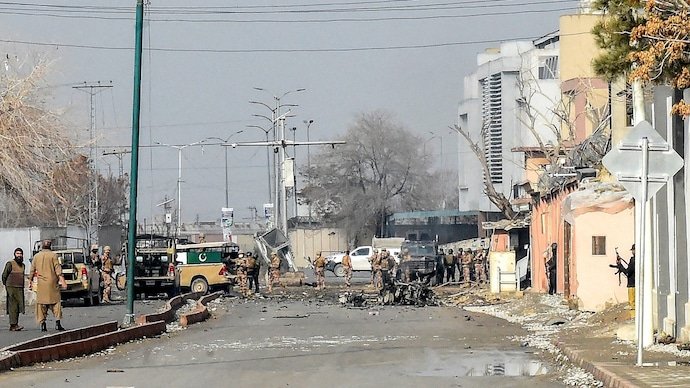
On Sunday, security forces continued search operations across affected areas, sealing off nearly a dozen locations. Mobile internet services have been suspended across Balochistan for more than 24 hours as part of security measures.
Train services remain suspended, while road traffic continues to face major delays. In Quetta, usually a bustling provincial capital, streets appeared deserted as residents stayed indoors fearing further violence.
Shops and businesses were shut, major roads blocked, and debris from explosions—including damaged vehicles and twisted metal—littered several areas.
“Anyone who leaves home has no certainty of returning safely,” said Hamdullah, a 39-year-old shopkeeper in Quetta. “The fear of not coming back unharmed is constant.”
Key Facts From the Balochistan Violence
| Category | Details |
|---|---|
| Militants killed | 145 in around 40 hours |
| Civilians killed | 31 |
| Security personnel killed | 17 |
| Areas affected | Quetta, Gwadar, Mastung, Noshki, others |
| Claimed by | Baloch Liberation Army (BLA) |
| Security measures | Internet suspension, transport disruption, combing operations |
Ongoing Uncertainty in Pakistan’s Largest Province
The latest violence underscores the persistent instability in Balochistan, where separatist insurgency, economic grievances, and security operations have shaped the region for decades.
As Pakistan intensifies its counterterrorism campaign and diplomatic tensions with India resurface, residents of Balochistan continue to bear the brunt of the conflict, facing fear, disruption, and uncertainty in their daily lives.
For breaking news and live news updates, like us on Facebook or follow us on Twitter and Instagram. Read more on Latest World on thefoxdaily.com.





COMMENTS 0