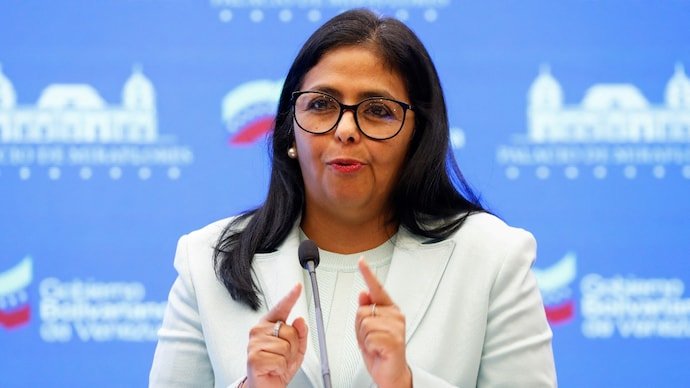
Venezuela’s acting President Delcy Rodriguez used her first state of the union address on Thursday to push for opening the country’s state-run oil industry to greater foreign participation, marking a significant shift in policy after the Trump administration moved to seize control of Venezuelan crude sales.
Less than two weeks after the United States arrested and removed former President Nicolas Maduro, Rodriguez presented her first public vision of Venezuela’s new political reality, one that departs sharply from the ideological foundations of the previous government.
The former vice president said a “new policy is being formed in Venezuela,” acknowledging mounting US pressure to restructure the country’s heavily sanctioned oil industry and reintegrate it into global markets.
Rodriguez urged lawmakers to approve sweeping reforms that would allow foreign companies access to Venezuela’s vast oil reserves. Addressing foreign diplomats in attendance, she encouraged them to brief potential investors on what she described as a new era for Venezuela’s energy sector.
“Venezuela can sell the products of its energy industry in free trade relations with the world,” Rodriguez said during the address.
The Trump administration has stated that it intends to regulate future Venezuelan oil export revenues, arguing that the proceeds should directly benefit the Venezuelan population.
Aligning with that position, Rodriguez explained that income from oil sales would be channeled into two sovereign wealth funds. One fund would be dedicated to restoring Venezuela’s collapsing health-care system, while the other would focus on rebuilding public infrastructure that has deteriorated after years of neglect.
Many of Venezuela’s hospitals are now so under-resourced that patients are required to bring their own basic medical supplies, including syringes and surgical materials.
While Rodriguez condemned the US detention of Maduro as a “stain on bilateral relations,” she simultaneously called for renewed diplomatic engagement between the longtime adversaries. Her restrained tone stood in contrast to the extended anti-US speeches that defined the Maduro and Hugo Chavez eras.
“Let us not be afraid of diplomacy,” Rodriguez said. “I ask that politics not begin with bigotry or hatred.”
Speaking briefly to reporters a day earlier, Rodriguez said her administration would continue releasing prisoners detained under Maduro’s rule. Human Rights organizations, however, have confirmed only a limited number of such releases so far.
The acting president appeared to carefully balance competing pressures. A photograph of Maduro and his wife, Cilia Flores, stood beside her as she spoke. Maduro is currently being held in a Brooklyn jail after pleading not guilty to US drug-trafficking charges.
Rodriguez urged US authorities to “respect the dignity” of Maduro, even as she emphasized Venezuela’s sovereignty amid rapidly warming ties with Washington.
“If I ever have to travel to Washington as acting president, I will go standing, walking, not dragged,” she said. “I will never crawl. I will go standing tall.”
Rodriguez delivered her speech as opposition leader Maria Corina Machado, a nobel peace prize laureate, was in Washington meeting with President Donald Trump. Venezuelan state media did not cover Machado’s visit.
Instead, state television continued broadcasting pro-government programming, including speeches by Russian and Iranian leaders criticizing US policies and extensive coverage of demonstrations calling for Maduro’s return.
On Thursday, hundreds of teachers marched through central Caracas chanting pro-government slogans and carrying signs accusing the US of “kidnapping” Maduro. National police in riot gear were deployed across the capital. Graffiti reading “To doubt is to betray” was visible on city walls.
David Smilde, a Venezuela expert at Tulane University, said the government appears to be recalibrating rather than abandoning its ideological posture.
“They’ve kept the anti-imperialist rhetoric, but in a more moderated form,” Smilde said. “The strategy seems to be giving Trump what he wants economically while preserving political control.”
With much of Maduro’s security apparatus still intact, many Venezuelans in Caracas declined to speak openly about the changes, citing fear of retaliation.
Others expressed uncertainty about the country’s future. “It’s a sea of uncertainty,” said Pablo Rojas, a 28-year-old music producer. “Right now, the only actor with real decision-making power seems to be the United States government.”
Rojas said he was closely following Trump’s meeting with Machado to see whether she might emerge as a future leader or presidential candidate.
“It’s impossible to predict what comes next,” he said, shaking his head.
For breaking news and live news updates, like us on Facebook or follow us on Twitter and Instagram. Read more on Latest World on thefoxdaily.com.

COMMENTS 0