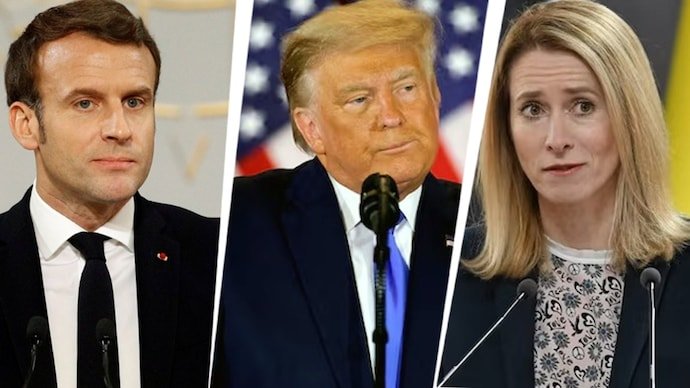
Tensions flared across the Atlantic over the weekend after the United States signaled plans to impose tariffs connected to Greenland, prompting strong reactions from senior European Union officials. The controversy has raised alarms about a widening divide among Western allies at a time when cooperation is considered vital for global security.
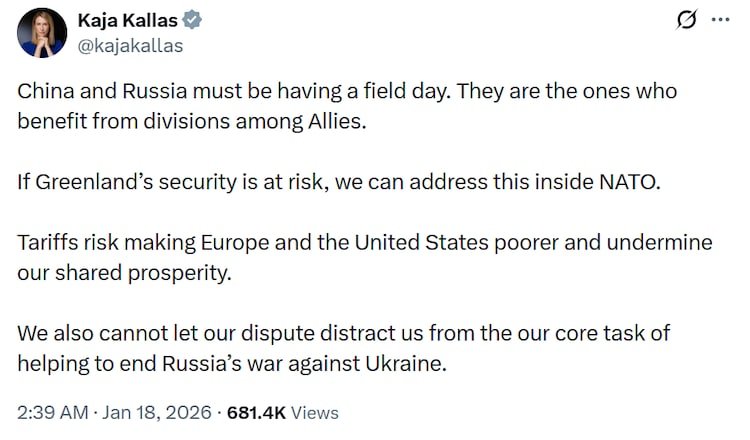
The European Union’s foreign policy chief, Kaja Kallas, issued a sharp warning, arguing that the growing discord between the US and Europe is directly benefiting geopolitical rivals. In a post on social media platform X, Kallas stated that Russia and china stand to gain the most from divisions among NATO allies.
“Russia and China must be having a great time. They are the ones who benefit from divisions among Allies,” Kallas wrote, responding to US President Donald Trump’s announcement of new tariffs on several European nations.
Kallas stressed that if concerns truly exist regarding Greenland’s security, they should be addressed within NATO rather than through economic measures. She cautioned that tariffs would harm both sides of the Atlantic, weakening shared prosperity and damaging long-standing partnerships.
“If Greenland’s security is at risk, we can address this inside NATO,” she said, adding that trade restrictions risk making both Europe and the United States economically weaker.
She also warned that internal disagreements must not overshadow the larger geopolitical challenge posed by Russia’s ongoing war in Ukraine. According to Kallas, losing focus at such a critical moment could have long-term consequences for European and global security.
French President Emmanuel Macron echoed similar concerns, calling the tariff threats unacceptable if they were to be confirmed. Macron emphasized that Europe would respond collectively and firmly to any such measures.
“When faced with such circumstances, we will not be swayed by intimidation or threats, whether in Greenland, Ukraine, or anywhere else in the world,” Macron stated on X. He added that tariff threats were inappropriate and that European nations would act in a unified and coordinated manner if necessary.
Threat of Tariffs Over Greenland
The strong reactions followed President Trump’s announcement that the United States would begin imposing new tariffs on imports from eight European countries starting February 1, with the possibility of higher rates from June onward. The US administration cited national security concerns linked to Greenland as justification.
According to the announcement, countries facing the proposed duties include the United Kingdom, Denmark, France, Germany, Finland, the Netherlands, and Norway. Greenland, though geographically distinct, is an autonomous territory within the Kingdom of Denmark.
President Trump has repeatedly argued that the United States must acquire Greenland for strategic and security reasons, citing fears that China or Russia could gain influence over the mineral-rich and strategically vital Arctic island. Denmark and Greenland have firmly rejected any suggestion of transferring sovereignty, reiterating that the territory is not for sale.
EU Leaders Warn of a Dangerous Downward Spiral
Senior European leaders have voiced concerns about the broader political and economic fallout of the tariff dispute. European Commission President Ursula von der Leyen and European Council President Antonio Costa warned that retaliatory trade measures could trigger a dangerous downward spiral.
They cautioned that escalating trade tensions could further strain transatlantic relations at a moment when unity is seen as essential for countering Russia’s actions in Ukraine and addressing wider global security challenges.
Russia Weighs In With a Sharp Warning
Moscow responded swiftly to the growing dispute, appearing eager to exploit fractures within the Western alliance. Kirill Dmitriev, the Russian presidential envoy and head of the Russian Direct Investment Fund, issued a pointed message aimed at Europe.
“Trump imposes 10% tariffs on the UK, Denmark, France, Germany, Finland, Netherlands, and Norway over their ‘dangerous game’ of sending military to Greenland,” Dmitriev wrote on X, adding a provocative remark urging Europe to avoid escalating tensions.
His claim that the tariffs amounted to roughly “1% per soldier sent to Greenland” was widely interpreted by analysts as an attempt to mock European security efforts and highlight divisions among Western allies.
As geopolitical rivalries intensify, European officials remain concerned that internal disputes could weaken collective influence on the global stage, providing strategic openings for both Russia and China at a time when unity is more critical than ever.
For breaking news and live news updates, like us on Facebook or follow us on Twitter and Instagram. Read more on Latest World on thefoxdaily.com.




COMMENTS 0