
For more than 40 years, Bangladesh’s political destiny was dominated by a bitter, deeply personal rivalry between two formidable women: Sheikh Hasina and Begum Khaleda Zia. Their confrontation was not merely an electoral contest between rival parties, but an all-consuming struggle that seeped into every institution of the state. The so-called “Battle of the Begums” disrupted governance, eroded democratic norms, fuelled recurring street violence, and turned politics into a zero-sum game where compromise was viewed as betrayal.
At its core, this rivalry was about more than power. It was a contest over identity, memory, and the soul of Bangladesh itself. Born out of the traumatic aftermath of the country’s independence in 1971, both leaders came to embody sharply divergent interpretations of the nation’s history. Politics, as a result, became intensely polarised—victory meant total control, while defeat often led to exile, marginalisation, or imprisonment.
A Betrayal With Roots in Blood
The origins of this political feud lie in the blood-soaked years following Bangladesh’s birth as a nation. Sheikh Hasina is the daughter of Sheikh Mujibur Rahman, the towering figure of the independence movement and the country’s first president. Mujib’s assassination in a brutal military coup in August 1975—during which most of his family was killed—plunged Bangladesh into chaos and trauma. Hasina herself narrowly survived and spent years in exile, carrying both personal grief and political resentment.
Khaleda Zia’s political journey was shaped by a parallel tragedy. In the turbulent years after Mujib’s death, her husband, Major General Ziaur Rahman, rose through the ranks to become president. Ziaur Rahman articulated a different vision of Bangladeshi nationalism—one that emphasised Islamic identity and deliberately distanced the state from Mujib’s secular and socialist ideals.
When Ziaur Rahman was assassinated in another failed military coup in 1981, Khaleda Zia was thrust into politics. She took over leadership of the Bangladesh Nationalist Party (BNP), positioning herself as the custodian of her husband’s legacy. From that moment on, Bangladesh’s politics revolved around two competing dynastic narratives, each shaped by assassination, loss, and unresolved grievances.
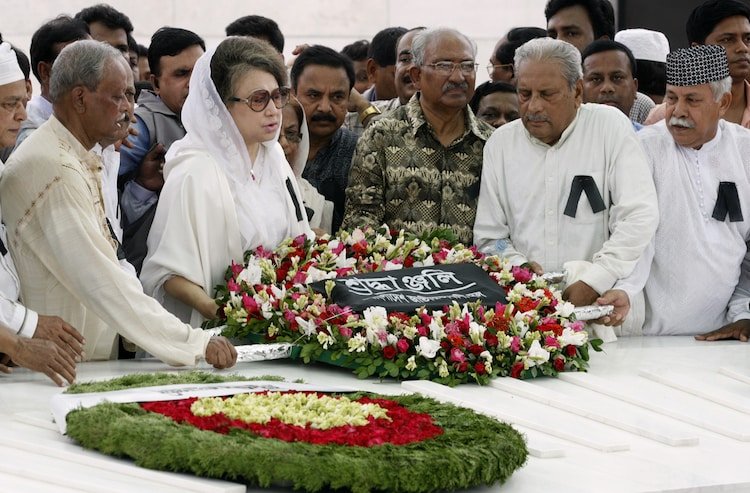
Khaleda Zia is often remembered laying a wreath at the mausoleum of her husband, President Ziaur Rahman—a powerful image that symbolised how personal tragedy and political ambition became inseparable in Bangladesh’s power struggle.
A Rare Moment of Unity in the 1980s
Despite their mutual hostility, history forced Sheikh Hasina and Khaleda Zia into an uneasy alliance during the 1980s. Bangladesh was then under the authoritarian rule of General Hussain Muhammad Ershad, who seized power in a 1982 coup, imposed martial law, and orchestrated tightly controlled elections to legitimise his regime.
Throughout the decade, Hasina’s Awami League and Khaleda’s BNP led parallel protest movements. Cities were frequently paralysed by hartals, street battles, and mass civil disobedience. Dhaka, in particular, became the epicentre of unrest as students, workers, and opposition activists confronted state repression.
By the late 1980s, both leaders recognised that Ershad could not be removed without coordinated resistance. Temporarily setting aside personal animosity, they joined a broad anti-Ershad coalition demanding an end to military rule and the restoration of democracy. The movement reached its peak in 1990, when relentless protests brought the country to a standstill.
Facing mounting public anger, economic decline, and wavering support from the military, Ershad resigned on December 6, 1990. The episode marked a historic turning point. The brief unity between the two Begums succeeded in dismantling authoritarian rule and ushered in elections under a neutral caretaker government—an arrangement designed to ensure credible polls and peaceful transfers of power.
From Political Rivalry to Personal Vendetta
The fragile unity quickly collapsed once democracy was restored. Through the 1990s and 2000s, the Hasina–Zia rivalry hardened into a permanent state of political warfare. Elections became existential battles, parliamentary boycotts became routine, and governance repeatedly ground to a halt.
Streets once again turned into battlegrounds, with rival supporters clashing during strikes, shutdowns, and protest marches. When in office, each leader used the machinery of the state to weaken the other—through arrests, corruption cases, administrative pressure, and legal manoeuvres. Politics became less about policy and more about survival.
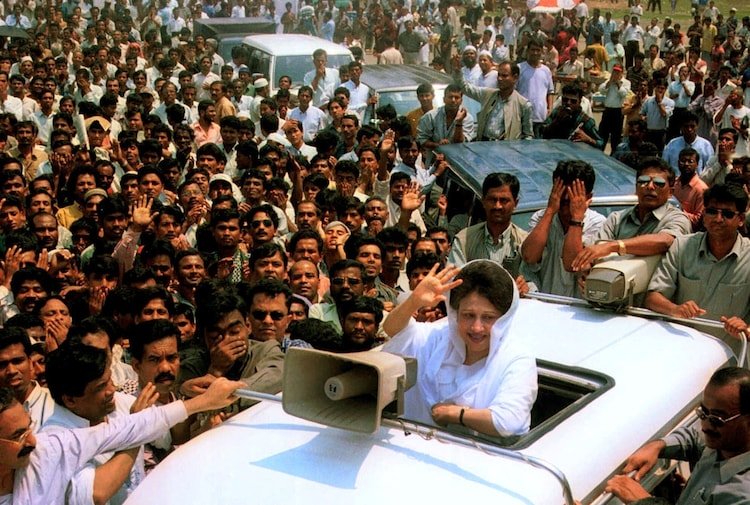
The consequences were profound. Public trust in elections declined, democratic institutions weakened, and political intolerance became entrenched. Bangladesh oscillated between elected governments, but the confrontational mindset never faded. A defining image of this era was Khaleda Zia waving to supporters in May 1999 as she launched a 400-kilometre protest march from Dhaka to Dinajpur.
The Caretaker Government Flashpoint
One of the most contentious battlegrounds in the Battle of the Begums was the caretaker government system. Introduced to ensure free and fair elections, the system required an impartial interim administration to oversee polls after an elected government completed its term.
While initially welcomed as a democratic safeguard, it soon became another source of conflict. Khaleda Zia strongly defended the caretaker system, arguing that no ruling party could conduct fair elections. Sheikh Hasina, after returning to power, claimed the system was unconstitutional and vulnerable to manipulation.
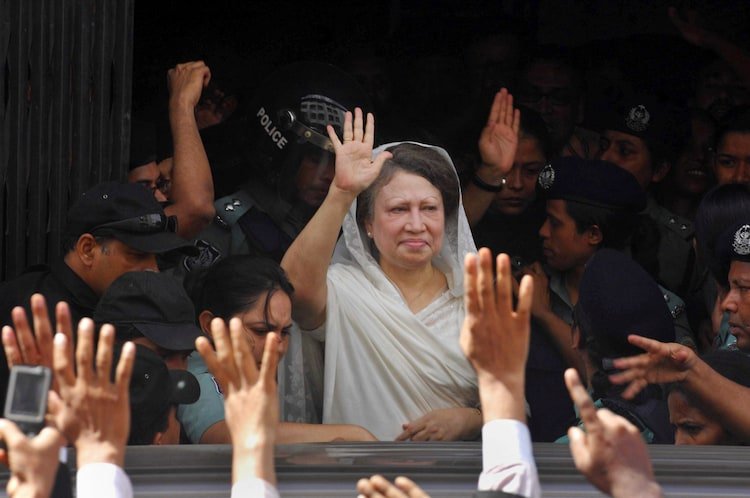
The crisis peaked in 2007, when an army-backed caretaker government imposed emergency rule. Both Hasina and Zia were arrested on corruption and extortion charges, sidelining them from politics. After intense political pressure and judicial intervention, both leaders were released a year later.
In 2011, Hasina’s government abolished the caretaker system through constitutional amendment. The BNP denounced the move as an assault on democratic norms. Subsequent elections—particularly in 2014 and 2018—were marred by boycotts, allegations of rigging, and claims of repression, drawing sustained international criticism and narrowing the political space further.
From Rivalry to One-Sided Rule
By the mid-2010s, the Battle of the Begums had become increasingly uneven. Sheikh Hasina emerged as Bangladesh’s longest-serving prime minister, presiding over years of economic growth, major infrastructure projects, and relative macroeconomic stability. At the same time, critics accused her government of centralising power, weakening the judiciary, curbing media freedom, and systematically marginalising the opposition.
Khaleda Zia’s political career effectively stalled after her conviction in corruption cases and prolonged imprisonment in 2018. Confined for years due to health concerns and legal restrictions, she gradually faded from active politics. The Awami League consolidated power, while the BNP struggled to function without its leader.
For many observers, it appeared that the rivalry which once defined Bangladesh’s politics was ending not through democratic competition, but through attrition and institutional dominance.
The Dramatic Unravelling of 2024
The political landscape shifted dramatically in August 2024 with the collapse of Sheikh Hasina’s government. Within hours of her resignation, President Mohammed Shahabuddin ordered Khaleda Zia’s immediate release from house detention, ending years of confinement. A series of judicial decisions followed, and by early 2025, the Supreme Court cleared Zia of the remaining corruption cases that had barred her from politics.
During the transition overseen by interim chief adviser Muhammad Yunus, Khaleda Zia re-emerged as a powerful moral presence. Her legal rehabilitation allowed the BNP to reclaim its position as a central force in national politics.
Her return was widely described as a “politics of return”—first through her own reappearance after specialised medical treatment in London, and later through the return of her son and political heir, Tarique Rahman.
After a prolonged illness, Khaleda Zia passed away at the age of 80. Her death, coming just months before scheduled elections, marks the end of an era. As Bangladesh stands at another crossroads, the legacy of the Battle of the Begums continues to shape the nation’s political memory, even as it turns a page on one of the most defining rivalries in South Asian politics.
For breaking news and live news updates, like us on Facebook or follow us on Twitter and Instagram. Read more on Latest World on thefoxdaily.com.






COMMENTS 0