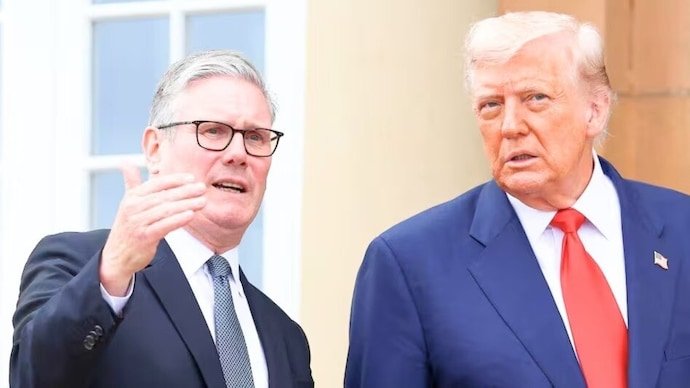
The intervention unfolded against the backdrop of intense diplomatic engagement between European capitals, NATO leadership and Washington, following President Donald Trump’s announcement that the United States would impose a 10 per cent tariff on goods imported from Denmark, Norway, Sweden, France, Germany, the United Kingdom, the Netherlands and Finland beginning February 1, 2026.
Trump’s declaration of a 10 per cent tariff on imports from eight European nations prompted urgent discussions among European governments, NATO officials and U.S. counterparts, as concerns mounted over the potential consequences for transatlantic relations.
The announcement, which targeted Denmark, Norway, Sweden, France, Germany, the United Kingdom, the Netherlands and Finland, coincided with heightened diplomatic activity as European leaders sought to understand Washington’s intentions and prevent further escalation.
During a phone conversation, British Prime Minister Keir Starmer strongly criticised U.S. President Donald Trump for threatening to use tariffs on NATO allies as leverage over Greenland, warning that such actions were incorrect and risked destabilising long-standing transatlantic ties.
In the same call, Starmer reiterated his opposition to using economic pressure against NATO partners, cautioning that threatening tariffs in relation to Greenland could seriously undermine trust between allies and strain the collective security framework.
The intervention again came amid urgent diplomatic exchanges between European capitals, NATO leadership and Washington following Trump’s tariff announcement, underlining the growing unease among U.S. allies.
Trump also warned that if no agreement was reached regarding Greenland, the tariff could be raised to 25 per cent starting June 1, 2026. He has not ruled out the possibility of using force to seize Greenland, repeatedly asserting that control of the territory is vital to U.S. security.
The U.S. president reiterated that without progress on Greenland, the higher levy would be imposed from June, maintaining that Greenland’s strategic importance justified stronger measures.
Starmer Warns Trump Over Tariff Threats
In addition to speaking directly with Trump on Sunday, Starmer held separate calls with NATO Secretary General Mark Rutte, European Commission President Ursula von der Leyen, and Danish Prime Minister Mette Frederiksen.
“The prime minister reaffirmed his position on Greenland in every call. He stressed that security in the high north is a shared priority for all NATO allies to protect Euro-Atlantic interests,” a Downing Street summary said. “He also made clear that applying tariffs on allies for pursuing collective NATO security is wrong.”
Starmer’s direct approach carries the risk of antagonising Trump, who has threatened to impose tariffs on eight European nations, including the United Kingdom, if negotiations over Greenland fail to move in Washington’s favour.
EU Assesses Retaliatory Options
The U.S. president’s threats “undermine transatlantic relations and risk a dangerous downward spiral,” according to a joint statement issued by the targeted countries on Sunday. The group said it stood “in full solidarity” with Greenland and Denmark and remained committed to dialogue grounded in territorial integrity and sovereignty.
European Union ambassadors also reached broad agreement on stepping up diplomatic efforts to dissuade Trump from implementing the tariffs, while quietly preparing retaliatory measures should talks break down. EU leaders are expected to convene an emergency meeting in Brussels later this week to determine next steps.
Among the options under discussion is the reactivation of duties on €93 billion worth of U.S. imports that were previously suspended. Another, more controversial measure involves the EU’s never-used “Anti-Coercion Instrument,” which would allow Brussels to restrict U.S. access to public procurement, investment opportunities or parts of the services market.
Pressure Builds on Multiple Fronts
Danish Prime Minister Mette Frederiksen said Europe would not yield to pressure as she and other European leaders continued deliberations on how to respond to the U.S. tariff threats.
Leaders across the European Union echoed a similarly firm stance. While French President Emmanuel Macron has privately supported tougher countermeasures, Frederiksen stated that Europe “will not be blackmailed.” Irish Prime Minister Micheál Martin cautioned that although retaliation would be unavoidable if tariffs were imposed, deploying the EU’s strongest tools too quickly might be premature.
European Commission President Ursula von der Leyen said on Sunday that the European Union remained committed to defending the sovereignty of Greenland and the Kingdom of Denmark.
In a post on X, von der Leyen said she had discussed the Greenland issue with German Chancellor Friedrich Merz, French President Emmanuel Macron, British Prime Minister Keir Starmer, Italian Prime Minister Giorgia Meloni, and NATO Secretary General Mark Rutte.
Von der Leyen also confirmed in a separate post that she had spoken with Macron, Starmer, Merz, Meloni and Rutte to coordinate positions on Greenland.
Europe’s Projects Are Weak, Says the U.S.
Senior officials in the Trump administration, meanwhile, have defended a more assertive U.S. posture on Greenland. U.S. Treasury Secretary Scott Bessent said Europe’s geopolitical vulnerability was a key factor behind Washington’s push to assert control over the Arctic region.
Speaking on NBC’s Meet the Press, Bessent argued that Greenland had become central to a broader geopolitical contest involving Russia and china, and that U.S. leadership was necessary to maintain global stability.
“We are the strongest country in the world,” he said. “Europeans are perceived as weak. The United States projects strength.”
He repeated that message, stating, “We are the strongest country in the world. Europeans come across as feeble. The United States exudes power.”
Reiterating the administration’s stance, he added, “We are the strongest country in the world. People in Europe appear weak. The U.S. presents a powerful image.”
He continued, “We are the strongest country in the world. Europeans portray themselves as weak. The U.S. conveys strength.”
Once again emphasising the point, Bessent said, “We are the strongest country in the world. Europeans are perceived as feeble. The United States exudes strength.”
For breaking news and live news updates, like us on Facebook or follow us on Twitter and Instagram. Read more on Latest World on thefoxdaily.com.



COMMENTS 0