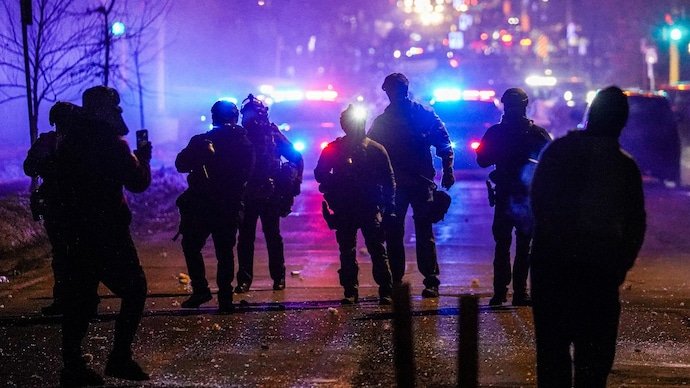
US President Donald Trump escalated tensions on Thursday amid his administration’s sweeping immigration crackdown by threatening to invoke the Insurrection Act of 1807 and deploy federal troops to Minneapolis to suppress ongoing protests targeting federal immigration authorities.
The warning followed a series of violent confrontations between demonstrators and federal officers, as protests across Minneapolis grew increasingly volatile. The unrest began after the fatal shooting of 37-year-old Renee Good earlier this month by an Immigration and Customs Enforcement (ICE) agent, an incident that triggered nightly demonstrations and widespread public outrage.
As clashes intensified, Trump issued a strong warning through social media, accusing Minnesota’s political leadership of failing to maintain Law and Order and allowing unrest to spiral out of control.
“If the corrupt politicians of Minnesota don’t obey the law and stop the professional agitators and insurrectionists from attacking the Patriots of ICE, who are only trying to do their job, I will institute the INSURRECTION ACT,” Trump wrote. “I will quickly put an end to the travesty that is taking place in that once great State.”
Tensions escalated further a day earlier when an immigration officer, reportedly under attack with a shovel and a broom handle, fired his weapon and injured another individual. The shooting fueled fresh anger and fear, deepening divisions across Minneapolis and intensifying calls for accountability.
Trump has repeatedly floated the idea of invoking the Insurrection Act, a rarely used federal law that grants the president authority to federalize the National Guard or deploy active-duty military forces domestically without the consent of a state governor.
What is the Insurrection Act?
The Insurrection Act has been invoked more than 20 times throughout US history, most notably in 1992, when President George H.W. Bush sent federal troops to Los Angeles at the request of state officials during riots following the Rodney King verdict.
The law is a US federal statute that authorizes the president to deploy military forces or federalize state National Guard units in situations involving domestic unrest, insurrection, or the obstruction of federal law.
At its core, the Insurrection Act allows military involvement in civilian law enforcement when state authorities are either unwilling or unable to enforce federal laws or protect constitutional rights. Under these circumstances, troops may perform functions typically reserved for civilian police, including arrests and searches.
Although commonly referred to as the Insurrection Act of 1807, the current statute incorporates provisions enacted between 1792 and 1871. Historically, it has been viewed as a last-resort mechanism intended for extreme cases of disorder or rebellion.
Why is the Insurrection Act controversial?
The use of military force against civilians raises some of the most serious constitutional concerns in American governance, making the Insurrection Act one of the most contentious federal laws.
The framers of the US Constitution were deeply wary of standing armies enforcing domestic law, shaped by colonial experiences under British military rule. These concerns ultimately led to the passage of the Posse Comitatus Act of 1878, which generally bars the military from performing civilian policing duties.
The Insurrection Act stands as a rare exception to that principle. Civil liberties organizations warn that its broad language gives presidents sweeping discretion, raising fears that it could be misused to suppress lawful protests rather than to restore public safety.
Does a president need a governor’s approval?
In most cases, the Insurrection Act is invoked at the request of a state governor seeking federal assistance to restore order. However, the law also permits unilateral presidential action if the president determines that state authorities are unable or unwilling to enforce federal law or protect constitutional rights.
Such unilateral use of the statute is rare. One notable example occurred in 2005, when President George W. Bush ultimately chose not to invoke the Insurrection Act after Hurricane Katrina, in part because Louisiana’s governor opposed federalizing the state’s National Guard.
For breaking news and live news updates, like us on Facebook or follow us on Twitter and Instagram. Read more on Latest World on thefoxdaily.com.



COMMENTS 0