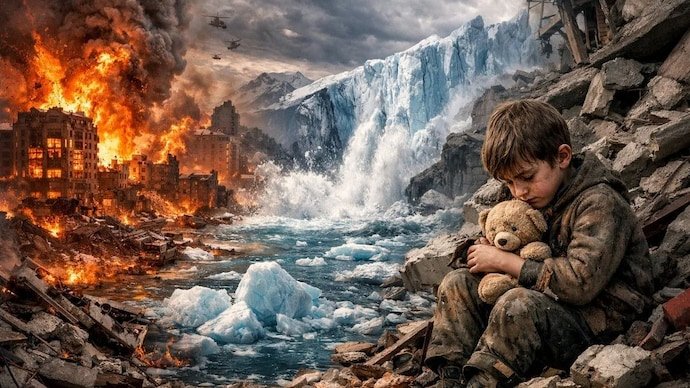
Sometimes, only by stepping back and looking at the bigger picture can we truly grasp the scale of human contradiction. We are a species that has decoded DNA, split the atom, and even sent a car into space as a demonstration of technological prowess. Today, serious global efforts are underway to send humans to Mars—a barren, lifeless planet millions of kilometers away.
Yet, despite these extraordinary achievements, we continue to struggle with something far more basic: coexisting peacefully on the only habitable planet we have.
War at the Heart of Global Energy Supply
In 2026, the conflict involving the United States, Israel, and Iran has once again placed the world on edge. Beyond the immediate human cost—lives lost, cities damaged, and families displaced—the war is unfolding at one of the most strategically vital points on Earth: the Strait of Hormuz.
This narrow waterway, just about 33 miles wide at its narrowest, connects the persian gulf to global markets. Roughly 20 million barrels of oil—nearly 20% of the world’s daily consumption—pass through it every day. It fuels homes, hospitals, industries, and transportation systems worldwide.
Since the outbreak of hostilities, tanker movement through the Strait has nearly come to a halt. The disruption is not just an economic crisis—it is a looming environmental catastrophe.
A single attack on an oil tanker does not simply remove fuel from the market. It spills into the ocean. Environmental organizations have warned that a major oil spill in the region could devastate marine ecosystems, destroying coral reefs, mangroves, and seagrass beds across the Arabian Sea and the Gulf of Oman.
The long-term consequences of such damage are severe. Marine wildlife suffers, fisheries collapse, and coastal communities lose their livelihoods. The scars left behind by oil spills can persist for decades, silently compounding the damage long after the war headlines fade.
A Planet Already Under Stress
This conflict does not exist in isolation. It unfolds against the backdrop of an already fragile climate system. The past few years—2023, 2024, and 2025—have been among the hottest ever recorded in modern history.
Scientists warn that global temperatures are rising at an alarming pace, with recent data suggesting that the planet may have already crossed the critical 1.5°C warming threshold above pre-industrial levels—a limit long considered a safeguard against the worst impacts of climate change.
Glaciers are retreating, sea levels are rising, and extreme weather events are becoming more frequent and intense. Yet, instead of prioritizing climate action, global powers continue to allocate vast resources toward warfare and military expansion.
The contradiction is striking. While the Earth warms and ecosystems collapse, billions are spent on weapons designed to destroy rather than preserve.
The Illusion of Progress
Humanity often celebrates its progress, but that progress comes with paradoxes. We created the internet—yet also enabled misinformation and division. We mapped the human genome—yet still struggle with inequality and discrimination. We built global institutions meant to prevent war—yet conflicts persist.
The lines we draw—based on borders, religion, race, and identity—mean little to the natural world. Rising seas do not recognize passports. Wildfires do not discriminate based on belief. Oceans warming off one coast affect ecosystems across the globe.
Nature is not at war with humanity. It is responding to it.
The Mars Dream vs Earth Reality
Amid all this, humanity is investing heavily in the idea of colonizing Mars. It is often framed as a backup plan—a second home, an insurance policy against catastrophe.
But this raises an uncomfortable question: What kind of civilization are we planning to take there?
If we carry forward the same divisions, inequalities, and conflicts, then Mars risks becoming not a new beginning, but an extension of old problems. A distant outpost for the privileged, while the majority remain on a deteriorating Earth.
This is not a vision of progress—it is an evasion of responsibility.
The Real Victims of War and Crisis
In every conflict, the burden is rarely borne by decision-makers or those in power. Instead, it falls on ordinary people—families, workers, and communities far removed from the centers of decision-making.
It is the sailor navigating dangerous waters in the Strait of Hormuz, the fisherman whose livelihood disappears after an oil spill, and the child in a distant country facing power outages because Global energy supplies have been disrupted.
For countries dependent on energy imports, especially those relying on liquefied natural gas shipments through the Strait, disruptions can have immediate and severe consequences. Entire populations may face electricity shortages, economic strain, and uncertainty—all triggered by a conflict thousands of kilometers away.
A Defining Moment for Humanity
Climate scientists have repeatedly warned that the current pace of warming is unprecedented in human history. The Earth is approaching conditions not seen for millions of years, with long-term implications for sea levels, ecosystems, and human survival.
And yet, instead of uniting to address this shared crisis, humanity remains divided—investing energy and resources into conflict rather than cooperation.
The reality is both simple and profound: humans are the only species capable of understanding the consequences of their actions on a planetary scale. And yet, we continue to act against our own long-term interests.
This contradiction may well define our era—not as a time of innovation, but as a moment when knowledge failed to translate into wisdom.
The question is no longer whether we can change course. It is whether we will choose to.
For breaking news and live news updates, like us on Facebook or follow us on Twitter and Instagram. Read more on Latest World on thefoxdaily.com.






COMMENTS 0