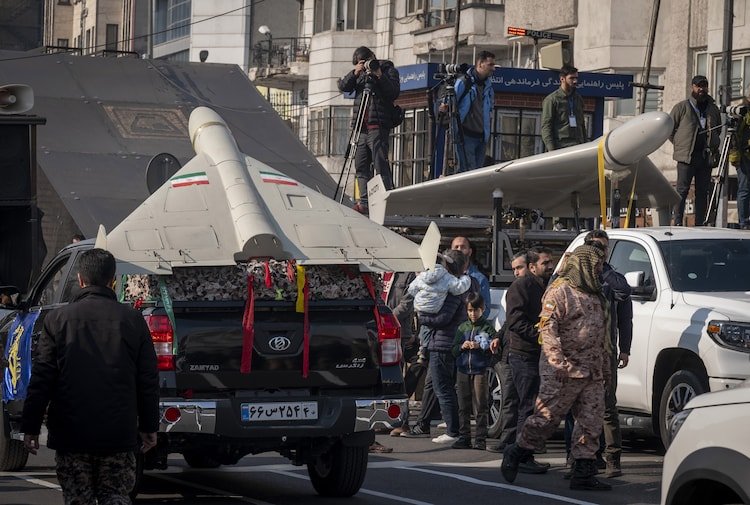
During the ongoing conflicts across the Middle East and earlier in Eastern Europe, one weapon has stood out not just for its impact—but for its unmistakable sound: the Iranian Shahed-136 drone. Often described as sounding like a “moped” or “lawnmower,” this low-cost loitering munition has become a defining feature of modern Drone Warfare.
The nickname first emerged in Ukraine around 2022, when civilians and soldiers began hearing a strange buzzing noise overhead. Many in Kyiv compared it to the sound of a scooter engine or a small generator. As these drones became more frequent, Western media quickly adopted the term “flying mopeds” to describe the incoming threats.
These drones, later identified as the Shahed-136, were supplied to Russia and used extensively in the Russia-Ukraine War. Defence expert Sandeep Unnithan notes that the platform itself has existed for over a decade, but its widespread combat use brought global attention to its design and capabilities.
Today, the same drones are actively used by Iran in its regional conflicts. From Ukraine to the Middle East, the battlefield may have changed—but the sound remains the same.
But what exactly causes this unusual noise? Why don’t these drones sound like jets or advanced UAVs? And are they really powered by moped engines, as many believe?
HOW IRAN USES SHADED DRONES IN MODERN WARFARE
The Shahed-136 has become one of Iran’s primary tools in asymmetric warfare. Designed for cost efficiency and mass deployment, these drones are used in swarm attacks to overwhelm sophisticated air defense systems.
In recent conflicts, Iran reportedly launched large numbers of Shahed drones targeting military bases, ports, and infrastructure across the Gulf region. Their primary advantage lies in numbers—while many are intercepted, a few can penetrate defenses and strike targets.
Compared to expensive missiles, these drones are significantly cheaper, making them ideal for attritional warfare. Even advanced systems like Patriot and THAAD can be strained when facing large swarms of low-cost drones.
Ukraine saw a similar pattern. By 2024, the Shahed-131 and Shahed-136 had become a central part of Russia’s long-range strike strategy. Their frequent use and distinctive sound made them instantly recognizable.

WHY IRAN DEVELOPED THE SHADED-136 DRONE
The Shahed-136 is a “loitering munition,” meaning it can hover or circle a target area before diving in to strike. This makes it highly effective for targeting air defense systems, radar installations, and strategic infrastructure.
Its primary role is often described as SEAD (Suppression of Enemy Air Defences). By overwhelming radar systems and forcing defenders to react, these drones create openings for other attacks.
The origins of the Shahed-136 trace back to Cold War-era technology. According to experts, its design is influenced by the German DAR (Drohne Anti-Radar), developed by Dornier in the 1980s. That system was intended to detect and destroy radar installations—a concept that continues in modern loitering drones.
Iran adapted and simplified this concept, focusing on affordability and scalability. Instead of building highly advanced drones, it prioritized mass production and operational efficiency.
This approach allowed Iran to bypass technological limitations caused by Sanctions while still maintaining a viable strike capability.
KEY DESIGN FEATURES OF SHADED-136
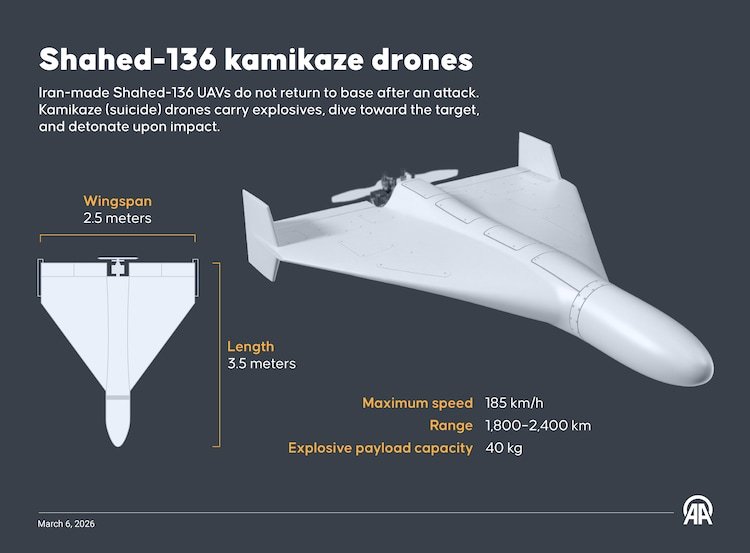
| Feature | Description | Impact on Performance |
|---|---|---|
| Engine Type | Small piston engine (similar to model aircraft engines) | Produces loud buzzing sound |
| Propeller Design | Rear-mounted (pusher configuration) | Amplifies noise and vibration |
| Structure | Lightweight fiberglass and composite materials | Cheap and easy to mass-produce |
| Speed | Approx. 185 km/h | Slow but effective in swarms |
| Purpose | Loitering munition (kamikaze drone) | Ideal for saturation attacks |
WHY SHADED-136 DRONES SOUND LIKE MOPEDS
The distinctive “moped-like” sound of the Shahed-136 is primarily due to its engine and propeller combination.
Unlike modern military drones that use jet engines or electric propulsion systems, the Shahed-136 relies on a small gasoline-powered piston engine. This type of engine produces a rough, repetitive buzzing noise, similar to that of a lawnmower or scooter.
Experts believe the engine is derived from designs similar to the Limbach L550E, a small aircraft engine used in civilian aviation. Reports also link it to the Iranian Mado MD-550 engine, which shares similar characteristics.
These engines are not designed for stealth. Instead, they are chosen for their simplicity, reliability, and low cost.
Additionally, the drone uses a rear-mounted propeller, which further amplifies the sound. As the propeller pushes air backward, it creates a continuous droning noise that becomes particularly noticeable at night.
Unlike jet-powered drones that produce a smooth “whoosh,” the Shahed-136 emits a mechanical, sputtering hum due to its combustion process. This is why people often describe it as sounding like a generator or motorbike.
Interestingly, this sound has both advantages and disadvantages. While it makes the drone easier to detect, it also creates psychological pressure. Civilians and soldiers often hear the drone before they see it, increasing fear and anticipation.
THE STRATEGIC TRADE-OFF: COST VS STEALTH
The Shahed-136 is not built to be invisible—it is built to be effective at scale. Its loud sound is a direct result of this design philosophy.
Iran’s strategy focuses on deploying large numbers of inexpensive drones rather than relying on a few advanced, costly systems. This allows it to challenge even technologically superior adversaries.
In many ways, this is why the Shahed-136 is often called the “AK-47 of drones.” Like the iconic rifle, it is simple, reliable, and widely used.
Despite its limitations, the drone has proven to be a powerful tool in modern warfare. Its ability to overwhelm defenses, combined with its low production cost, makes it a key component of Iran’s military strategy.
Ultimately, the “moped sound” is not a flaw—it is a signature of its design. It reflects a deliberate choice: prioritize affordability and mass deployment over stealth and sophistication.
And that is precisely what makes the Shahed-136 one of the most talked-about weapons in today’s conflicts.
For breaking news and live news updates, like us on Facebook or follow us on Twitter and Instagram. Read more on Latest World on thefoxdaily.com.






COMMENTS 0