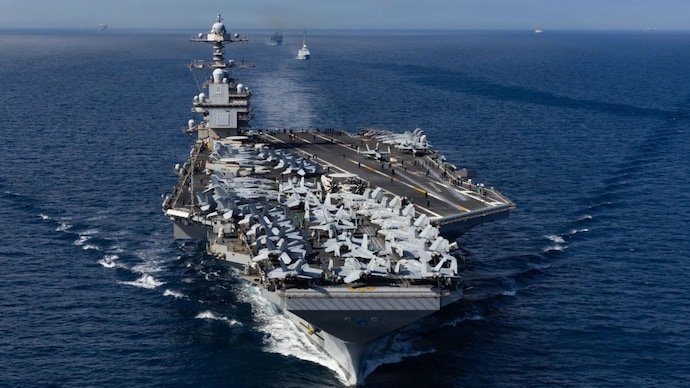
Rising tensions between the United States and Iran have triggered renewed global concern, with senior officials and strategic analysts warning that a major armed confrontation could erupt within days or weeks. According to a detailed report by Axios, despite ongoing diplomatic negotiations, the possibility of military escalation is no longer remote but increasingly plausible.
Drawing on multiple high-level sources, the report suggests that Washington’s patience with Tehran is wearing thin. The geopolitical atmosphere has grown more volatile following recent nuclear discussions in Geneva, even as both sides publicly maintain that dialogue remains open.
Amos Yadlin, former head of Israeli Military Intelligence, underscored the gravity of the situation in remarks quoted by the publication. Speaking to Israel’s Channel 12, Yadlin admitted that while he recently felt comfortable traveling abroad, he is now reconsidering such plans amid growing uncertainty.
“A superpower does not go to war in a matter of days,” Yadlin observed, adding that although the United States and Iran are closer to confrontation than before, diplomatic channels must still be exhausted. His assessment reflects a broader understanding within Israel’s security establishment that while military readiness is crucial, diplomacy remains strategically significant.
However, Yadlin also acknowledged divisions within Washington. While “many oppose the attack” and the Pentagon reportedly lacks clarity regarding the precise objectives of potential strikes, the US president appears firm in his posture. The assertion that “all options are on the table” is reportedly backed by credible military preparations, including deployments off Iran’s coast and heightened aerial activity.
US officials cited in the Axios report suggest that any potential operation would not resemble a short-lived or symbolic show of force. Instead, it would likely unfold as a sustained campaign lasting several weeks, targeting key Iranian infrastructure and strategic assets.
A White House official was quoted as estimating a 90 percent likelihood of kinetic action in the coming weeks. A senior aide reportedly stated that President Donald Trump is “getting fed up,” signaling mounting frustration over stalled negotiations and perceived Iranian defiance. According to the adviser, although some within the administration caution against entering another Middle Eastern conflict, the momentum toward military action is building.
The anticipated operation, according to the report, would likely be coordinated closely with Israel. It could also exceed the scale of last year’s 12-day Israeli-led bombing campaign against Iranian-linked targets. The scope and duration of any joint campaign would depend on strategic objectives, Iranian retaliation, and regional dynamics.
Israeli officials have also signaled preparations for potential conflict. Two sources cited in the report indicated that Israel is planning for hostilities that could begin “within days.” Strategic discussions reportedly include contingency plans that might directly challenge Iran’s current leadership structure.
Boaz Bismuth, a Likud Member of Parliament and chair of the Knesset’s Foreign Affairs and Defense Committee, acknowledged the growing anxiety within Israel. He stated that Israel is facing “challenging days,” reflecting both public apprehension and governmental readiness.
“Every Israeli citizen asks themselves multiple times a day, ‘When will the Iran conflict happen?’” Bismuth remarked, emphasizing that both the public and state institutions are preparing for multiple scenarios ranging from limited strikes to broader regional escalation.
Communications and Incident in Tehran Province
Amid heightened tensions, a fire broke out Wednesday in Parand, located in Tehran province. Iran’s state broadcaster IRIB reported that thick smoke billowed into the sky, prompting speculation across social media platforms.
Videos circulating online showed a large, dark plume rising over the region. However, Iranian authorities moved swiftly to clarify the situation. There were no immediate reports of serious damage or casualties.
The Parand Fire Department, later quoted by state media, attributed the smoke to reeds burning along a riverside area. Firefighting units were dispatched promptly, and containment operations were initiated to prevent further spread. While officials described the incident as accidental, its timing intensified public concern amid broader geopolitical developments.
Diplomatic Efforts Continue Despite Escalating Rhetoric
Despite the mounting rhetoric and military mobilization, diplomatic efforts between Washington and Tehran are ongoing. Following Tuesday’s talks in Geneva, Iranian officials stated that both sides had agreed on certain “guiding principles” intended to reduce the risk of conflict.
US Vice President JD Vance acknowledged progress in some areas but emphasized that critical disagreements remain unresolved. In an interview with Fox News, he said that Tehran has not yet accepted Washington’s defined red lines. “In some respects, the talks have gone well,” Vance noted, “but it is clear that the president has set certain red lines that Iran has not fully acknowledged or agreed to address.”
US Energy Secretary Chris Wright reinforced Washington’s position during discussions linked to the International Atomic Energy Agency in Paris. He stressed that preventing Iran from obtaining nuclear weapons remains a non-negotiable objective.
“What Iran would do with nuclear weapons has been made very obvious. It is completely unacceptable,” Wright stated. “One way or another, we will end or deter Iran’s march toward a nuclear weapon.” His remarks underscore the administration’s firm stance on nuclear non-proliferation and regional security.
Middle East Sees Increased US Military Presence
Open-source flight tracking data has revealed a noticeable increase in US military aircraft deployments toward the Middle East. Fighter jets including F-22s, F-35s, and F-16s have reportedly been observed transiting to the region, accompanied by aerial refueling tankers — a logistical sign often associated with sustained operational readiness.
On the Iranian side, the Revolutionary Guards have initiated maneuvers in the strategically vital Strait of Hormuz, a chokepoint through which a significant portion of the world’s oil supply passes. Iranian media have also reported planned joint naval exercises between Tehran and Russia in the northern Indian Ocean and the Sea of Oman.
The rapid military buildup on both sides has intensified fears that the region may be approaching a broader confrontation with potentially far-reaching geopolitical and economic consequences. Energy markets, global shipping routes, and regional alliances could all be affected should tensions spiral into open warfare.
As diplomatic engagement continues alongside military preparedness, the coming weeks are likely to prove decisive. The international community watches closely, aware that any miscalculation could transform a tense standoff into a prolonged and destabilizing conflict.
For breaking news and live news updates, like us on Facebook or follow us on Twitter and Instagram. Read more on Latest World on thefoxdaily.com.






COMMENTS 0