Trump’s 48-Hour Warning to Iran Over Hormuz Blockade: Escalation Risks & What...
Trump’s 48-Hour Warning to Iran Over Hormuz Blockade: Escalation Risks & What Happens Next
As tensions peak in the Gulf, Trump issues a stark ultimatum to reopen the Strait of Hormuz, while Iran rejects US demands and insists on “fair and lasting” terms for any negotiation
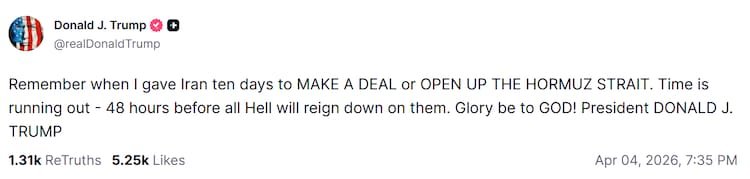
US President Donald Trump has issued a dramatic 48-hour ultimatum to Iran, warning that “all hell will rain down” if Tehran does not comply with his demand to reopen the Strait of Hormuz. The warning, delivered via Truth Social, marks a sharp escalation in rhetoric as the conflict between the United States and Iran enters a critical phase with global implications.
The Strait of Hormuz-one of the world’s most vital energy chokepoints-has remained disrupted amid the ongoing conflict, threatening global oil supply chains and raising fears of a wider economic fallout. Trump’s warning comes just days after he extended an earlier deadline by 10 days, setting April 6 as the final cutoff for Iran to act.
At the same time, diplomatic efforts led by Pakistan continue in the background, with Iran maintaining that it has not refused talks but will only engage in negotiations that ensure a “conclusive and lasting” end to what it calls an “illegal war.” The situation, therefore, presents a volatile mix of military threats, shifting political positions, and fragile diplomacy.
Trump’s Ultimatum: A High-Stakes Warning
Trump’s latest statement reflects both urgency and pressure. His message was blunt and characteristically dramatic:
“Time is running out – 48 hours before all Hell will rain down on them.”
Donald Trump’s fresh warning to Iran
This warning follows a pattern of escalating rhetoric from the US administration. Initially expressing optimism about ongoing negotiations, Trump extended the deadline for Iran to reopen the Strait. However, the tone has since shifted toward a more confrontational stance, suggesting dwindling patience in Washington.
The ultimatum is not just about reopening a maritime route-it is about asserting strategic control and signaling resolve. In geopolitical terms, such warnings are often designed as much for deterrence as for action.
Why the Strait of Hormuz Matters So Much
The Strait of Hormuz is not just another shipping lane-it is the lifeline of Global energy markets. Roughly a significant portion of the world’s oil supply passes through this narrow waterway connecting the Persian Gulf to international waters.
Any disruption here has immediate consequences:
Global oil prices can spike within hours
Energy-importing nations face supply uncertainty
Shipping and insurance costs surge dramatically
Markets react with volatility across sectors
In simple terms, blocking Hormuz is like shutting down a major highway during peak traffic-except the “traffic” here fuels entire economies. That’s why Trump’s focus on reopening the Strait is both strategic and economic.
Operation Epic Fury and Shifting US Objectives
The current conflict traces back to February 28, when Trump launched “Operation Epic Fury” alongside Israel. The initial objectives were ambitious: dismantle Iran’s missile capabilities, weaken its naval strength, and eliminate any pathway to nuclear weapons.
However, more than a month into the conflict, those goals appear to have shifted multiple times. Trump has alternated between expanding and narrowing the mission’s scope, sometimes within days.
This inconsistency has raised questions among analysts about the clarity of US strategy. For instance:
At one point, Trump stated the war had “nothing to do with oil”
Later, he suggested the US should “take the oil & make a fortune”
He has both hinted at deploying ground troops and ruled it out
He has declared the war nearly over, then warned of prolonged escalation
Such shifting narratives can complicate diplomatic efforts, as adversaries and allies alike struggle to interpret long-term intentions.
Military Build-Up and Regional Tensions
The United States has already deployed around 50,000 troops across the Middle East, signaling a significant military commitment. This buildup serves multiple purposes:
Deterrence against further Iranian actions
Preparation for potential escalation
Reassurance to regional allies
However, a large military presence also increases the risk of miscalculation. In conflict zones, even minor incidents can escalate rapidly when tensions are high and forces are on alert.
Iran, for its part, has demonstrated its ability to respond asymmetrically-targeting infrastructure, disrupting shipping routes, and leveraging regional alliances.
Iran’s Response: Rejecting “Unrealistic” Demands
Tehran has dismissed Trump’s proposals as “unrealistic, illogical, and excessive.” Iranian officials argue that the US “15-point plan for de-escalation” effectively demands complete capitulation rather than mutual compromise.
This stance aligns with Iran’s broader messaging strategy: it is willing to negotiate, but not under pressure or unequal conditions.
“What we care about are the terms of a conclusive and lasting end to the illegal war imposed on us.”
This emphasis on terms highlights a key sticking point in negotiations. While the US may be seeking immediate actions like reopening Hormuz, Iran appears focused on securing broader guarantees related to sovereignty and security.
Pakistan’s Mediation Efforts: Quiet but Crucial
Amid rising tensions, Pakistan has stepped in as a mediator, attempting to bridge the gap between Washington and Tehran. According to officials, back-channel communications have taken place, with messages exchanged between the two sides.
However, progress has been uneven. Reports suggest that while some movement has occurred, the lack of a clear signal from Iran has slowed momentum.
Interestingly, Pakistan-and reportedly china-have both encouraged Iran to engage in dialogue. This reflects a broader international concern about the potential consequences of prolonged conflict in the region.
Diplomatic mediation in such scenarios often operates behind the scenes. What appears as inactivity in public may actually be intense negotiation in private.
Analysis: Is the 48-Hour Deadline Real or Strategic?
Trump’s 48-hour warning raises an important question: is this a firm deadline or a strategic pressure tactic?
Historically, such ultimatums serve multiple purposes:
ضغط الخصم (pressure the opponent) into concessions
Signal resolve to domestic and international audiences
Create urgency in stalled negotiations
However, deadlines in Geopolitics are often flexible. Trump himself has already extended the timeline once, which suggests that the current ultimatum could also be subject to change depending on developments.
That said, repeated escalation of rhetoric can narrow diplomatic space. The more public and dramatic the warning, the harder it becomes for either side to back down without appearing weak.
Contradictions in Messaging: A Strategic Risk?
One of the defining features of this conflict has been inconsistent messaging from the US side. Trump’s statements have at times contradicted each other, particularly regarding:
The role of oil in the conflict
The duration and objectives of the war
The responsibility for reopening Hormuz
While some analysts argue that unpredictability can be a strategic advantage, others warn that it can undermine credibility and complicate alliances.
In diplomacy, clarity often strengthens negotiating positions. Mixed signals, on the other hand, can create confusion and reduce trust.
Global Implications: Beyond the US and Iran
The stakes of this conflict extend far beyond the immediate parties involved. A prolonged disruption in the Strait of Hormuz could trigger:
Global energy crises
Economic slowdowns in major economies
Increased geopolitical polarization
Heightened military tensions in the Gulf
Countries heavily dependent on oil imports are particularly vulnerable, as even short-term disruptions can have long-term economic consequences.
In this sense, the conflict is not just a bilateral issue-it is a global concern.
Key Developments at a Glance
Aspect
Details
Deadline
48-hour ultimatum issued by Trump
Previous Extension
Deadline extended to April 6
US Troops in Region
Approximately 50,000 deployed
Iran’s Position
Rejects US demands as “unrealistic”
Mediation
Pakistan facilitating talks
What Happens Next?
The next 48 hours could prove निर्णायक (decisive). Several scenarios are possible:
Iran partially complies, reopening Hormuz to ease tensions
Back-channel diplomacy leads to a temporary compromise
The US escalates military action targeting infrastructure
The deadline is extended again, buying more time for talks
Each scenario carries its own risks and implications. The most likely outcome may not be immediate resolution, but continued negotiation under pressure.
Conclusion: A Tense Countdown with Uncertain Outcomes
Trump’s warning has added a new layer of urgency to an already volatile situation. While the rhetoric suggests imminent escalation, the underlying reality remains complex, shaped by competing interests, strategic calculations, and ongoing diplomatic efforts.
Iran’s refusal to accept what it sees as one-sided demands, combined with the US push for immediate action, creates a challenging environment for negotiations.
As the deadline approaches, the world watches closely-not just for what happens next, but for what it means for global stability.
Because when it comes to the Strait of Hormuz, even a small disruption can send shockwaves far beyond the Gulf-and in geopolitics, those shockwaves rarely stay contained.
Ashish Kumar is the creative mind behind The Fox Daily, where technology, innovation, and storytelling meet. A passionate developer and web strategist, Ashish began exploring the web when blogs were hand-coded, and CSS hacks were a rite of passage. Over the years, he has evolved into a full-stack thinker—crafting themes, optimizing WordPress experiences, and building platforms that blend utility with design.
With a strong footing in both front-end flair and back-end logic, Ashish enjoys diving into complex problems—from custom plugin development to AI-enhanced content experiences. He is currently focused on building a modern digital media ecosystem through The Fox Daily, a platform dedicated to tech trends, digital culture, and web innovation.
Ashish refuses to stick to the mainstream—often found experimenting with emerging technologies, building in-house tools, and spotlighting underrepresented tech niches. Whether it's creating a smarter search experience or integrating push notifications from scratch, Ashish builds not just for today, but for the evolving web of tomorrow.







COMMENTS 0