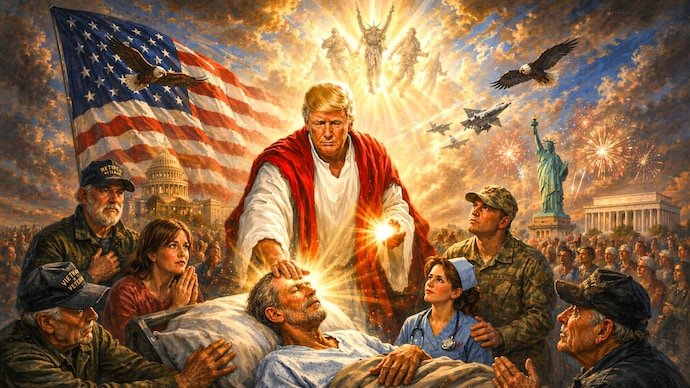
US President Donald Trump sparked fresh Controversy after posting an AI-generated image portraying himself as a Jesus Christ-like figure on Social Media. The post came shortly after a public disagreement with Pope Leo XIV, escalating tensions between political and religious leadership. The incident unfolded on Sunday night, as Trump traveled back to Washington from Florida, where he openly criticized the Pope’s views on global conflicts, particularly the ongoing tensions involving Iran. The move appears to be both a political statement and a personal rebuttal, raising questions about leadership, symbolism, and the intersection of religion and Politics.
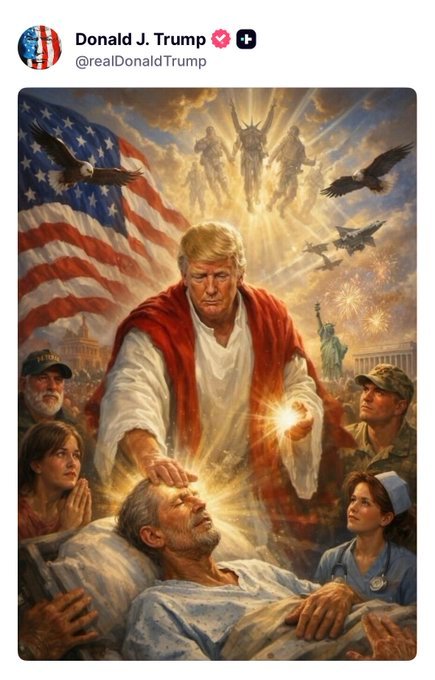
Trump’s AI Image: Symbolism and Controversy
The image shared by Trump depicted him in flowing robes, surrounded by radiant light, and seemingly performing a healing act on another individual. Figures resembling angels or soldiers stood beside him, adding to the religious symbolism. The portrayal quickly drew attention online, with reactions ranging from amusement to criticism.
While Trump has previously used provocative imagery and messaging to communicate with his supporters, this particular depiction stood out due to its strong religious undertones. Critics argued that such imagery could be seen as inappropriate or offensive, especially given the sacred nature of the symbolism. Supporters, however, viewed it as a bold and satirical expression of confidence and leadership.
Why the Image Matters
The use of AI-generated religious imagery in political discourse highlights a growing trend where technology, media, and leadership intersect. It also raises broader questions about the role of symbolism in shaping public perception. In this case, the image was not just a visual—it became a statement within an ongoing ideological Conflict.
The Feud Between Trump and Pope Leo XIV
The controversy did not arise in isolation. It followed a series of pointed remarks exchanged between Trump and Pope Leo XIV regarding global conflicts and political responsibility.
Trump openly criticized the Pope, calling him “weak” and “very liberal,” and expressing dissatisfaction with his views on international issues. Speaking to reporters, Trump stated:
“I’m not a fan. I think he’s been terrible for foreign policy.”
The President’s criticism centered on what he perceived as the Pope’s lenient stance on major geopolitical threats, including nuclear concerns involving Iran.
Pope Leo XIV’s Position on War
Pope Leo XIV has consistently advocated for peace and Diplomacy. During a recent prayer service at St Peter’s Basilica, he warned against what he described as a “delusion of omnipotence” driving global conflicts. Although he did not directly name Trump, his remarks were widely interpreted as a critique of aggressive political strategies.
“God does not listen to the prayers of those who wage war,” the Pope said, emphasizing the moral consequences of violence.
This philosophical difference—between assertive political action and moral restraint—lies at the heart of the dispute.
Key Points of Disagreement
| Issue | Trump’s View | Pope Leo XIV’s View |
|---|---|---|
| Iran Nuclear Policy | Strong opposition, advocates strict control | Calls for diplomacy and caution |
| Global Conflicts | Supports assertive intervention | Promotes peace and dialogue |
| US Foreign Policy | Defends past actions, including Venezuela | Critical of aggressive international actions |
| Leadership Style | Direct and confrontational | Spiritual and conciliatory |
Trump’s Broader Criticism of the Vatican
Beyond specific policy disagreements, Trump also questioned the circumstances surrounding Pope Leo XIV’s rise to leadership. He suggested that the Pope’s American identity may have played a role in his elevation, framing it as a politically influenced decision.
In a social media post, Trump wrote that without his presidency, Leo would not have ascended to the Vatican’s top position. He further urged the Pope to “stop catering to the Radical Left” and focus on his religious duties.
Such statements marked a significant departure from traditional diplomatic language typically used between political leaders and religious institutions.
Reference to Venezuela
Trump also brought up past US actions in Venezuela, defending his administration’s stance against President Nicolas Maduro. He accused the Pope of opposing American interests, reinforcing his argument that Leo’s positions were misaligned with global security priorities.
The Role of Religion in Political Messaging
The incident highlights the complex relationship between religion and politics, especially in an era dominated by digital communication. Leaders increasingly use visual content, including AI-generated images, to convey messages quickly and impactfully.
However, blending religious symbolism with political messaging carries risks. It can deepen divisions, provoke strong emotional reactions, and shift focus away from substantive policy discussions.
AI and Political Communication
The use of Artificial Intelligence in creating such imagery adds another layer to the conversation. AI Tools enable rapid content creation, allowing public figures to experiment with messaging in ways that were previously difficult or time-consuming.
While this opens new avenues for engagement, it also raises ethical concerns about authenticity, intent, and potential misuse.
Public Reaction and Media Coverage
The response to Trump’s post was immediate and widespread. Social media platforms saw a surge in discussions, with users debating the appropriateness and implications of the image.
- Some users found the post humorous or symbolic of strong leadership.
- Others criticized it as disrespectful or overly self-aggrandizing.
- Political analysts viewed it as a strategic move to dominate media narratives.
Mainstream media outlets also covered the story extensively, focusing on both the image and the underlying conflict with the Pope.
Analysis: Strategy or Spontaneity?
Trump’s actions often blur the line between calculated strategy and spontaneous expression. Sharing such a provocative image could serve multiple purposes:
- Shifting attention from policy criticism to cultural debate
- Reinforcing his image as a strong and unconventional leader
- Mobilizing his support base through bold and controversial messaging
At the same time, the move risks alienating moderate audiences and drawing criticism from religious communities.
The Bigger Picture
This episode reflects a broader trend in modern politics where communication is increasingly visual, immediate, and emotionally charged. Leaders are no longer just policymakers—they are also content creators navigating a highly competitive media environment.
Conclusion
The clash between Donald Trump and Pope Leo XIV underscores a deeper divide between political assertiveness and moral diplomacy. Trump’s decision to share an AI-generated image portraying himself as a Christ-like figure added a dramatic and controversial dimension to the dispute, capturing global attention.
While the immediate impact has been heightened media coverage and public debate, the long-term implications remain uncertain. The incident raises important questions about the use of symbolism, the role of technology in political communication, and the boundaries between leadership and personal expression.
Looking ahead, as AI tools become more integrated into public discourse, such moments may become more frequent. The challenge for leaders and audiences will be to navigate this evolving landscape with clarity, responsibility, and a focus on meaningful dialogue rather than spectacle.
For breaking news and live news updates, like us on Facebook or follow us on Twitter and Instagram. Read more on Latest World on thefoxdaily.com.



COMMENTS 0