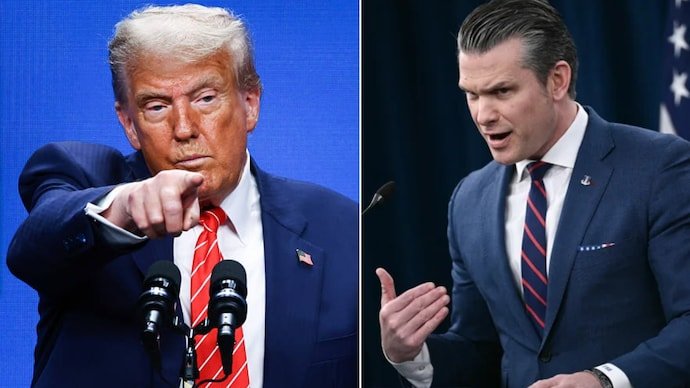
With the Iran war now entering its fourth week, scrutiny is growing over how and why the United States chose to engage militarily. In response, President Donald Trump has begun reshaping the narrative—this time suggesting that Defense Secretary Pete Hegseth played a leading role in initiating the conflict.
Speaking at a roundtable event in Tennessee, Trump publicly credited Hegseth as one of the earliest advocates for military action. “Pete, I believe you were the first to speak up, and you said, ‘Let’s do it because you can’t let them have a nuclear weapon,’” Trump stated, with Hegseth standing beside him.
This statement adds another layer to an already evolving and often inconsistent account of how the Trump administration arrived at the decision to go to war with Iran.
A Shifting Narrative Around the Origins of the War
One of the most striking aspects of the Iran conflict is the lack of a consistent explanation from within the US administration. Different officials have offered varying reasons for military intervention, making it difficult to establish a clear and unified rationale.
Some within the administration argue that US involvement was unavoidable, especially given Israel’s readiness to act against Iran. Others have claimed that Iran was on the verge of deploying a nuclear weapon, necessitating immediate action.
Trump himself has provided a more informal and anecdotal version of events. He described making a series of calls to key figures, including Pete Hegseth and General Kane, framing the decision as a choice between inaction and resolving a major geopolitical crisis.
However, this casual portrayal contrasts sharply with the gravity of launching a large-scale military operation, raising further questions about the clarity and structure of the decision-making process.
Conflicting Reasons Behind the War
| Claim | Explanation Given | Source Within Administration |
|---|---|---|
| Prevent Nuclear Threat | Iran was close to developing or using nuclear weapons | Trump, Defense Officials |
| Support Israel | US acted because Israel was preparing to strike | Senior Officials |
| Strategic Necessity | Needed to address broader Middle East instability | Various Advisors |
Contradictions Over Iran’s Retaliation
The confusion surrounding the war’s origins is matched by conflicting accounts of its aftermath. Just hours before crediting Hegseth, Trump claimed that Iran’s retaliatory strikes across the Gulf caught the administration off guard.
“Observe how they unexpectedly attacked all those countries. No one was even considering it,” Trump remarked.
However, this assertion appears to contradict reports indicating that US intelligence agencies had already warned about the likelihood of Iranian retaliation. According to these reports, such warnings may not have been fully acted upon.
These discrepancies further complicate the administration’s narrative and raise concerns about preparedness and strategic planning.
Pete Hegseth Emerges as the Face of the War Effort
Amid the shifting narratives, Defense Secretary Pete Hegseth has become a central figure in the war effort. At the Pentagon, he has taken a prominent role in outlining military objectives and defending the administration’s strategy.
Hegseth has emphasized goals such as dismantling Iran’s missile systems, disrupting drone production capabilities, and weakening its naval forces. These objectives signal a broad and aggressive military approach.
He has also been vocal in criticizing media coverage of the conflict, urging for more supportive reporting of a campaign that has already resulted in significant casualties, including the deaths of thirteen American service members.
Despite his visibility, Hegseth has remained cautious about timelines, stating that the mission is “on track” but declining to provide a clear endpoint for the operation.
| Military Objective | Description |
|---|---|
| Missile Program | Neutralize Iran’s ballistic missile capabilities |
| Drone Production | Disrupt manufacturing and deployment systems |
| Naval Strength | Limit Iran’s influence in regional waters |
Internal Divisions Within the Administration
While Trump has publicly supported the war effort, not all members of his administration appear to share the same level of enthusiasm. Vice President JD Vance, for instance, has been notably restrained in his public comments regarding the conflict.
Reports suggest that internal debates were intense, with some influential figures advocating for military action while others urged caution. Among those reportedly pushing for intervention were media mogul Rupert Murdoch and Israeli Prime Minister Benjamin Netanyahu.
The tensions have already led to fallout within the administration. Joe Kent, former head of the National counterterrorism Center, became the first senior official to step down amid the controversy surrounding the war.
Uncertain Diplomacy and Denied Negotiations
Even as military operations continue, Trump has hinted at the possibility of diplomatic talks with Iran. He has expressed a willingness to negotiate an agreement aimed at ending hostilities and reopening the Strait of Hormuz.
“We’d like to make a deal,” Trump stated, while also warning that military action would continue if negotiations failed.
He referenced potential discussions involving a senior Iranian figure, alongside key US representatives such as Jared Kushner and envoy Steve Witkoff.
However, Iranian officials have firmly denied that any such negotiations are taking place, adding another layer of uncertainty to an already complex situation.
Deadlines Shift as Uncertainty Grows
Initially, Trump had set a strict deadline for Iran to comply with US demands or face intensified military strikes. That deadline has now been extended by five days, signaling a possible window for diplomatic engagement—or continued indecision.
The evolving timeline reflects the broader uncertainty surrounding the conflict. With changing explanations, disputed claims, and unclear negotiations, the narrative of the Iran war continues to shift rapidly.
What remains constant, however, is the lack of clarity—about how the war began, how it will unfold, and ultimately, who bears responsibility for one of the most significant geopolitical decisions in recent history.
For breaking news and live news updates, like us on Facebook or follow us on Twitter and Instagram. Read more on Latest World on thefoxdaily.com.




COMMENTS 0