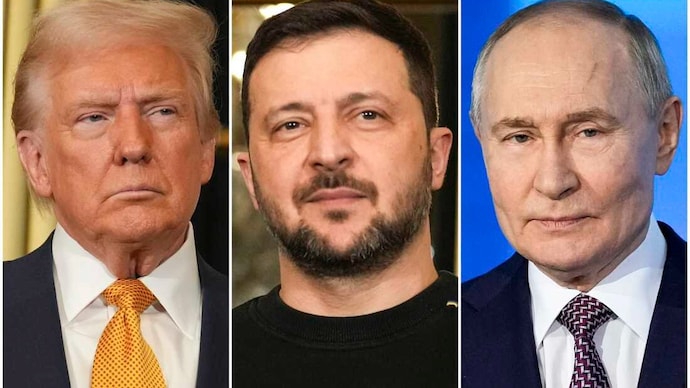
US President Presses for Swift Agreement Despite Intensifying Frontline Fighting
As diplomatic channels reopen between Washington, Moscow, and Kyiv, US President Donald Trump is signaling impatience. Even as preparations move forward for another round of US-led negotiations in Geneva next week, Trump has publicly urged Ukrainian President Volodymyr Zelenskyy to accelerate efforts toward a settlement with Russia.
“Zelenskyy needs to move quickly because Russia wants to make a deal, or else he will lose out on a fantastic opportunity,” Trump told reporters on Friday. “He needs to get up.”
The remarks come at a sensitive moment. While diplomacy is being revived, combat continues to intensify along Ukraine’s extensive front lines. The renewed talks are seen by Washington as a potential opening, yet the battlefield reality underscores the complexity of reaching a durable agreement.
Resumption of Talks in Geneva
Officials confirmed that negotiations are scheduled for Tuesday and Wednesday in Geneva. Dmytro Lytvyn, communications adviser to Zelenskyy, acknowledged that Ukrainian representatives would participate in the discussions.
The Geneva meetings follow earlier US-facilitated talks in Abu Dhabi that failed to resolve fundamental disagreements. Chief among them is the status of Ukraine’s Donbas region, significant portions of which remain under Russian control. Territorial sovereignty, security guarantees, and reconstruction commitments remain central sticking points.
Russia’s delegation will once again be led by presidential adviser Vladimir Medinsky, a key figure in previous negotiation rounds. On the Ukrainian side, Rustem Umerov, head of the National Security and Defense Council, is expected to lead Kyiv’s team.
It remains unclear which American officials will attend the Geneva session. US envoys Steve Witkoff and Jared Kushner participated in earlier discussions, signaling Washington’s continued direct involvement in the mediation process.
Mounting Political Pressure and Diplomatic Deadlines
Trump’s comments reflect broader political pressure surrounding the stalled peace efforts. While he has occasionally voiced frustration with Russian President Vladimir putin, the former president has more frequently criticized Zelenskyy, suggesting Kyiv may be slowing progress toward a negotiated settlement.
According to Zelenskyy, the United States has set a June deadline for reaching an agreement. However, past deadlines announced by Trump have elapsed without producing tangible breakthroughs, raising questions about whether the current timeline will hold.
Meanwhile, Zelenskyy attended the Munich Security Conference, where he met with German officials and visited a Ukrainian-German drone manufacturing facility. Germany remains one of Ukraine’s principal military and financial backers, reinforcing Kyiv’s international support network even as diplomatic talks resume.
NATO Secretary-General Mark Rutte downplayed perceptions of rapid Russian battlefield gains. “This so-called Russian bear is not there,” Rutte was quoted as saying. “It is still essentially as fast as a garden snail.” His remarks highlight ongoing debate among Western officials about the true pace and sustainability of Moscow’s advances.
Territorial Realities and the Cost of War
Since hostilities first erupted in 2014 — and especially following Russia’s full-scale invasion in February 2022 — Moscow has come to control roughly 20% of Ukrainian territory. While Russian forces have achieved incremental advances, military analysts widely note that these gains have been costly and slow.
For negotiators, the core challenge lies in reconciling battlefield realities with political red lines. Kyiv insists on preserving sovereignty and territorial integrity, while Moscow seeks recognition of its territorial claims and security assurances. Bridging these fundamentally opposing objectives remains the central obstacle in Geneva.
War Continues Along the 1,250-Kilometer Front Line
Even as diplomatic momentum builds, the war continues unabated along the nearly 1,250-kilometer front line. Ukraine has reportedly launched near-daily long-range drone strikes deep into Russian territory, targeting military and logistical infrastructure.
At the same time, Russian forces continue bombardments of Ukrainian civilian areas and energy infrastructure. Authorities in eastern Ukraine reported that three brothers, aged 8 to 19, were killed in an overnight strike between Thursday and Friday. Additional attacks on port and energy facilities in Odesa left one person dead and six others injured.
Russia’s Defense Ministry stated that it shot down 58 Ukrainian drones overnight, including 43 over the Volgograd region. Officials there reported injuries to three individuals.
The sustained exchange of drone and missile attacks underscores the paradox confronting negotiators: peace talks are resuming even as violence escalates. Whether the Geneva discussions can meaningfully alter the trajectory of the conflict remains uncertain.
A Critical Diplomatic Juncture
The coming week’s talks may prove pivotal. For Washington, the objective is to test whether both Moscow and Kyiv are prepared to explore compromise. For Ukraine, any agreement must balance battlefield resilience with long-term national security. For Russia, negotiations offer a potential path to consolidate gains or secure broader strategic concessions.
As the diplomatic clock ticks toward the proposed June deadline, the gap between rhetoric and reality remains wide. The world will be watching Geneva closely — not only for signs of progress, but for any indication that the grinding conflict might finally move toward resolution.
For breaking news and live news updates, like us on Facebook or follow us on Twitter and Instagram. Read more on Latest World on thefoxdaily.com.





COMMENTS 0