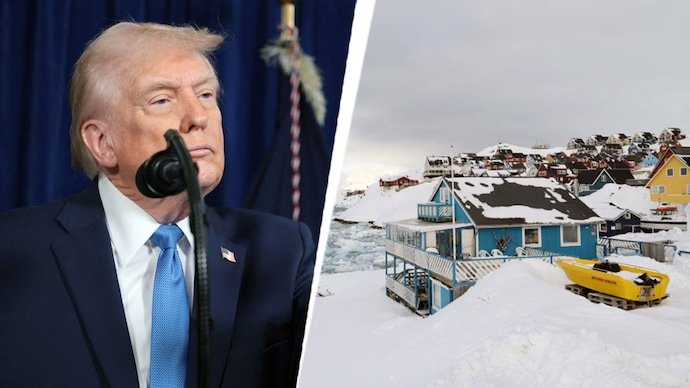
US President Donald Trump has once again placed Greenland at the centre of global debate, reviving his long-standing ambition for American control of the Arctic island. In a remark that has sparked widespread mockery and diplomatic unease, Trump dismissed Greenland’s defence capabilities as being limited to “two dog sleds,” while insisting that the United States must acquire the territory to prevent strategic rivals from gaining a foothold.
Trump, who has repeatedly argued that Greenland’s strategic location makes it vital for US national security, said Washington should purchase the territory outright rather than consider any form of leasing arrangement. He also warned that inaction could allow china or Russia to expand their military influence in the Arctic region.
Speaking to reporters aboard Air Force One on Sunday night, Trump was asked whether the United States had formally approached Denmark regarding Greenland. Greenland is currently a self-governing territory under the Kingdom of Denmark.
“I have not done that,” Trump said, according to Fox News. “Greenland should make the deal because Greenland does not want to see China or Russia take over. Basically, they have two dog sleds for defence. Do you know how they defend themselves? Two dog sleds.”
Trump went on to contrast what he described as Greenland’s limited security infrastructure with what he claimed was an expanding Chinese and Russian military presence across the Arctic. According to the US President, rival powers are increasing their naval deployments in the region.
“You have Chinese and Russian submarines and destroyers all over the place,” he said. “We’re not going to let that happen. And if it affects NATO, then it affects NATO.”
Making his position unmistakably clear, Trump rejected the idea of a temporary or conditional arrangement. “We’re not talking about leasing,” he said. “We’re talking about acquiring.” He further asserted that Greenland needs the United States more than Washington needs Greenland.
Reiterating his warning later, Trump added, “If we don’t take Greenland, Russia or China will take Greenland. And I will not allow that to happen. I’d love to make a deal with them. It’s easier. But one way or the other, we’re going to have Greenland.”
The remarks have drawn strong objections from Greenland’s political leadership. On Friday, Greenland Prime Minister Jens-Frederik Nielsen, along with leaders of four major political parties, issued a joint statement rejecting any notion of the island joining either Denmark or the United States.
“We don’t want to be Americans, we don’t want to be Danes, we want to be Greenlanders,” the statement said, underlining the island’s insistence on self-determination and political autonomy.
Despite being a long-time ally of the United States, Greenland has consistently rebuffed Trump’s proposals for US control. However, several members of his administration have echoed his belief that American oversight of the island is essential due to its strategic location between North America, Europe, and the Arctic Ocean.
Denmark has reacted with growing concern to Trump’s rhetoric. Danish Prime Minister Mette Frederiksen warned that any suggestion of annexation or military pressure could seriously undermine NATO unity. Speaking to Danish broadcaster TV2, she said, “If the United States chooses to attack another NATO country militarily, then everything stops.”
Frederiksen cautioned that such actions would threaten the very foundation of the post–World War II security framework that underpins the transatlantic alliance.
In a related development, and amid speculation about possible US military intentions, Denmark’s Defence Ministry has reaffirmed a Cold War–era directive. The policy instructs Danish forces to open fire immediately, without waiting for further orders, if any foreign power attempts to invade Danish territory, including Greenland.
As Trump’s renewed focus on Greenland fuels diplomatic tension and public ridicule, the episode highlights the growing geopolitical importance of the Arctic and the increasingly sharp competition among global powers for influence in the region.
For breaking news and live news updates, like us on Facebook or follow us on Twitter and Instagram. Read more on Latest World on thefoxdaily.com.



COMMENTS 0