- What Trump Announced and Why It Matters
- Why the Strait of Hormuz Is Critical
- Talks Collapse Over Iran’s Nuclear Programme
- US Navy’s Role: From Deterrence to Direct Action
- Trump Praises Pakistan’s Role in Mediation
- Iran Responds: Trust Deficit Remains
- Global Impact: Energy, Trade, and Security Risks
- A High-Stakes Moment in Global Politics
- Conclusion: Escalation with Uncertain Outcomes
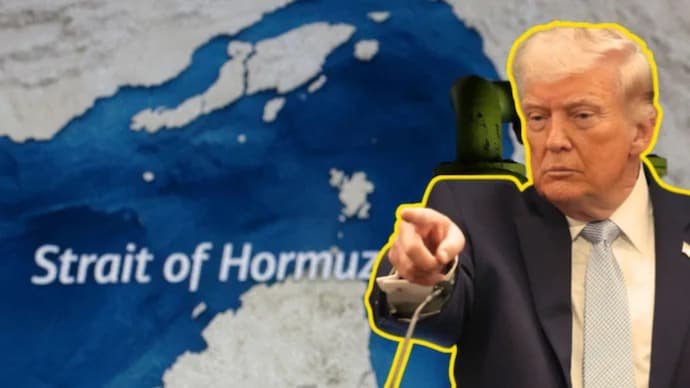
Washington/Islamabad/Tehran: US President Donald Trump on Sunday announced that the United States would begin blockading ships attempting to enter or exit the Strait of Hormuz, marking a significant escalation in tensions with Iran. The move follows the collapse of high-level US-Iran talks, where negotiations reportedly failed over Tehran’s nuclear programme. Trump also warned that vessels suspected of paying what he called “illegal tolls” to Iran would not be allowed safe passage.
What Trump Announced and Why It Matters
In a strongly worded statement, Trump declared that the US Navy would take immediate steps to control maritime movement through the Strait of Hormuz, one of the world’s most strategically vital waterways.
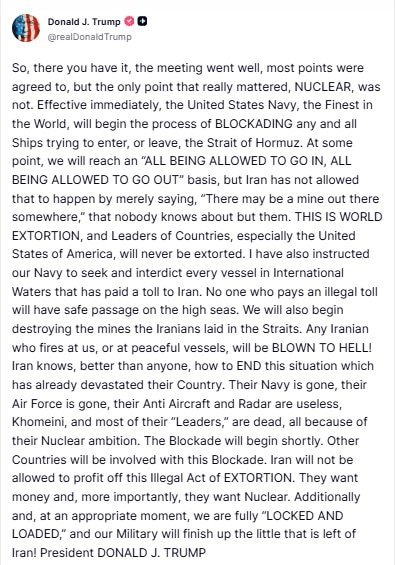
“Effective immediately, the United States Navy will begin the process of blockading any and all ships trying to enter or leave the Strait of Hormuz,” Trump said.
He accused Iran of using threatsparticularly the possibility of naval minesto intimidate commercial shipping and extract payments. According to Trump, such actions amount to “world extortion.”
The announcement signals not just a show of force but a potential shift toward direct maritime enforcement, raising concerns of confrontation in a region already under strain.
Why the Strait of Hormuz Is Critical
The Strait of Hormuz is a narrow passage connecting the Persian Gulf to the Arabian Sea, and it serves as a lifeline for global energy supply.
| Key Fact | Details |
|---|---|
| Global Oil Flow | ~20% passes through the Strait |
| Strategic Importance | Primary route for Middle East oil exports |
| Economic Impact | Disruption can affect global fuel prices |
Any disruption in this corridor has immediate global consequences, potentially driving up oil prices and affecting economies worldwideincluding India, which depends heavily on energy imports.
Talks Collapse Over Iran’s Nuclear Programme
The “Red Line” That Broke Negotiations
According to Trump, the marathon talks with Iranian officialsheld in Islamabad and lasting nearly 20 hoursmade progress on several fronts but ultimately failed on what he described as the most critical issue: Iran’s nuclear ambitions.
“The meeting went well, most points were agreed to, but the only point that really mattered, nuclear, was not,” Trump stated.
He reiterated his long-standing position that Iran must not develop nuclear weapons, emphasizing that continued Diplomacy without movement on this issue would not be acceptable.
The talks were facilitated by Pakistan and involved senior US officials, including Vice President JD Vance and key envoys, indicating the high stakes involved.
US Navy’s Role: From Deterrence to Direct Action
Blockade and Maritime Interdiction
Trump’s announcement goes beyond rhetoric. He outlined specific actions that the US Navy would undertake:
- Clearing suspected naval mines in the Strait
- Stopping vessels believed to be paying tolls to Iran
- Ensuring “safe passage” only for compliant ships
He warned that any vessel engaging in what he described as illegal transactions with Iran would face consequences.
“No one who pays an illegal toll will have safe passage on the high seas,” Trump said.
Strong Military Warning
The US President also issued a stark warning to Iran, stating that any attack on US forces or commercial vessels would be met with overwhelming retaliation.
“Any Iranian who fires at us, or at peaceful vessels, will be blown to hell,” he said.
Such language underscores the seriousness of the situation and the potential for rapid escalation.
Trump Praises Pakistan’s Role in Mediation
Amid rising tensions, Trump also highlighted Pakistan’s role in facilitating the talks. He praised Army Chief General Asim Munir and Prime Minister Shehbaz Sharif, calling them “extraordinary men” and crediting their leadership during the negotiations.
This endorsement aligns with Trump’s recent pattern of publicly acknowledging Pakistan’s diplomatic involvement in regional issues.
Iran Responds: Trust Deficit Remains
Tehran Blames Washington
Iran, however, presented a different narrative. Officials stated that the talks failed due to a lack of trust, accusing the United States of not making sufficient efforts to build confidence.
“The US has understood Iran’s logic and principles and it’s time for them to decide whether they can earn our trust or not,” said Iran’s Parliamentary Speaker Mohammad Baqer Qalibaf.
The Iranian delegation, led by Qalibaf and Foreign Minister Abbas Araqchi, maintained that constructive proposals were put forward but did not receive adequate response.
End of Ceasefire Momentum
The talks followed a 14-day ceasefire intended to create space for diplomacy. However, the failure to reach an agreement has now raised fears of renewed confrontation.
Notably, this was the first direct engagement between the US and Iran in over a decade, making its collapse even more significant.
Global Impact: Energy, Trade, and Security Risks
The implications of a blockade in the Strait of Hormuz extend far beyond the region.
Economic Consequences
- Potential spike in global oil prices
- Supply chain disruptions
- Increased inflationary pressure worldwide
Geopolitical Risks
- Heightened military tensions in the Gulf
- Risk of direct confrontation between US and Iran
- Impact on global trade routes
For countries like India, which rely heavily on Middle Eastern oil, any prolonged disruption could have significant economic repercussions.
A High-Stakes Moment in Global Politics
Trump’s decision to initiate a blockade represents a turning point in US-Iran Relations. By moving from negotiation to enforcement, Washington is signaling a more aggressive approach.
At the same time, the situation remains fluid. Much will depend on how Iran responds and whether diplomatic channels can be reopened.
Conclusion: Escalation with Uncertain Outcomes
The announcement of a potential blockade in the Strait of Hormuz marks one of the most serious escalations in recent US-Iran tensions. With nuclear negotiations failing and military rhetoric intensifying, the risk of conflict is higher than it has been in years.
While the United States frames its actions as necessary to ensure free navigation and counter “extortion,” Iran’s response highlights a deep trust deficit that continues to hinder diplomacy.
Looking ahead, the situation will require careful navigationboth militarily and diplomatically. Any misstep could have far-reaching consequences, not just for the region, but for the Global Economy and security landscape.
For breaking news and live news updates, like us on Facebook or follow us on Twitter and Instagram. Read more on Latest World on thefoxdaily.com.





COMMENTS 0