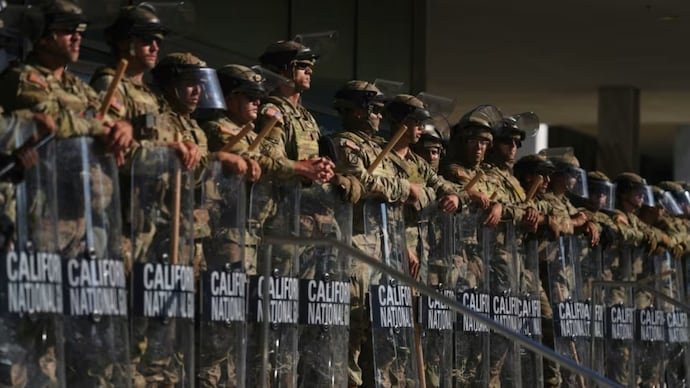
US President Donald Trump on Wednesday announced that his administration is withdrawing National Guard troops from Portland, Los Angeles, and Chicago, bringing an end to a controversial federal deployment that had sparked prolonged political and legal disputes with local authorities.
In a social media post, Trump claimed that the presence of National Guard personnel had played a decisive role in reducing crime in the three cities. However, he warned that federal forces could be redeployed swiftly if crime levels were to rise again.
“We are removing the National Guard from Chicago, Los Angeles, and Portland, despite the fact that crime has been greatly reduced by having these great Patriots in those cities, and ONLY by that fact,” Trump wrote.
He added a pointed warning: “We will come back, perhaps in a much different and stronger form, when crime begins to soar again — only a question of time!”
Ongoing Dispute Over Federal Troop Deployments
The deployment of National Guard troops to several major Democratic-led cities had been a major source of friction between the Trump administration and state and local governments. Governors and mayors in Portland, Los Angeles, and Chicago consistently argued that the federal intervention was unwarranted and driven more by political messaging than by public safety needs.
Local officials maintained that crime levels did not justify the presence of military personnel and accused the White House of inflaming tensions during a period marked by widespread but largely peaceful protests.
Democratic leaders also accused the administration of federal overreach, arguing that isolated incidents of violence were exaggerated to rationalize the use of troops. Several city administrations challenged the deployments in court, citing constitutional concerns and the limits of federal authority over local law enforcement.
President Trump, however, repeatedly defended the decision, asserting that local governments had failed to maintain Law and Order. The Republican leader argued that federal forces were necessary to protect government buildings, federal employees, and public safety, particularly amid unrest linked to protests and immigration enforcement actions.
Courts Push Back Against the Administration
The legal challenges mounted by cities led to a series of setbacks for the administration. Judges overseeing the cases frequently ruled against the federal government, finding that it had not provided sufficient evidence of an immediate threat that would justify National Guard deployments.
In several rulings, courts concluded that claims about the need to protect federal property from demonstrators were unsupported and that the administration had exceeded its legal authority.
The troop deployments began in June, initially in response to protests against Trump’s hardline immigration policies, including efforts to significantly expand deportations. As demonstrations spread to multiple cities, critics accused the administration of using military force to intimidate protesters rather than de-escalate tensions.
Trump also ordered troops into Washington, DC, citing what he described as “rampant crime” in the nation’s capital and temporarily assumed control of local law enforcement. However, contemporaneous crime data did not support claims of a dramatic surge in violence.
In recent months, mounting legal challenges placed the National Guard missions in operational and legal uncertainty. Military leaders gradually scaled back the deployments, and Wednesday’s announcement formally confirmed the withdrawal of troops from Chicago, Los Angeles, and Portland.
The move marks a significant shift in the administration’s domestic security posture, even as Trump signaled that federal intervention could return if he believes local authorities are unable to control crime.
For breaking news and live news updates, like us on Facebook or follow us on Twitter and Instagram. Read more on Latest World on thefoxdaily.com.


COMMENTS 0