- Trump’s Expanding Claim on India-Pakistan Ceasefire
- Strong Praise for Pakistan’s Leadership
- India Rejects Third-Party Mediation Claims
- The Conflict Behind the Controversy
- Iran and the Strait of Hormuz: The Larger Context
- A Blended Geopolitical Narrative
- Analysis: Diplomacy, Narrative, and Reality
- Conclusion: Claims, Contradictions, and Continuing Debate
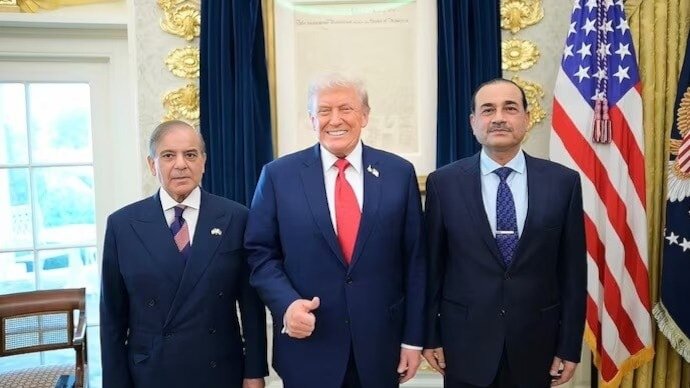
Washington/New Delhi/Islamabad: US President Donald Trump on Sunday once again stirred geopolitical debate by combining tensions in the Middle East with South Asia in a sweeping statement. Addressing issues ranging from Iran and the Strait of Hormuz to India–Pakistan relations, Trump renewed his controversial claim that he helped prevent a major conflict between the two nuclear-armed neighbors. He also offered unusually strong praise for Pakistan’s Army Chief General Asim Munir and Prime Minister Shehbaz Sharif, calling them “extraordinary men.”
Trump’s Expanding Claim on India-Pakistan Ceasefire
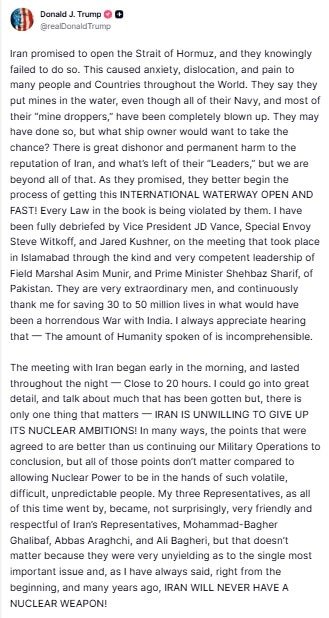
In a detailed Social Media post, Trump reiterated his long-standing assertion that his intervention prevented a potential war between India and Pakistan. According to him, the conflict could have resulted in catastrophic loss of life.
“They continuously thank me for saving 30 to 50 million lives,” Trump wrote, referring to Pakistan’s leadership. This marks a noticeable escalation from his earlier statements, where he had cited lower figures.
The claim, however, remains unverified and disputed, particularly by Indian officials.
A Pattern of Increasing Numbers
Trump’s narrative around the India-Pakistan episode has evolved over time. Earlier in the year, he mentioned a figure of around 35 million potential casualties in a hypothetical nuclear conflict. His latest statement stretches that estimate to “30 to 50 million,” continuing a pattern where the scale of the claim grows with each retelling.
This tendency to amplify figures has been observed in several of Trump’s foreign policy assertions, often drawing both attention and skepticism.
Strong Praise for Pakistan’s Leadership
From “Competent” to “Extraordinary”
In his latest remarks, Trump significantly elevated his praise for Pakistan’s top leadership. Referring to General Asim Munir and Prime Minister Shehbaz Sharif, he described them as “very extraordinary men,” highlighting what he called their “kind and very competent leadership.”
This marks one of the most emphatic endorsements Trump has made regarding Pakistan’s current leadership, signaling a tone that stands out even by his own diplomatic standards.
Such praise also reflects Trump’s broader approach to International Relations, where personal rapport with leaders often plays a central role in his public messaging.
India Rejects Third-Party Mediation Claims
India has consistently and firmly rejected Trump’s claims of external involvement in de-escalating tensions with Pakistan.
External Affairs Minister S. Jaishankar has previously clarified that the situation was resolved through direct military-level communication between the two countries.
According to the Indian government:
- No third-party mediation, including by the United States, took place
- The ceasefire understanding was achieved through established bilateral channels
- Pakistan initiated contact to ease tensions
This position highlights a clear divergence between Trump’s narrative and India’s official stance.
The Conflict Behind the Controversy
The tensions referenced in Trump’s statement trace back to a deadly terror attack in Pahalgam on April 22, which claimed 26 lives. The incident triggered a sharp escalation between India and Pakistan.
Operation Sindoor and Aftermath
In response, India launched Operation Sindoor on May 7, targeting terror infrastructure located in Pakistan and Pakistan-occupied Kashmir.
The situation remained tense for several days before stabilizing. Indian officials maintain that the de-escalation was the result of direct engagement between the two militaries, without any external intervention.
This account stands in contrast to Trump’s repeated assertions of playing a decisive role.
Iran and the Strait of Hormuz: The Larger Context
Interestingly, Trump’s remarks on India and Pakistan came within a broader message focused on Iran. He accused Tehran of violating international norms and warned that it must reopen the Strait of Hormuz, a critical global oil transit route.
Describing the situation as causing “anxiety, dislocation, and pain” worldwide, Trump emphasized the strategic importance of the waterway and called for immediate action.
He also reiterated a familiar position on Iran’s nuclear ambitions, stating that the country would “never have a nuclear weapon,” following what he described as extensive negotiations.
A Blended Geopolitical Narrative
Trump’s statement stands out for merging multiple global flashpoints into a single narrative. By linking Iran, the Strait of Hormuz, and South Asia, he presented a broad view of international security challenges—albeit one centered heavily on his own role.
This approach reflects his communication style, where different geopolitical issues are often interconnected in a single message, sometimes blurring context but amplifying impact.
Analysis: Diplomacy, Narrative, and Reality
Trump’s repeated claims about preventing an India-Pakistan war raise important questions about the role of narrative in global Diplomacy.
While such statements may serve political or strategic messaging purposes, they also underline the importance of verified facts and official positions in international relations.
In this case:
- India maintains that de-escalation was bilateral
- No independent confirmation supports Trump’s claims
- Pakistan has not publicly detailed any such mediation in official terms
This creates a complex picture where perception and reality may diverge significantly.
Conclusion: Claims, Contradictions, and Continuing Debate
Donald Trump’s latest remarks once again bring attention to his controversial claim of preventing an India-Pakistan war, now coupled with strong praise for Pakistan’s leadership. While his statements add a dramatic dimension to geopolitical discourse, they remain contested—especially by India, which continues to reject any suggestion of third-party mediation.
At the same time, his comments on Iran and the Strait of Hormuz highlight ongoing global tensions, reinforcing the interconnected nature of modern geopolitics.
Looking ahead, such narratives are likely to keep resurfacing, particularly in politically charged environments. However, for policymakers and observers alike, the focus remains on verified developments, official channels, and grounded diplomacy rather than rhetorical claims.
For breaking news and live news updates, like us on Facebook or follow us on Twitter and Instagram. Read more on Latest World on thefoxdaily.com.



COMMENTS 0