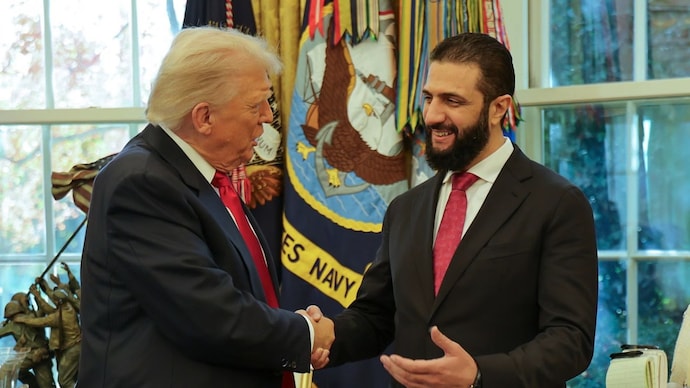
Washington witnessed an unprecedented diplomatic encounter as Syrian President Ahmed al-Sharaa met U.S. President Donald Trump in what is being hailed as a historic step toward normalizing U.S.-Syria relations. The meeting came months after Sharaa, a former rebel leader once linked to al-Qaeda, overthrew the Assad regime and began steering Syria toward political and economic rehabilitation.
Trump described Sharaa as a “strong and determined leader,” adding that the United States would “do everything possible to ensure Syria’s success.” The White House meeting was the first between the two nations since 2011, symbolizing a possible thaw in relations after more than a decade of war and isolation.
Sharaa’s Rise: From Rebel Commander to National Leader
Ahmed al-Sharaa’s journey has been nothing short of extraordinary. The 43-year-old former rebel, who once commanded Islamist forces against Assad, ascended to power after leading a swift offensive that ousted Syria’s long-time autocrat on December 8 last year. Since then, Sharaa has embarked on a global diplomatic tour to reshape his image from insurgent to reformer, appealing to the international community for reconstruction support.
One of Sharaa’s top goals in Washington was to push for the complete lifting of U.S. sanctions under the 2019 Caesar Act, which targeted the Assad regime for human rights abuses. Although the U.S. Treasury Department extended the current sanctions waiver for another 180 days, only Congress holds the authority to fully revoke the act.
A Meeting Marking a Diplomatic Shift
The White House visit marked the first time a Syrian president had set foot in Washington. The subdued arrival of Sharaa, who once carried a $10 million U.S. bounty, contrasted sharply with the pomp often associated with state visits. He entered through a side entrance, avoiding the usual West Wing ceremonial reception.
Trump acknowledged Sharaa’s controversial past, remarking, “We’ve all had difficult pasts.” The U.S. President’s comments reflected a pragmatic tone as Washington seeks stability in the Middle East and attempts to recalibrate its Syria policy away from confrontation and toward cautious engagement.
U.S. Sanctions and Syria’s Economic Revival
The U.S. Treasury issued a fresh directive extending the May 23 waiver of the Caesar Act’s enforcement, ensuring continued sanctions relief for another six months. The move is seen as a gesture of goodwill amid cautious optimism that Syria will continue distancing itself from past extremist affiliations.
| Sanctions Framework | Key Details |
|---|---|
| Caesar Act (2019) | Imposed over Assad-era human rights abuses; restricts foreign investment and trade. |
| Waiver Extension | Extended for 180 days under Trump–Sharaa meeting outcome. |
| Next Review | Expected in May 2026; depends on Syria’s internal stability and counterterror commitments. |
Sharaa reportedly urged for a full repeal of the sanctions to attract global investment. According to the World Bank, Syria needs over $200 billion for post-war reconstruction, with infrastructure and energy sectors being the most affected.
Security Talks and Regional Realignment
Since toppling Assad, Syria has shifted its geopolitical stance — distancing itself from Iran and Russia, Assad’s long-time allies, and moving closer to Turkey, Gulf nations, and the U.S. Sources told Reuters that Washington plans to establish a limited military advisory presence at a Damascus airbase as part of an evolving security cooperation deal.
Israel, wary of Sharaa’s past links to al-Qaeda, is mediating discussions between Damascus and Washington. Syria also joined the Global Coalition to Defeat ISIS, marking its first collaboration with U.S.-led forces in nearly two decades, according to a statement by Syria’s communications minister on X (formerly Twitter).
Assassination Attempts Foiled Before the Visit
Just hours before the Trump-Sharaa summit, intelligence officials disclosed that Syrian security forces had foiled two assassination plots by ISIS cells targeting the new president. More than 70 suspects were arrested nationwide during a sweeping counter-terrorism operation, according to the interior ministry.
The subdued nature of Sharaa’s arrival — no flags, no red-carpet — reflected both security concerns and diplomatic sensitivity. Inside the White House, discussions reportedly focused on reconstruction funding, refugee repatriation, and integrating Syria into regional trade frameworks.
Political Reactions and Domestic Pushback
Not all in Washington approved of the meeting. U.S. Representative Marjorie Taylor Greene criticized the White House for “focusing on foreign leaders over domestic priorities.” Trump fired back, asserting that “the presidency is an international position” and warning that “conflicts abroad can easily reach our borders.”
As Sharaa left the White House, he greeted a small crowd of cheering supporters waving Syrian flags. The moment symbolized the re-entry of Damascus into the international diplomatic stage after years of isolation.
Challenges Ahead: Rebuilding a Fractured Nation
Despite newfound recognition, Syria continues to grapple with internal strife. Since Assad’s fall, more than 2,500 people have been killed in renewed sectarian violence, threatening the stability of Sharaa’s fragile coalition government.
Within Syria, optimism is mixed with skepticism. Critics argue that despite his moderate tone, Sharaa faces the daunting task of balancing former rebel factions, managing humanitarian crises, and rebuilding a nation still reeling from 14 years of conflict.
Dramatic Transformation of a Former Rebel
Sharaa’s personal transformation mirrors Syria’s own turbulent journey. Once known as Abu Mohammad al-Golani, he fought alongside al-Qaeda during the Iraq War and was imprisoned for several years. By 2016, he had renounced jihadist ideology and formed a local governance network in northwest Syria, which eventually evolved into a nationwide political movement.
In a major shift, the UN Security Council last week lifted all terrorism-related sanctions against Sharaa and his interior minister, Anas Khattab, following Washington’s decision in December to rescind his bounty and remove his “Global Terrorist” designation.
Trump’s Broader Middle East Vision
Trump’s renewed engagement with Syria aligns with his broader 20-point Middle East stabilization plan, which also aims to secure the ceasefire in Gaza and rebuild diplomatic channels between Israel and Arab states. Administration officials believe that stabilizing Syria could help curb regional extremism and migration flows into Europe.
“We are committed to a peaceful, stable Middle East,” Trump said in a closing statement. “Syria deserves a chance to rebuild and rejoin the world.”
Conclusion
The Trump-Sharaa meeting marks a watershed moment in post-war diplomacy. While the path ahead remains uncertain, the encounter has reopened doors that were long sealed by decades of conflict, mistrust, and sanctions. Whether this new partnership ushers in lasting peace or ignites new geopolitical rivalries will depend on the choices made in Damascus and Washington in the months ahead.
For breaking news and live news updates, like us on Facebook or follow us on Twitter and Instagram. Read more on Latest World on thefoxdaily.com.





COMMENTS 0