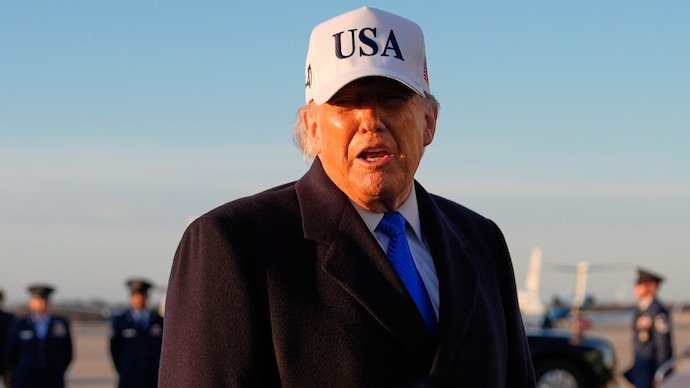
Former US President Donald trump has claimed that iran has been “completely defeated” following continued military operations involving the United States and israel, as tensions across the Middle East remain high after nearly two weeks of escalating conflict.
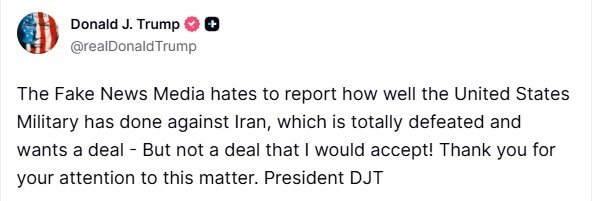
In a post on the social media platform Truth Social, Trump asserted that Tehran is now seeking negotiations but insisted that he would not accept any settlement proposal from the Iranian government.
“The fake news media hates reporting on how brilliantly the US military has performed against Iran, which is totally defeated and wants a settlement, but I won’t allow it,” Trump wrote in his message, praising the performance of American armed forces during the conflict.
His remarks come amid an intensifying geopolitical crisis involving the United States, Israel, and Iran, with ongoing missile exchanges and military strikes raising concerns about a wider regional war.
US Strikes Target Strategic Iranian Locations
Recent US military strikes reportedly targeted Iran’s Kharg Island in the Persian Gulf, a critical hub for the country’s oil export infrastructure. The island plays a central role in Iran’s energy network and global oil supply chains.
According to Trump, US forces focused their operations on military targets while deliberately avoiding direct destruction of major oil facilities for the time being.
However, he warned that Iran’s energy infrastructure could be targeted if Tehran attempts to disrupt international shipping through the Strait of Hormuz, one of the world’s most important oil transit routes.
Approximately one quarter of globally traded crude oil passes through the narrow waterway, making it a crucial artery for Global energy markets.
Iran Warns of Strong Retaliation
Iranian officials have warned that attacks on strategic locations such as Kharg Island could provoke stronger retaliation. Iranian Parliament Speaker Mohammad Bagher Qalibaf previously stated that strikes along the country’s southern maritime border could force Tehran to abandon restraint.
The warnings highlight the growing risk that the conflict could expand further across the Gulf region.
Conflict Expanding Across the Gulf Region
Reports indicate that missile and drone attacks have already been recorded in several Gulf countries, suggesting the conflict is spreading beyond Iran’s borders.
While Israeli and US forces continue targeting military infrastructure and strategic sites within Iran, Tehran has launched multiple missile barrages toward Israel and neighboring Gulf areas.
The ongoing exchange of strikes has significantly heightened fears of a broader regional war.
US Reinforces Military Presence in the Middle East
In response to the escalating conflict, the United States is strengthening its military presence in the region. US officials confirmed that the amphibious assault ship USS Tripoli and around 2,500 additional Marines are being deployed to the Middle East.
Among the reinforcements is the 31st Marine Expeditionary Unit, a rapid-response force capable of conducting amphibious operations, protecting diplomatic missions, evacuating civilians, and responding to humanitarian emergencies.
US naval forces are already heavily active in the region. Earlier this week, a fleet of roughly a dozen US ships—including the aircraft carrier USS Abraham Lincoln—was reported to be operating in the Arabian Sea.
Large-Scale Military Operations Underway
US Defense Secretary Pete Hegseth said the scale of military activity since the beginning of the conflict has been extensive. According to him, more than 15,000 targets inside Iran have been struck during the ongoing operations.
Israeli officials have also reported large-scale air operations. On one day alone, Israeli forces reportedly struck nearly 200 targets, including missile launchers, air defense systems, and weapons production facilities.
Humanitarian Impact Growing
Beyond the military consequences, the conflict is also creating a growing humanitarian crisis across the region. Israeli strikes targeting Iran-backed militant groups in Lebanon have reportedly resulted in nearly 800 deaths and forced around 850,000 people to flee their homes.
Despite concerns about potential disruptions to global oil supplies through the Strait of Hormuz, US officials say they are closely monitoring maritime traffic and working to ensure the security of international shipping routes.
Although Trump insists that Iran has been decisively weakened and is seeking negotiations, the situation across the Middle East remains volatile, with continued missile exchanges, military deployments, and diplomatic tensions shaping the rapidly evolving crisis.
For breaking news and live news updates, like us on Facebook or follow us on Twitter and Instagram. Read more on Latest World on thefoxdaily.com.





COMMENTS 0