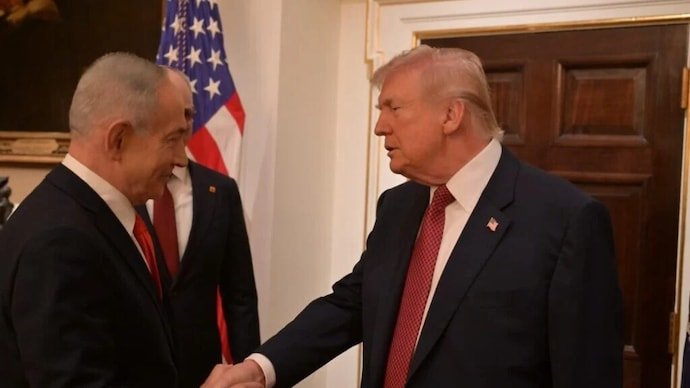
US President Donald Trump on Wednesday said that no “definitive” agreement was reached during his extended meeting with Israeli Prime Minister Benjamin Netanyahu, though he stressed that diplomatic efforts with Iran would continue.
The two leaders met behind closed doors in Washington for more than two and a half hours — their sixth meeting since Trump returned to office last year. Expectations had been high ahead of the talks, particularly regarding US-Iran negotiations and Israel’s security concerns. However, Trump clarified afterward that discussions remained ongoing.
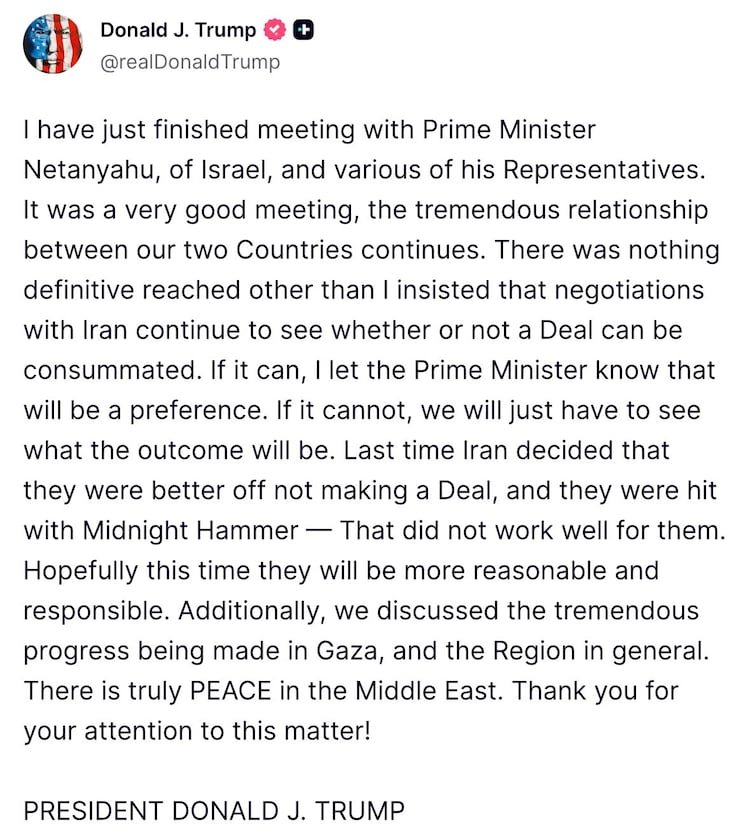
Posting on social media following the meeting, Trump stated: “Nothing definitive was reached other than I insisted that negotiations with Iran continue to see whether or not a Deal can be consummated.”
He added, “If it can, that will be a preference. If it cannot, we will just have to see what the outcome will be,” without specifying whether Netanyahu fully endorsed his approach.
Iran Talks: Diplomacy Continues Without Breakthrough
Iran was central to the discussions. Israeli officials had signaled in advance that Netanyahu would push Washington to broaden the scope of negotiations beyond Iran’s nuclear programme to include restrictions on ballistic missile development and Tehran’s regional activities.
While Netanyahu reportedly underscored Israel’s security concerns, there was no indication that the United States agreed to expand the framework of talks. Israeli leaders have repeatedly cautioned that a narrowly focused nuclear agreement may fail to address Iran’s broader military and regional influence, including its support for groups such as Hezbollah and Hamas.
Trump, for his part, reiterated that diplomacy remains the preferred path but did not rule out alternative measures. In a recent interview with Fox Business, he said an acceptable agreement would mean “no nuclear weapons, no missiles,” though he declined to elaborate further on negotiation specifics.
He also told Axios that he is considering deploying a second aircraft carrier strike group to the Middle East, part of a wider US military posture in the region. The move comes amid heightened tensions, with Tehran warning it would respond forcefully to any military action.
Iranian officials have consistently rejected efforts to link nuclear negotiations to their missile programme or regional alliances, arguing that such matters fall outside the scope of current diplomatic discussions.
In a formal statement, Netanyahu’s office said: “The Prime Minister emphasized the security needs of the State of Israel in the context of the negotiations, and the two agreed to continue their close coordination and tight contact.”
Gaza Ceasefire and Regional Developments
Beyond Iran, Trump and Netanyahu also discussed Gaza and broader regional developments. The US President has been attempting to revive support for a ceasefire and post-conflict stabilisation framework, though progress has been slow amid disagreements over Hamas disarmament and the withdrawal of Israeli forces.
“We discussed the tremendous progress being made in Gaza, and the Region in general,” Trump said after the meeting, offering limited details.
Netanyahu’s visit was notably low-profile. Unlike previous high-level meetings, there was no extended media availability in the Oval Office. Only a brief official photograph was released showing the two leaders shaking hands, and US officials did not clarify the reason for the muted format.
Israel Joins Trump’s ‘Board of Peace’ Initiative
Separately, Netanyahu met with US Secretary of State Marco Rubio during his Washington visit. Following that meeting, Netanyahu announced that Israel would join what Trump has described as the “Board of Peace” initiative.
Posting on X, Netanyahu wrote that he had “signed Israel’s accession as a member of the ‘Board of Peace.’”
The initiative is linked to a United Nations Security Council resolution adopted last November authorising the creation of an international stabilisation force in Gaza. Under Trump’s proposal, the Board of Peace would oversee temporary governance mechanisms in the territory before potentially expanding its mandate to address other conflict zones globally.
While the structure and authority of the proposed board remain under discussion, its creation reflects Washington’s broader effort to shape post-conflict governance arrangements in Gaza and reassert diplomatic leadership in the region.
Strategic Uncertainty Ahead
The outcome of the Trump-Netanyahu meeting highlights the complexity of aligning US and Israeli priorities at a time of heightened regional volatility. With no definitive agreement on Iran and limited clarity on Gaza’s political future, both leaders appear committed to continued coordination — even as key policy questions remain unresolved.
As negotiations with Tehran proceed and military posturing intensifies, the coming weeks are likely to test whether diplomacy can produce tangible results or whether regional tensions will escalate further.
For breaking news and live news updates, like us on Facebook or follow us on Twitter and Instagram. Read more on Latest World on thefoxdaily.com.






COMMENTS 0