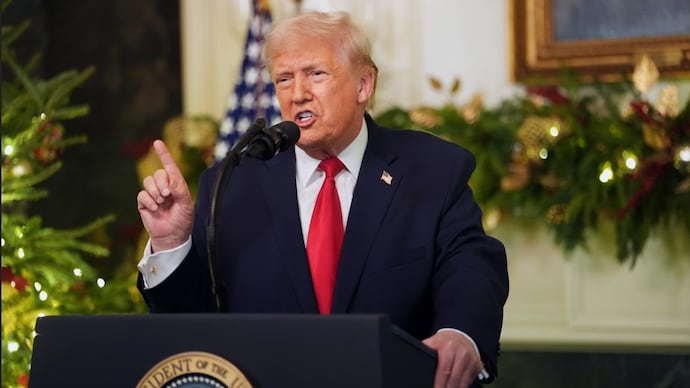
US President Donald Trump has once again returned to a familiar refrain, claiming that his aggressive tariff policies helped him prevent or conclude “eight wars in ten months.” Addressing the nation, the 79-year-old president declared that “tariffs” remain his favourite word in the English language, while sharply criticising his predecessor Joe Biden for leaving behind what he described as a “total mess.”
During the speech, Trump portrayed his second term as one defined by restored American strength, bold economic decisions, and sweeping foreign policy victories. “I’ve restored American strength, settled eight wars in ten months, destroyed the Iran nuclear threat, and ended the war in Gaza, bringing peace for the first time in 3,000 years,” Trump said while laying out his administration’s 2026 agenda. He also claimed credit for securing the release of hostages, both living and deceased.
The president’s remarks were widely shared on social media, reigniting debate over his repeated assertions of global conflict resolution. Critics have long questioned both the scope and accuracy of Trump’s claims, particularly his insistence that tariffs alone served as a decisive diplomatic tool.
Notably, Trump avoided addressing inflation directly during the speech. Instead, he argued that tariffs imposed on countries such as Canada, Mexico, Brazil, India, and others were strengthening the US economy, despite mounting evidence that his trade policies have contributed to higher consumer prices at home.
“We made a lot more money than anybody thought because of tariffs, and the bill helped us along,” Trump said, referring to the major tax cuts passed earlier this year by the Republican-controlled congress. He suggested that tariff revenues, combined with legislative reforms, had significantly boosted federal income.
Trump returned to the White House for a second term by capitalising on voter anger over high inflation during the Biden administration and the tenure of former Vice President Kamala Harris. However, recent polling suggests that the president is struggling to convince Americans that the economy is now on solid footing.
According to a Reuters/Ipsos poll released on Tuesday, only 33% of American adults approve of Trump’s handling of the economy so far. Despite these numbers, the president offered no detailed explanation or economic roadmap during his address.
Instead, Trump repeatedly placed blame on the previous Democratic administration. “When I took office, I inherited a mess, and I’m fixing it,” he said, pointing to issues related to Immigration, inflation, and what he described as cultural decline under Biden’s leadership.
Setting the tone early in the speech, Trump accused Biden of being responsible for nearly every major challenge currently facing the country, reinforcing a narrative he has returned to frequently since reassuming office.
This was not the first time Trump has claimed credit for ending conflicts. The president has repeatedly asserted that he helped defuse tensions between India and Pakistan during their May crisis by threatening tariffs and trade restrictions. While Pakistan acknowledged the Trump administration’s role in facilitating dialogue, India has consistently downplayed Washington’s involvement, maintaining that US officials were merely kept informed.
In a move that surprised many observers, Trump also used the national address to display plaques featuring images of former US presidents, highlighting what he described as their failures. Among those singled out was former President Barack Obama, continuing a pattern of public criticism aimed at past administrations.
One of the major announcements of the evening involved the US military. Trump revealed that more than 1.4 million American service members would receive payments of $1,776 before Christmas — a gesture he referred to as “warrior dividends.”
| Key Claim by Trump | Trump’s Explanation | Public & Political Response |
|---|---|---|
| Ending eight wars in 10 months | Attributed largely to tariffs and trade pressure | Supporters praise strong diplomacy; critics question scope and evidence |
| Tariffs boosting US economy | Higher revenues and support for tax cuts | Concerns over inflation and rising consumer prices |
| India-Pakistan ceasefire | Claims tariffs helped force de-escalation | Pakistan credits US role; India downplays involvement |
| “Warrior dividends” for troops | Payments funded by tariff revenues | Welcomed by military families, debated by economists |
While announcing the payments, the president strongly implied that the funds were made possible through tariff revenues. “Nobody deserves it more than our military, and I say congratulations,” Trump said, once again defending his controversial trade policies as both patriotic and economically effective.
Trump opened his national address by blaming Biden for current problems, setting the tone before taking credit for everything else.
Inherited a mess… again… somehow. pic.twitter.com/pkTBgTAQv0
— The Vivlia (@TVivlia) December 18, 2025
As Trump continues to champion tariffs as a solution to economic and geopolitical challenges, his sweeping claims — particularly regarding wars and peace deals — are likely to remain a flashpoint of political debate both at home and abroad.
For breaking news and live news updates, like us on Facebook or follow us on Twitter and Instagram. Read more on Latest World on thefoxdaily.com.


COMMENTS 0