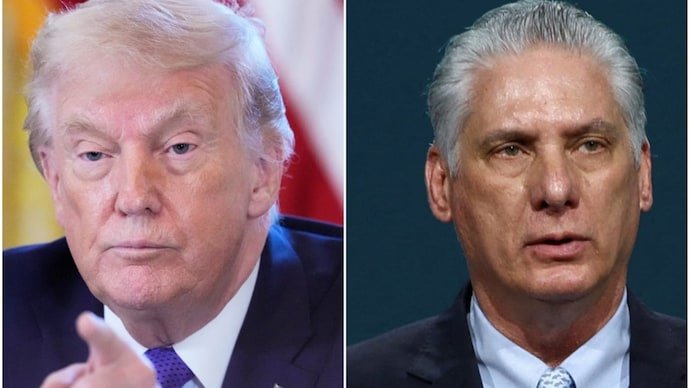
Former US President Donald Trump has issued a stark warning to Cuba, threatening to completely shut off the island’s remaining energy supply and isolate it economically unless Havana agrees to Washington’s terms. Cuba has strongly condemned the remarks, accusing the United States of acting in a “criminal” manner that endangers international peace and stability.
Trump asserted that Cuba had managed to sustain itself for years on “large amounts of oil and money from Venezuela” and alleged that, in return, Havana provided security support to the Venezuelan government. Cuban authorities rejected the claim, calling it a justification for coercive policies that violate international norms.
Speaking on Sunday, Trump said Cuba now faces a choice: strike a deal with Washington or brace for complete economic isolation. The warning significantly raises tensions at a time when Cuba is already struggling with severe energy shortages and economic distress.
The latest escalation follows the arrest of Venezuelan President Nicolás Maduro earlier this month in a US military operation, a development that effectively severed Cuba’s most critical economic lifeline. Venezuela has long been Cuba’s primary supplier of subsidised oil, cushioning the island from the full impact of US Sanctions.
Trump’s Ultimatum to Havana
In a post on his Truth Social platform, Trump declared that the era of Venezuelan subsidies propping up the Cuban economy had come to an end.
“There will be zero more money or oil going to Cuba,” Trump wrote. “I strongly suggest they make a deal, before it’s too late.”
Although Trump did not outline what such a deal would entail, the message marked a sharp escalation in Washington’s efforts to assert control across the Western Hemisphere. With Cuba already facing prolonged blackouts, analysts warn that any further disruption to energy supplies could trigger widespread instability.
The pressure campaign has extended beyond rhetoric. US authorities have reportedly begun intercepting oil shipments linked to Venezuela in an effort to restrict global distribution. For Cuba, which depends heavily on imported fuel, the move has intensified fears of deeper economic and social upheaval.
Trump further fueled controversy by reposting a social media message suggesting that US Secretary of State Marco Rubio could one day become president of Cuba. “Sounds good to me!” Trump added, amplifying tensions with Havana.
Havana Pushes Back
Cuba’s leadership responded swiftly and forcefully, rejecting Washington’s claim that it has the authority to dictate Havana’s policies or alliances.
“Cuba is a sovereign, independent, and free country. No one dictates what we do,” Cuban President Miguel Díaz-Canel said in a post on X. While stressing that Cuba does not seek conflict, he added that the country remains prepared to defend itself “to the last drop of blood.”
Foreign Minister Bruno Rodríguez went further, accusing the United States of engaging in “criminal” conduct that threatens Global Peace. He dismissed Trump’s allegations of quid pro quo security arrangements with Venezuela, stating that Cuba has the right to import petroleum from any nation willing to sell it.
Ties to Venezuela at the Core of the Dispute
The war of words comes against the backdrop of the sudden collapse of the long-standing partnership between Havana and Caracas following US intervention in Venezuela. For years, Venezuela supplied roughly half of Cuba’s oil needs, allowing the island to offset chronic energy shortages.
However, shipping data indicates that since Maduro’s arrest in early January, no Venezuelan oil shipments have departed for Cuba. Havana has also confirmed that 32 Cuban military personnel were killed during the US operation in Venezuela, where they had been deployed in security roles.
Meanwhile, Washington has moved quickly to redirect Venezuela’s energy resources. A $2 billion agreement between the United States and Venezuela’s interim government to supply 50 million barrels of oil to the US is reportedly progressing, with proceeds placed in accounts under US oversight.
A Growing Crisis on the Ground
For ordinary Cubans, the diplomatic confrontation has translated into worsening daily hardships. Even before the disruption in oil supplies, the island was grappling with rolling blackouts lasting several hours, along with acute shortages of food and medicines.
Between 2020 and 2024, an estimated 1.4 million people left Cuba, reflecting a historic wave of emigration driven by economic despair. Media reports continue to highlight widespread frustration and uncertainty across the country.
“I would be lying if I said I don’t want to leave,” Amanda Gomez, a 16-year-old student, told the Associated Press. “We’re all thinking about leaving, from the youngest to the oldest.”
Experts warn that a complete cutoff of oil supplies could prove catastrophic. Michael Galant of the Center for Economic and Policy Research said the US strategy appears aimed at intensifying pressure to a point that could spark unrest. He described it as a form of “besieging” designed to inflict broad-based hardship.
What Is the Endgame?
Within the United States, opinions differ on whether the mounting pressure will finally destabilise Cuba’s communist system. Some lawmakers view the current moment as a turning point.
“We are witnessing what I believe will be the beginning of the end of the regime in Havana,” Representative Mario Díaz-Balart of Florida wrote on X, praising Trump’s approach.
Others caution that decades of sanctions have failed to bring about regime change. “The Cuban people have endured suffering for a very long time,” Galant noted, warning against assumptions of a swift collapse.
For now, Cuba remains in a state of deep uncertainty, caught between intensifying US pressure and an increasingly fragile domestic situation.
For breaking news and live news updates, like us on Facebook or follow us on Twitter and Instagram. Read more on Latest World on thefoxdaily.com.




COMMENTS 0