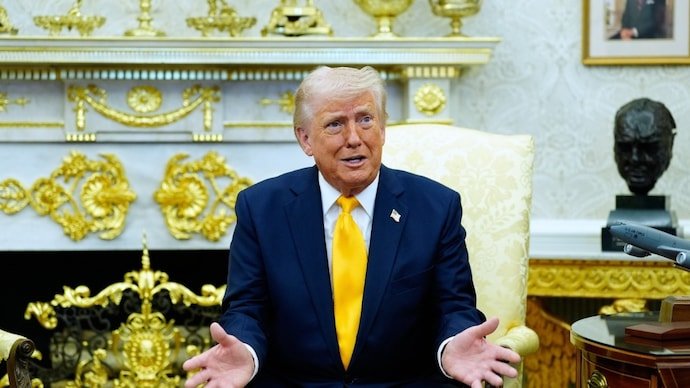
US President Donald Trump is set to address the nation on April 1 at 6:30 PM IST, with the White House confirming that the speech will focus on the ongoing Iran war. The announcement comes at a critical moment, as the conflict enters its second month and global attention remains fixed on Washington’s next move.
The highly anticipated address follows Trump’s recent remarks suggesting that the United States may soon withdraw from the conflict in West Asia—a war that has already claimed thousands of lives and disrupted Global energy markets.
Speaking earlier at the White House, Trump stated, “We’ll be leaving very soon,” adding that a military pullout could happen within the next two to three weeks. :contentReference[oaicite:0]{index=0}
These comments have fueled speculation that Trump could use the April 1 speech to formally announce the end or winding down of US military operations that began on February 28, targeting key Iranian leadership and infrastructure.
Possible Announcement: End of Military Operations
Based on recent statements, analysts believe Trump may declare that US objectives in Iran have largely been achieved. Reports suggest the administration views the mission as successful, particularly in weakening Iran’s military and nuclear capabilities.
There is growing expectation that Trump will frame the outcome as a strategic victory while signaling a phased withdrawal of US forces from the region.
| Key Issue | What Trump May Announce |
|---|---|
| Military Presence | Possible withdrawal within 2–3 weeks |
| War Status | Declaration of mission success or end of operations |
| Nuclear Threat | Claim that Iran’s capabilities have been significantly reduced |
| Diplomacy | No immediate need for a formal peace deal |
| Global Role | Shift responsibility to allies for regional stability |
Trump’s Stand: “No Deal Needed”
In a surprising shift from traditional diplomatic approaches, Trump has indicated that ending the war does not require a formal agreement with Iran.
“Iran does not need to make a deal,” Trump stated, distancing himself from earlier suggestions that negotiations could play a central role in ending the conflict.
This stance appears to contradict comments from US Defense Secretary Pete Hegseth, who had suggested that Washington remained open to a diplomatic resolution.
Previously, the United States had outlined a 15-point proposal for peace, which included reopening the Strait of Hormuz, halting Iran’s nuclear program, and ending support for proxy groups.
However, Trump’s recent remarks suggest that the US may move forward with an exit strategy regardless of whether those conditions are fully met.
Focus on Iran’s Nuclear Program
One of the central objectives of the US campaign has been to curb Iran’s nuclear ambitions. Trump has repeatedly emphasized that military operations would continue until Iran’s ability to develop nuclear weapons is significantly weakened.
He recently stated that the goal is to push Iran “into the stone age” in terms of its nuclear capability, ensuring that it cannot quickly rebuild its infrastructure.
In his upcoming speech, Trump is expected to provide an update on the status of Iran’s nuclear facilities and whether the US considers this objective achieved.
Questions Over Regime Change
Another key issue likely to feature in the speech is the political situation inside Iran. Trump has previously claimed that the country has undergone major leadership changes following US-Israeli strikes.
He has described the new leadership, reportedly under Mojtaba Khamenei, as more “reasonable” compared to previous regimes—a notable shift from his earlier criticism.
In recent interviews, Trump has suggested that Iran needs leadership willing to pursue peace and stability in the region, even hinting at US influence in shaping future leadership outcomes.
These remarks have added another layer of complexity to the conflict, raising concerns about the broader geopolitical implications of regime change.
Global Impact and Rising Expectations
The upcoming address comes amid signs of potential de-escalation, with markets reacting cautiously to Trump’s signals that the war may soon wind down. :contentReference[oaicite:1]{index=1}
At the same time, uncertainty remains over key issues such as the reopening of the Strait of Hormuz and the long-term stability of the region.
Trump has previously indicated that ensuring the security of global oil routes may not remain a US responsibility, instead urging other nations to take the lead.
All Eyes on April 1 Address
As Trump prepares to deliver his national address, expectations are high that he will outline a clear roadmap for ending US involvement in the Iran war.
Whether he formally declares victory, announces a withdrawal timeline, or introduces a new strategic approach, the speech is expected to have significant implications for global politics, energy markets, and regional stability.
For now, the world waits for clarity on one of the most consequential conflicts of the year.
For breaking news and live news updates, like us on Facebook or follow us on Twitter and Instagram. Read more on Latest World on thefoxdaily.com.



COMMENTS 0