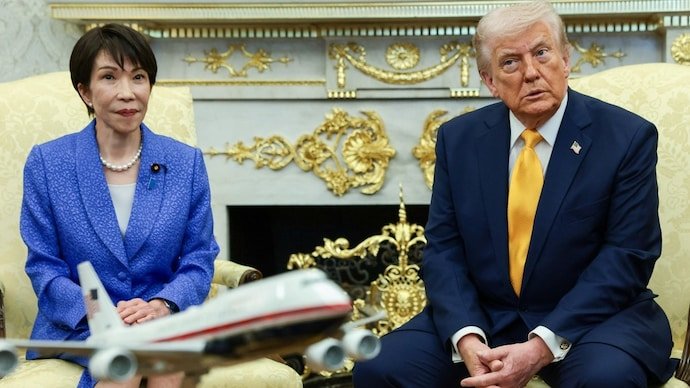
A joint press conference at the White House between US President Donald Trump and Japanese Prime Minister Sanae Takaichi turned unexpectedly tense after a mix of light humor and a controversial historical reference. The leaders had just concluded discussions on a strategic minerals agreement and key energy cooperation initiatives when the interaction took an awkward turn.
Initially, the atmosphere appeared relaxed. Trump praised Takaichi’s fluency in English, making a lighthearted remark about not needing translation services during their conversation. “It’s so nice we don’t have to sit through translation,” he said, drawing polite smiles from those present.
He continued in a joking tone, suggesting he might learn Japanese before her next visit. While intended as humor, the comment placed the spotlight on Takaichi, who remained composed but reserved throughout the exchange.
A SHIFT FROM HUMOR TO DISCOMFORT
The tone of the briefing changed sharply when Trump addressed a question regarding why certain allies were not informed in advance about US-Israeli military actions involving Iran. Attempting to justify the secrecy, he remarked, “We wanted to be surprised.”
What followed, however, drew immediate attention. Trump referenced Japan’s 1941 attack on Pearl Harbor, saying, “Who knows more about surprise than Japan?” He then turned toward Takaichi and added, “Why didn’t you tell me about Pearl Harbor?”
The remark created visible discomfort in the room. The Japanese Prime Minister appeared taken aback, maintaining silence while relying on her interpreter. Observers noted her uneasy body language, as the comment echoed through the press briefing.
WHY THE PEARL HARBOR REFERENCE MATTERS
The mention of Pearl Harbor carries deep historical weight. On December 7, 1941, Japan launched a surprise military strike on the United States naval base in Hawaii, resulting in the deaths of nearly 2,400 Americans. The attack led directly to the United States entering World War II.
The significance of the event continues to shape US-Japan relations, making it a sensitive topic in diplomatic settings. References to such events, even in jest, can evoke strong reactions and underscore lingering historical memory.
| Aspect | Details |
|---|---|
| Event Referenced | Pearl Harbor Attack (1941) |
| Impact | Led to US entry into World War II |
| Casualties | Approximately 2,400 Americans killed |
| Diplomatic Sensitivity | Highly sensitive in US-Japan relations |
DIPLOMACY, HUMOR, AND LIMITS
While humor is often used in Diplomacy to ease tensions, moments like this highlight the fine line leaders must navigate. What may be intended as a casual or witty remark can quickly become controversial when it touches on painful historical events.
Takaichi’s visit itself was significant, as she is among the first global leaders to meet Trump following the escalation of US and Israeli military actions involving Iran. The meeting was expected to reinforce strategic cooperation between the two nations.
However, the incident served as a reminder that even informal comments can carry weight in International Relations, especially when history and Geopolitics intersect.
Despite the awkward moment, both nations are likely to continue strengthening ties in areas such as defense, energy, and economic collaboration. Yet, the exchange underscores how quickly tone and perception can shift in high-level diplomacy.
For breaking news and live news updates, like us on Facebook or follow us on Twitter and Instagram. Read more on Latest World on thefoxdaily.com.



COMMENTS 0