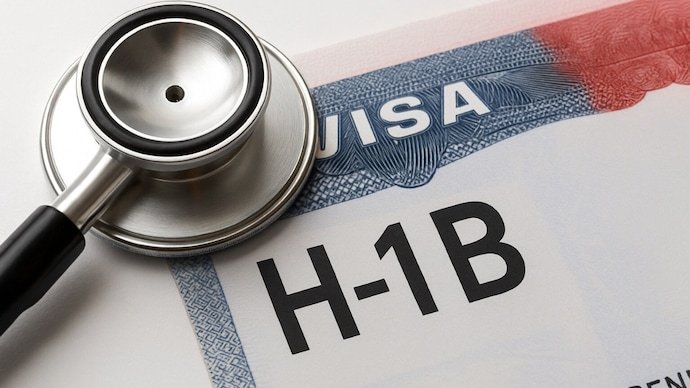
A new bipartisan bill introduced in the United States House of Representatives aims to remove the steep $100,000 H-1B visa fee imposed on foreign Healthcare professionals, including physicians and nurses. The proposed legislation comes at a time when the US is grappling with a growing shortage of qualified medical workers.
The bill, reported by The New York Times, is designed to support hospitals and healthcare systems that rely heavily on international talent to meet rising patient care demands, particularly in underserved and rural regions.
Background: Trump-Era $100K H-1B Fee
In September 2025, the administration of former US President Donald Trump introduced a Presidential Proclamation that imposed a $100,000 fee on certain H-1B visa applications. The move was widely criticized by healthcare groups, business organizations, and several state governments.
Multiple lawsuits have since challenged the legality of the fee, with opponents arguing that it could weaken essential services in hospitals and educational institutions by restricting access to skilled foreign professionals.
What the New Bill Proposes
The legislation, titled the “H-1Bs for Physicians and the Healthcare Workforce Act”, seeks to exempt doctors, nurses, and other medical professionals from the $100,000 visa fee. It was introduced by a bipartisan group of lawmakers, including Republicans Mike Lawler and Maria Elvira Salazar, along with Democrats Sanford D. Bishop Jr. and Yvette Clarke.
Lawmakers backing the bill argue that removing the financial barrier is essential to ensuring that US healthcare systems can continue to recruit qualified professionals from abroad.
| Key Aspect | Details |
|---|---|
| Bill Name | H-1Bs for Physicians and the Healthcare Workforce Act |
| Main Proposal | Waive $100,000 H-1B visa fee for healthcare workers |
| Target Beneficiaries | Doctors, nurses, and medical professionals |
| Introduced By | Bipartisan group of US lawmakers |
| Objective | Address healthcare workforce shortages |
Why the US Relies on H-1B Healthcare Workers
The H-1B visa program is a temporary work visa system designed to attract highly skilled professionals from around the world to work in sectors such as technology, Education, and healthcare. For many international workers, it also serves as a pathway to long-term residency in the United States.
In healthcare, the program plays a crucial role in filling workforce gaps. According to projections from the American Medical Association, the US could face a shortage of up to 86,000 physicians by 2036. The nursing workforce is also under pressure, with a significant portion of registered nurses being immigrants.
Impact on Rural and Underserved Areas
Rural hospitals and medically underserved regions are among the most dependent on international medical graduates. These areas often struggle to attract and retain locally trained professionals, making foreign healthcare workers indispensable.
Experts warn that the $100,000 fee could severely disrupt this pipeline. Many smaller hospitals already operate under tight financial constraints and may not be able to afford the additional cost, potentially leading to staffing shortages and reduced patient care capacity.
Political Debate Around H-1B Visas
The H-1B program has long been a subject of political debate. Critics, particularly among some conservative groups, argue that the visa system is sometimes used by employers to replace American workers with foreign labor.
However, supporters of the program counter that in sectors like healthcare, there simply are not enough qualified domestic professionals to meet demand. They emphasize that international workers are essential to maintaining service quality and accessibility.
Medical Community Raises Concerns
Leading medical organizations, including the American Medical Association (AMA), have voiced strong opposition to the high visa fee. In appeals to federal authorities, they have stressed that restricting access to international doctors and nurses could have serious consequences for patient care.
Healthcare leaders have highlighted that communities already facing shortages—such as rural towns and economically disadvantaged regions—would be disproportionately affected if the flow of international talent is reduced.
What Happens Next?
As the bill moves through the legislative process, its outcome could significantly impact the future of the US healthcare workforce. If passed, it would ease financial barriers for international medical professionals and help stabilize staffing levels in critical areas.
The debate ultimately reflects a broader challenge: balancing Immigration policy with the urgent need to maintain a robust and accessible healthcare system. For now, hospitals, policymakers, and patients alike are closely watching how the situation unfolds.
For breaking news and live news updates, like us on Facebook or follow us on Twitter and Instagram. Read more on Latest World on thefoxdaily.com.





COMMENTS 0