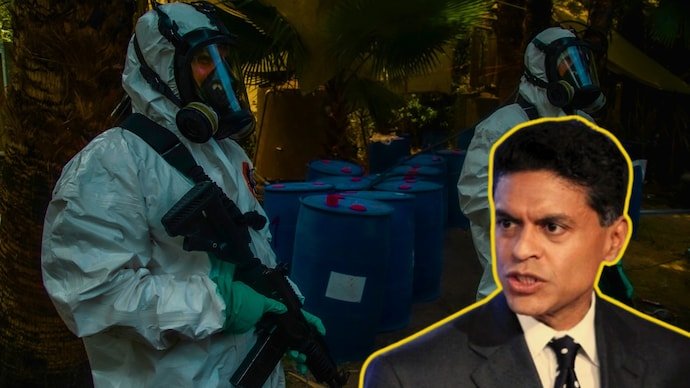
At a time when Washington has repeatedly accused Venezuela’s Maduro regime of flooding the United States with illegal narcotics, a starkly different assessment emerged on CNN’s Fareed Zakaria GPS. Drug historian David Herzberg categorically rejected the idea that Venezuela is a major contributor to America’s drug crisis.
Speaking with Indian-American journalist Fareed Zakaria, Herzberg argued that the opioid epidemic devastating the United States was largely created at home—by US pharmaceutical companies, lax regulation, and government responses that prioritised punishment over public health.
“Venezuela plays almost no role in the fentanyl supply entering the United States,” Herzberg said, adding that the country has only a marginal role in cocaine trafficking compared to other routes and producers.
Herzberg is a professor at the University at Buffalo and the author of White Market Drugs: Big Pharma and the Hidden History of Addiction in America, a widely cited work examining how legal pharmaceutical markets laid the groundwork for today’s illicit drug trade.
His remarks come amid renewed political rhetoric in the US, including claims by President Donald Trump that Venezuela is responsible for “poisoning” America with drugs—assertions Herzberg says are not supported by evidence.
The Real Roots of America’s Opioid Epidemic
According to Herzberg, the fentanyl crisis cannot be understood without examining the aggressive marketing of prescription opioids in the 1990s and early 2000s.
Drugs such as OxyContin were promoted by pharmaceutical companies as safe and non-addictive, leading to widespread prescription and dependency across the United States.
“Large segments of the American population became addicted through the legal medical system,” Herzberg explained. “That addiction didn’t disappear when prescriptions were cut off.”
He pointed out that fentanyl—now the leading cause of death for Americans aged 18 to 45—did not emerge in a vacuum. Instead, it filled the gap left when access to prescription opioids was suddenly restricted.
While pharmaceutical companies helped create the initial wave of addiction, Herzberg also criticised the US government’s response, which he said compounded the problem.
Rather than declaring a public health emergency and expanding treatment, policymakers increasingly framed addiction as criminal abuse. Measures such as heightened scrutiny, prescription monitoring, and sharp reductions in opioid availability cut off millions of dependent users from legal sources.
“People with addictions were suddenly locked out of the white market,” Herzberg said. “They didn’t stop needing drugs—they just turned to illegal markets.”
How Demand Drives the Illicit Drug Trade
Herzberg emphasised that the illegal drug trade in the US is fundamentally driven by a mismatch between supply and demand.
When legal access was restricted without adequate treatment alternatives, demand remained constant. The result was a booming illicit market ready to meet it.
“Opioids were still in high demand, but the legal supply was shut down,” Herzberg told Zakaria. “That pushed people toward informal and illicit markets.”
This demand, he explained, created powerful incentives for organised crime.
Mexican drug cartels—including the Sinaloa Cartel and Cartel Jalisco Nueva Generación (CJNG)—responded by importing precursor chemicals from china and manufacturing synthetic opioids like fentanyl at industrial scale.
These substances are cheap to produce, easy to transport, and highly potent—making them ideal for smuggling across the US–Mexico land border.
Herzberg stressed that this supply chain has far more to do with US demand and global chemical markets than with South American countries such as Venezuela.
Why Supply-Side Crackdowns Keep Failing
The historian was equally critical of America’s traditional “war on drugs” strategy, arguing that supply-side crackdowns have repeatedly failed—and often made the situation worse.
As long as demand exists, Herzberg said, suppliers will simply adapt, relocate, and continue operations.
Fareed Zakaria reinforced this point by tracing the historical pattern of US drug enforcement.
“The US cracked down in Florida, then Panama under Noriega, then Colombia,” Zakaria noted. “Each time, the drugs kept coming—only the suppliers changed.”
Eventually, Mexico became the primary hub, but the flow of narcotics into the US remained uninterrupted.
Herzberg warned that these crackdowns create what he described as a “Darwinian” illicit market.
“When one supply route is shut down, demand doesn’t disappear,” he explained. “It creates disruption that attracts new, often more violent and ruthless players.”
The result, he said, is an underground economy that becomes deadlier, more efficient, and harder to regulate.
Evidence Supports a Domestic Crisis
Herzberg’s arguments align with multiple government and academic reports showing that the majority of synthetic opioids entering the US originate from Mexican production networks, not Venezuela.
They also underline a deeper truth: the opioid crisis is rooted in America’s own economic, Healthcare, and regulatory systems.
“The reality is that there are a lot of people in America who want to use drugs outside the medical system,” Herzberg said. “That creates a system of incentives for traffickers to start businesses exporting drugs to the US.”
He added that this dynamic mirrors broader capitalist principles—where unmet demand inevitably creates supply.
Until the United States confronts addiction as a public health issue rather than a foreign threat, Herzberg warned, blaming external actors like Venezuela will do little to stop the crisis claiming tens of thousands of American lives each year.
For breaking news and live news updates, like us on Facebook or follow us on Twitter and Instagram. Read more on Latest World on thefoxdaily.com.

COMMENTS 0