- What Happened in the Skies Over Iran?
- Understanding the F-15E Strike Eagle
- Iran’s Response and Local Developments
- US Search-and-Rescue Operation
- Conflicting Claims and Fog of War
- Wider Context: Rising Air Losses in Conflict
- Parallel Claims on F-35 Jets
- Analysis: A High-Risk Turning Point
- Conclusion: Uncertainty Amid Escalation
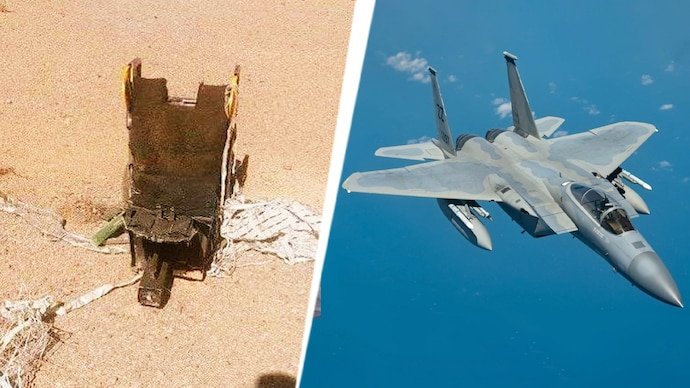
A US F-15E fighter jet was shot down over southern Iran on Friday, prompting a high-stakes search-and-rescue operation for its two crew members. While one of the crew has reportedly been rescued, uncertainty surrounds the fate of the second, with conflicting reports suggesting possible capture or an ongoing search effort.
According to multiple reports, the aircraft—operated by a two-person crew consisting of a pilot and a weapons systems officer (WSO)—was targeted by Iran’s Islamic Revolutionary Guard Corps (IRGC). Both crew members ejected before the jet crashed.
The incident marks a significant escalation in the ongoing conflict, highlighting the growing risks faced by air crews operating in contested airspace.
What Happened in the Skies Over Iran?
Initial reports from Iranian state-linked media claimed that at least one crew member had ejected after the jet was struck. Western and Israeli sources later indicated that one of the two crew members had been successfully rescued from Iranian territory.
However, the fate of the second crew member remains unclear. Some sources suggest that Iranian forces may have taken the individual into custody, while others indicate that US forces are still actively searching.
US forces reportedly launched a combat search-and-rescue mission to locate the crew before Iranian units could reach them.
The US President has been briefed on the situation, with officials confirming that recovery efforts are ongoing.
Understanding the F-15E Strike Eagle
The F-15E Strike Eagle is a dual-seat, all-weather fighter aircraft designed for deep strike missions. Unlike single-seat fighter jets, it carries both a pilot and a weapons systems officer.
| Role | Position | Function |
|---|---|---|
| Pilot | Front Seat | Controls flight and navigation |
| Weapons Systems Officer (WSO) | Rear Seat | Manages targeting, weapons, and sensors |
This configuration allows the aircraft to perform complex combat operations, but also means that any downing incident involves multiple personnel at risk.
Iran’s Response and Local Developments
In a controversial development, Iranian state-affiliated media reportedly urged civilians in the region to assist in locating the downed crew.
Local authorities in Kohkilouyeh and Boyer-Ahmad province—where the incident is believed to have occurred—issued statements suggesting that individuals who captured or reported the crew could be rewarded.
Broadcasts initially carried aggressive messaging but were later toned down to encourage capturing the pilot alive and handing them over to authorities.
“Anyone who captures the enemy pilot alive and hands them over to the police will be rewarded,” a local broadcast reportedly stated.
Images circulated by Iranian media also showed debris believed to be from the downed aircraft, along with increased aerial activity in the region.
US Search-and-Rescue Operation
Following the incident, US forces reportedly launched a combat search-and-rescue (CSAR) mission—one of the most complex and dangerous military operations.
Such missions typically involve:
- Helicopters and special operations teams
- Air cover from fighter jets and drones
- Real-time intelligence gathering
The goal is to locate and extract personnel quickly before hostile forces can intervene. In contested environments like southern Iran, these operations carry significant risks.
Conflicting Claims and Fog of War
As with many incidents in active conflict zones, information remains fragmented and difficult to verify independently.
Iranian sources have suggested that one of the crew members may be in custody, while Western reports emphasize ongoing rescue efforts. This divergence reflects the broader “fog of war,” where competing narratives often emerge simultaneously.
Until official confirmation is provided, the exact status of the second crew member remains uncertain.
Wider Context: Rising Air Losses in Conflict
The downing of the F-15E adds to a growing list of aircraft losses in the ongoing Iran conflict.
According to reports, at least four US military aircraft have been lost during the conflict prior to this incident:
- Three fighter jets reportedly downed due to friendly fire
- One KC-135 Stratotanker that crashed in Iraq, resulting in six fatalities
In one earlier incident, multiple crew members safely ejected after their aircraft was mistakenly targeted, highlighting the dangers not just from enemy fire but also operational complexities.
Parallel Claims on F-35 Jets
Separately, the IRGC has claimed that it shot down additional advanced aircraft, including F-35 fighter jets. These claims remain unverified by independent sources.
The reported targeting of high-end aircraft suggests Iran is attempting to demonstrate the effectiveness of its air defence systems, though such claims are often contested.
Analysis: A High-Risk Turning Point
The downing of a US F-15E inside Iranian territory represents a serious escalation in the conflict. It underscores the vulnerability of even advanced aircraft in heavily defended airspace.
More importantly, the situation involving the crew introduces a sensitive dimension. If a US service member is captured, it could significantly raise diplomatic and military tensions.
Search-and-rescue missions in hostile territory are among the most challenging operations, often requiring split-second decisions and precise coordination.
The outcome of this mission could influence not just military strategy, but also the broader trajectory of the conflict.
Conclusion: Uncertainty Amid Escalation
As rescue efforts continue, the fate of the second crew member remains unclear, with conflicting reports adding to the uncertainty. What is clear, however, is that the incident marks a critical moment in the ongoing conflict.
With both sides advancing competing narratives and military operations intensifying, the situation on the ground—and in the skies—remains highly volatile.
For now, all eyes are on the search-and-rescue mission, as the world waits for clarity on the fate of the missing crew member.
For breaking news and live news updates, like us on Facebook or follow us on Twitter and Instagram. Read more on Latest World on thefoxdaily.com.





COMMENTS 0