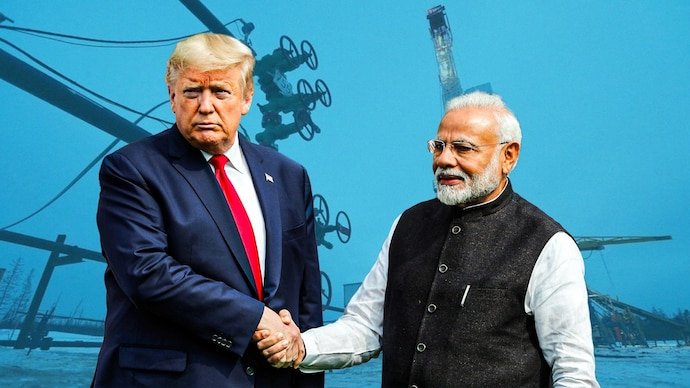
The United States has issued a temporary 30-day waiver allowing Russian Oil cargoes that are currently stranded at sea to be sold to India. The move comes as Washington attempts to ease mounting pressure on global oil markets caused by rising geopolitical tensions and disruptions in supply chains linked to the ongoing conflict involving the United States and Iran.
According to two senior U.S. officials who spoke to Reuters, the waiver specifically applies to Russian oil shipments that had already been loaded onto tankers before the latest wave of U.S. sanctions took effect. These cargoes were left without buyers after restrictions tightened, leaving large volumes of crude floating at sea.
By allowing India to temporarily purchase these shipments, the United States hopes to prevent sudden disruptions in the Global energy supply that could push oil prices higher and worsen inflation in multiple economies.
The waiver permits Indian refiners to offload and purchase these stranded shipments within a limited 30-day period. Officials emphasised that the measure is intended only as a short-term solution to maintain the steady flow of oil into international markets.
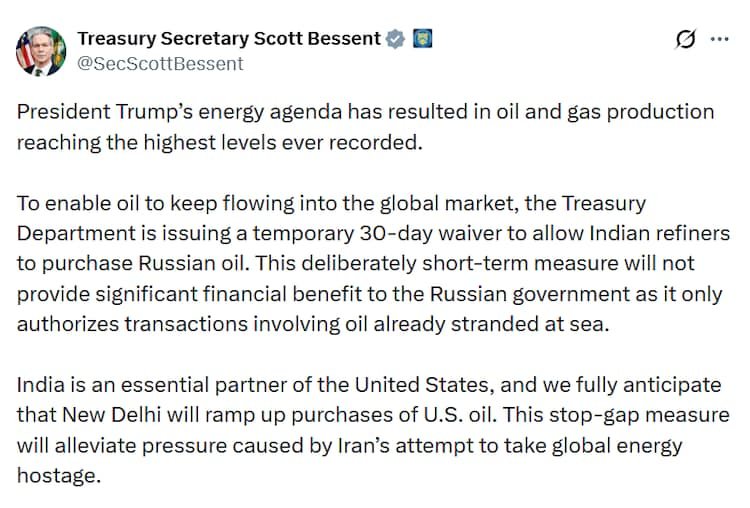
Confirming the development, U.S. Treasury Secretary Scott Bessent described India as a key strategic partner for the United States and explained that the waiver is designed to address instability in global energy supplies.
“India is an essential partner of the United States,” Bessent said, adding that the temporary waiver would help relieve pressure created by Iran’s attempts to disrupt global energy flows.
Bessent further explained that the decision allows Indian refiners to continue purchasing certain Russian cargoes so that the oil already loaded on ships does not remain stuck at sea and disrupt the balance of the global energy market.
“The U.S. is issuing a 30-day waiver to allow Indian refiners to purchase Russian oil to enable oil to keep flowing into the global market,” he stated.
Officials also stressed that the waiver applies only to cargoes that had already been loaded and does not represent a broader relaxation of sanctions against Russia. According to U.S. authorities, the measure is unlikely to significantly benefit Moscow financially.
India Faces Growing Energy Supply Risks
The decision to grant the waiver was partly influenced by India’s vulnerability to disruptions in Middle Eastern oil supplies. As one of the world’s largest importers of crude oil, India depends heavily on foreign energy sources to meet domestic demand.
Reuters reports that approximately 40% of India’s oil imports come from the Middle East. A significant portion of these shipments travels through the Strait of Hormuz, one of the most strategically important maritime chokepoints for global energy trade.
India’s strategic crude oil reserves are estimated to cover only around 25 days of demand, making the country particularly sensitive to sudden supply interruptions.
The situation has become more complicated due to escalating tensions in the Middle East. Iran has reportedly restricted shipping through the Strait of Hormuz as its confrontation with the United States intensifies. The waterway is responsible for nearly 20% of global oil shipments, making any disruption a serious concern for energy markets.
| Key Energy Factor | Details |
|---|---|
| Waiver Duration | 30 days |
| Eligible Cargoes | Russian oil shipments already loaded onto tankers before new sanctions |
| India’s Middle East Oil Dependence | Approximately 40% of total imports |
| Strategic Oil Reserve Coverage | About 25 days of domestic demand |
| Critical Shipping Route | Strait of Hormuz, carrying nearly 20% of global oil trade |
India’s Complex Oil Trade Strategy
Since Western sanctions were imposed on Russia following its invasion of Ukraine in 2022, India has emerged as one of the largest buyers of discounted Russian crude oil. The lower prices helped Indian refiners reduce import costs while maintaining stable domestic fuel supplies.
However, earlier this year India began reducing its purchases of Russian oil under increasing pressure from the United States and its Western allies. Washington has sought to limit Moscow’s oil revenues as part of broader efforts to weaken Russia’s ability to fund its military operations in Ukraine.
New Delhi also managed to reach an interim trade agreement with the United States that helped avoid potential tariffs of up to 25% on certain exports, partly by adjusting its energy trade patterns.
Indian Refiners Rush to Secure Russian Oil
Despite earlier reductions in imports, Indian state-run refiners are now returning to the market for Russian crude following the temporary waiver.
According to Reuters, several major Indian energy companies are currently negotiating with traders to purchase Russian oil cargoes for immediate delivery.
Among the companies involved in discussions are Indian Oil Corporation (IOC), Bharat Petroleum Corporation Limited (BPCL), Hindustan Petroleum Corporation Limited (HPCL), and Mangalore Refinery and Petrochemicals Limited (MRPL).
Sources familiar with the negotiations revealed that Indian state refiners have already secured approximately 20 million barrels of Russian oil from international traders.
For some companies, these purchases represent a return to Russian crude supplies after several months of reduced imports. Industry data indicates that both Hindustan Petroleum and Mangalore Refinery last received Russian oil shipments in November.
Sharp Shift in Russian Oil Pricing
The renewed demand from Indian refiners has also caused a noticeable shift in pricing for Russian crude oil.
Traders told Reuters that Russian Urals crude is currently being offered to Indian buyers at a premium of around USD 4 to USD 5 per barrel above Brent crude for cargoes expected to arrive in March and early April.
This marks a dramatic reversal from February, when similar Russian cargoes were trading at approximately USD 13 per barrel below Brent due to weak demand and heavy sanctions pressure.
At that time, Hindustan Petroleum had purchased two cargoes of Russian oil at the discounted price shortly before the latest conflict escalated on February 28.
Reliance Industries, India’s largest private refiner, has also reportedly approached traders in an attempt to secure additional Russian cargoes for near-term delivery.
According to a trader involved in Russian oil sales to India, supply availability is currently a bigger concern than price levels.
“Indian refiners are back in the market. Nowadays more than prices, availability of molecules is the issue,” the trader said.
Global Oil Market Stability Remains the Priority
U.S. officials indicated that the waiver decision was largely motivated by concerns that completely blocking the stranded cargoes could remove substantial volumes of crude oil from global markets at a time when supply is already under pressure.
Energy markets remain highly volatile due to ongoing tensions in West Asia, disruptions to maritime shipping routes, and uncertainty surrounding the broader geopolitical landscape.
By allowing these Russian shipments to reach India, Washington hopes to prevent sudden supply shortages and stabilize global oil prices. The move is also intended to reduce the risk of energy-driven inflation that could impact economies around the world.
While the waiver provides temporary relief for both India and global markets, analysts note that the long-term outlook for energy trade remains uncertain as geopolitical tensions continue to reshape global oil supply chains.
For breaking news and live news updates, like us on Facebook or follow us on Twitter and Instagram. Read more on Latest World on thefoxdaily.com.

COMMENTS 0