- Pakistan’s Diplomatic Balancing Act Under Pressure
- The Strategic Mutual Defence Agreement With Saudi Arabia
- Saudi Arabia Signals Expectation of Support
- Pakistan Attempts Diplomatic Mediation
- Domestic Tensions Inside Pakistan
- The Trump Factor in Pakistan’s Calculations
- A Difficult Strategic Dilemma
- Analysts Suggest Limited Military Support
- A Turning Point for Pakistan’s Foreign Policy
Pakistan once believed it had perfected a delicate diplomatic balancing act in West Asia. By strengthening ties with Saudi Arabia, maintaining working relations with Iran, and improving its relationship with the United States, Islamabad attempted to keep all major regional powers satisfied.
For a period, that strategy appeared to work. Pakistani leaders publicly supported Saudi Arabia, quietly reassured Iran through diplomatic channels, and made significant efforts to rebuild relations with Washington.
However, the sudden escalation of tensions in the Middle East has exposed the limits of that approach. After the assassination of Iran’s Supreme Leader Ayatollah Ali Khamenei in a joint US-Israeli operation, the region quickly descended into conflict. Missile exchanges across the Gulf followed, and Pakistan’s carefully balanced foreign policy began to face unprecedented pressure.
Islamabad now finds itself confronting a geopolitical crisis that threatens to undermine its diplomatic strategy and force difficult choices between key allies.
Pakistan’s Diplomatic Balancing Act Under Pressure
Pakistan’s foreign policy has long relied on maintaining strategic relationships with multiple regional powers simultaneously. The country has strong economic and defence ties with Saudi Arabia, maintains a long border and complex relationship with Iran, and recently worked to repair strained relations with the United States.
The current conflict, however, has created a situation where these relationships may no longer coexist without conflict.
Pakistan now faces three major challenges at the same time:
- Honoring its defence agreement with Saudi Arabia
- Managing domestic tensions among its Shia population
- Protecting its newly restored partnership with the United States
Analysts say pursuing all three goals simultaneously is becoming increasingly difficult as the regional conflict intensifies.
| Pakistan’s Strategic Relationships | Key Importance |
|---|---|
| Saudi Arabia | Major economic partner and defence ally |
| Iran | Neighbor sharing a 900 km border and religious connections |
| United States | Military and economic partner with growing diplomatic ties |
The Strategic Mutual Defence Agreement With Saudi Arabia
At the center of the crisis is a defence pact signed on September 17, 2025, between Saudi Arabia and Pakistan. The Strategic Mutual Defence Agreement was formalized by Saudi Crown Prince Mohammed bin Salman, Pakistani Prime Minister Shehbaz Sharif, and Army Chief General Asim Munir.
The agreement states that aggression against one country would be treated as aggression against both. Many analysts compared its language to NATO’s Article 5 collective defence principle.
Pakistan’s military leadership signed the agreement expecting long-term strategic and economic benefits from closer ties with Riyadh. However, few anticipated that the agreement would be tested so quickly.
Within months of the pact being signed, Iran reportedly launched ballistic missile strikes targeting Saudi military installations that also house American troops.
This development placed Pakistan in an extremely difficult position: whether to honor its defence obligations or attempt to remain neutral in a regional war.
Saudi Arabia Signals Expectation of Support
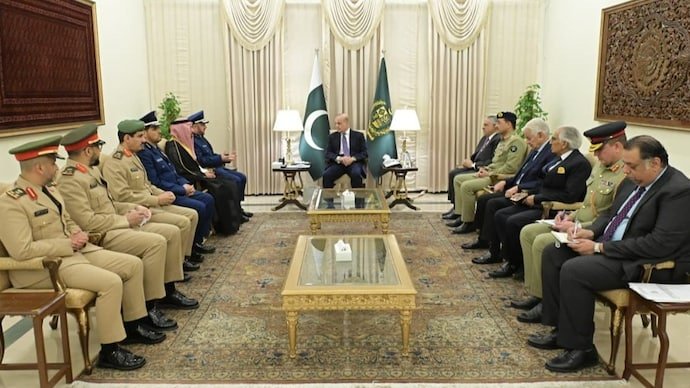
The seriousness of the situation became clear when Saudi Defense Minister Prince Khalid bin Salman met with Pakistan’s Army Chief General Asim Munir in Riyadh on March 6.
During the meeting, discussions focused on Iranian missile strikes against Saudi territory and possible responses under the framework of the mutual defence agreement.
Observers interpreted the discussion as a formal signal that Saudi Arabia expected Pakistan to honor its commitments under the pact.
This request placed Islamabad under immense pressure, forcing it to consider whether it could realistically stay out of the conflict.
Pakistan Attempts Diplomatic Mediation
Rather than committing military support, Pakistan initially chose a diplomatic route. Deputy Prime Minister Ishaq Dar launched what he described as a “shuttle diplomacy” effort between Riyadh and Tehran.
Pakistan’s message to Iran emphasized that Islamabad had defence obligations toward Saudi Arabia. At the same time, Pakistani officials sought assurances from Saudi Arabia that its territory would not be used as a launchpad for attacks against Iran.
Pakistani diplomats later suggested that this dialogue may have helped reduce the scale of Iranian attacks on Saudi targets.
However, tensions continued to escalate. Within a day of the diplomatic efforts, Iran reportedly launched three ballistic missiles toward Prince Sultan Air Base in Saudi Arabia.
Domestic Tensions Inside Pakistan
The conflict has also triggered immediate domestic consequences for Pakistan. Approximately 20 percent of the country’s 250 million citizens belong to the Shia Muslim community, many of whom maintain strong religious and cultural ties with Iran.
Following the reported killing of Iran’s Supreme Leader, protests erupted in several Pakistani cities.
At least 23 people were killed during demonstrations across the country. In Karachi, protesters stormed the United States consulate, prompting American security forces to fire warning shots at the crowd.
These protests reflected a combination of anti-American sentiment and strong pro-Iranian sympathies among parts of the population.
The Pakistani military imposed curfews in several areas to control unrest, but analysts warn that underlying tensions remain high.
The Trump Factor in Pakistan’s Calculations
Pakistan’s position is further complicated by its renewed relationship with the United States.
Since early 2025, Islamabad has invested significant effort into rebuilding ties with Washington after years of strained relations.
Pakistan even nominated former US President Donald Trump for the nobel peace prize and hosted several high-level diplomatic engagements.
Army Chief Asim Munir also held a private lunch with Trump at the White House, signaling a warming relationship between the two countries.
In return, Pakistan received several strategic benefits, including tariff relief, continued support for its F-16 fighter aircraft program, and renewed counterterrorism cooperation.
These developments helped restore a level of diplomatic goodwill that Pakistan had not experienced with Washington in over a decade.
A Difficult Strategic Dilemma
Pakistan now faces a difficult geopolitical dilemma.
- If Pakistan honors its defence pact with Saudi Arabia, it could become directly involved in a US-backed conflict against Iran.
- If it refuses to support Riyadh, it risks damaging relations with one of its most important economic partners.
- At the same time, escalating tensions with Iran could destabilize Pakistan’s long western border.
Each option carries serious political, economic, and security consequences for Islamabad.
| Possible Policy Choices for Pakistan | Potential Consequences |
|---|---|
| Support Saudi Arabia militarily | Risk conflict with Iran and regional instability |
| Remain neutral | Possible loss of Saudi financial support |
| Act as mediator | Maintain diplomacy but risk pressure from both sides |
Analysts Suggest Limited Military Support
Some analysts believe Pakistan may attempt a middle path by providing limited support to Saudi Arabia without formally entering the conflict.
This could include cooperation on air defense systems, intelligence sharing, and strategic planning while maintaining diplomatic channels with Tehran.
Such an approach could allow Pakistan to support its Saudi ally while avoiding direct military confrontation with Iran.
However, this strategy may only work temporarily. As Iranian missile strikes intensify and Saudi Arabia demands stronger support, Pakistan may eventually be forced to make a clear choice.
A Turning Point for Pakistan’s Foreign Policy
For decades, Pakistan’s foreign policy has been built on the assumption that its major allies would never become direct adversaries.
The current US–Iran conflict has shattered that assumption.
Pakistan now faces one of the most difficult diplomatic tests in its modern history. The decisions it makes in the coming months could reshape its relationships across the Middle East and redefine its regional role for years to come.
For breaking news and live news updates, like us on Facebook or follow us on Twitter and Instagram. Read more on Latest World on thefoxdaily.com.






COMMENTS 0